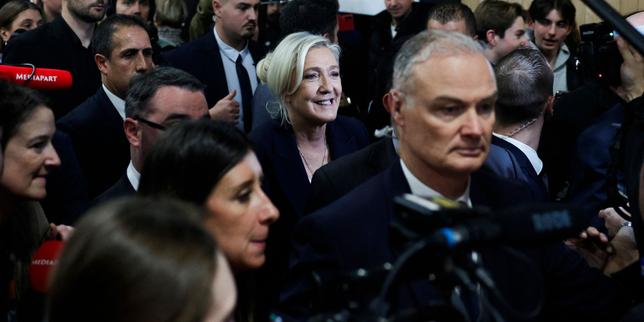
The prevailing media narrative treats Marine Le Pen’s willingness to meet Volodymyr Zelensky in Brussels as a sudden ideological U-turn. Standard political coverage frames the announcement—made during Zelensky’s high-profile European tour—as a dramatic softening of the French far-right’s longstanding skepticism toward Kyiv and NATO. According to the conventional commentary, Le Pen is shedding her party’s historical ties to Moscow to appear palatable to mainstream French voters ahead of future national elections.
That reading mistakes tactical domestic positioning for substantive foreign policy reform.
When examining the actual mechanics of French domestic politics and European diplomatic protocol, Le Pen’s statement is neither a capitulation to Brussels nor a genuine embrace of Ukrainian war aims. It is a calculated exercise in political normalization—known in France as dédiabolisation—designed to neutralize her greatest electoral vulnerability without altering the foundational pillars of her nationalist foreign policy.
The Anatomy of the Brussels Statement
To understand what happened, look closely at the context and phrasing. During a period when Volodymyr Zelensky addressed the European Parliament and met with EU heads of state in Brussels, journalists pressed French opposition figures on whether they would engage with the Ukrainian president. Marine Le Pen, leading the National Rally (Rassemblement National) parliamentary group in the French National Assembly, stated she was open to meeting Zelensky if the opportunity arose in Brussels.
Mainstream commentators immediately highlighted the contrast between this openness and her party's past positions. Critics pointed to the National Rally's 2014 loan from a Russian bank, Le Pen’s 2017 visit to the Kremlin to meet Vladimir Putin, and her previous statements characterizing Crimea’s annexation as legitimate. Against that backdrop, offering to sit down with Zelensky looks like a radical break.
In reality, refusing to meet a sitting head of state who is currently addressing the European Parliament would be an act of diplomatic self-sabotage for any politician seeking the French presidency. By saying "yes" to a hypothetical meeting, Le Pen paid zero political cost while reaping immediate reputational benefits. A meeting in Brussels requires no policy concessions, no vote for additional weapons packages, and no endorsement of Ukraine’s fast-track accession to the European Union or NATO.
The Nuance Missing From Standard Coverage
Political analysts who treat this moment as a binary choice—either Le Pen is pro-Kremlin or she has converted to the pro-Kyiv consensus—miss the specific doctrine the National Rally actually operates under.
Le Pen’s foreign policy is rooted in a rigid, Gaullist-inflected souverainism combined with economic nationalism. Within this framework, the primary antagonist is not necessarily Kyiv, nor is the primary ally necessarily Moscow; the primary target is supranational integration—specifically the European Union’s institutional expansion and NATO’s integrated military command.
Consider how Le Pen’s actual legislative record in the French National Assembly and the European Parliament aligns with her Brussels comment:
- Condemnation Without Escalation: Since the full-scale invasion in February 2022, Le Pen has repeatedly condemned Russia’s military aggression as a violation of international law and Ukrainian sovereignty. Meeting Zelensky is entirely consistent with acknowledging him as the legitimate leader of a sovereign state under attack.
- Opposition to Sanctions and Arms Transfers: Simultaneously, Le Pen and National Rally lawmakers have consistently opposed European Union energy sanctions against Russia, arguing they inflict disproportionate inflation and economic damage on French households. They have also expressed deep reservations about sending heavy offensive weaponry—such as Mirage fighter jets or long-range missiles—and categorically rejected French President Emmanuel Macron’s suggestion of potentially deploying Western ground troops.
- Resistance to EU Enlargement: Le Pen remains firmly opposed to Ukraine joining the European Union, arguing that integrating a massive agricultural economy at war would devastate French farmers and bankrupt the EU’s Common Agricultural Policy.
When you place her willingness to meet Zelensky alongside these three positions, the contradiction vanishes. She can shake Zelensky’s hand in Brussels, express sympathy for the Ukrainian people, and still vote against every major financial, military, and institutional mechanism Brussels uses to support Kyiv.
Why Competitors Misread the Domestic Calculus
Coverage that frames this as "Le Pen moves toward the center on Ukraine" ignores the structural reality of the French Fifth Republic. To win a presidential runoff in France, a candidate must assemble a coalition exceeding 50 percent of the electorate. Polling across France consistently shows that while voters are fatigued by inflation and skeptical of direct military escalation, outright alignment with Vladimir Putin is toxic to the median French voter.
During the 2022 French presidential campaign, Emmanuel Macron successfully weaponized Le Pen’s past Kremlin ties during their televised debate, framing her financial and political history as a national security liability. Le Pen’s advisers recognized that she cannot enter another presidential cycle carrying the label of a Russian proxy.
Therefore, her strategy since 2022 has been surgical:
- Settle historical liabilities: The National Rally paid off its controversial Russian loan early to remove a recurring talking point from opponents.
- Adopt diplomatic orthodoxy in form: Attending official ceremonies, expressing support for Ukrainian territorial integrity in principle, and signaling openness to meeting Zelensky demonstrate presidential stature.
- Maintain populist opposition in substance: Framing opposition to EU aid packages not as support for Russia, but as protection of French purchasing power and national defense stockpiles.
Media outlets that focus exclusively on the optics of a potential handshake amplify the exact image Le Pen’s communications team wants projected—that of a reasonable, mainstream stateswoman—while overlooking the substantive policy gridlock her platform would create if implemented.
What Would a Le Pen-Zelensky Meeting Actually Entail?
If a meeting between Marine Le Pen and Volodymyr Zelensky were to take place in Brussels, the diplomatic reality would be stark. Zelensky’s objective in every European engagement is concrete: securing air defense systems, artillery shells, long-range strike capabilities, frozen Russian asset transfers, and binding security guarantees.
Le Pen’s stated platform offers none of those things. Instead, her party advocates for an immediate push toward a negotiated diplomatic settlement, arguing that a military victory for Ukraine is unrealistic and that prolonged conflict risks direct nuclear confrontation between NATO and Russia. From Kyiv’s perspective, pushing for an immediate ceasefire while Russian forces occupy roughly a fifth of Ukrainian territory amounts to freezing the conflict on Moscow’s terms.
Consequently, a meeting between the two would not bridge the strategic divide; it would simply formalize it. Zelensky engages with opposition leaders across Western democracies—including Republicans in the United States and right-wing leaders in Italy and Hungary—because Ukraine’s survival depends on maintaining dialogue with anyone who might hold executive power in the future. Zelensky’s willingness to meet is driven by existential pragmatism, not ideological alignment.
The Broader European Shift
Viewing Le Pen’s statement in isolation also obscures a wider trend across European politics. Across the continent, nationalist and populist parties have adapted their rhetoric on the war in Ukraine without abandoning their core skepticism of Brussels.
In Italy, Prime Minister Giorgia Meloni maintained strong military and diplomatic backing for Ukraine once in office, surprising critics who expected her to break with NATO. Conversely, in Hungary and Slovakia, Viktor Orbán and Robert Fico have maintained direct diplomatic contact with Kyiv while routinely blocking or delaying EU financial packages and opposing sanctions.
Le Pen is positioning herself squarely in the latter camp—attempting to project the institutional respectability of a Meloni while preserving the sovereigntist, anti-sanctions policy agenda favored by Orbán.
The Real Takeaway for Observers
Journalists and political analysts looking for signs of a major geopolitical realignment in Le Pen’s Brussels remarks are looking in the wrong place. A politician’s foreign policy is not defined by whom they agree to meet in a corridor of the European Parliament; it is defined by how they vote on defense budgets, energy sanctions, treaty obligations, and military alliances.
Marine Le Pen’s openness to meeting Volodymyr Zelensky is a textbook example of modern political communication: an effortless, low-risk gesture that generates headlines suggesting moderation, while leaving every substantive obstacle to European military and financial aid completely intact.