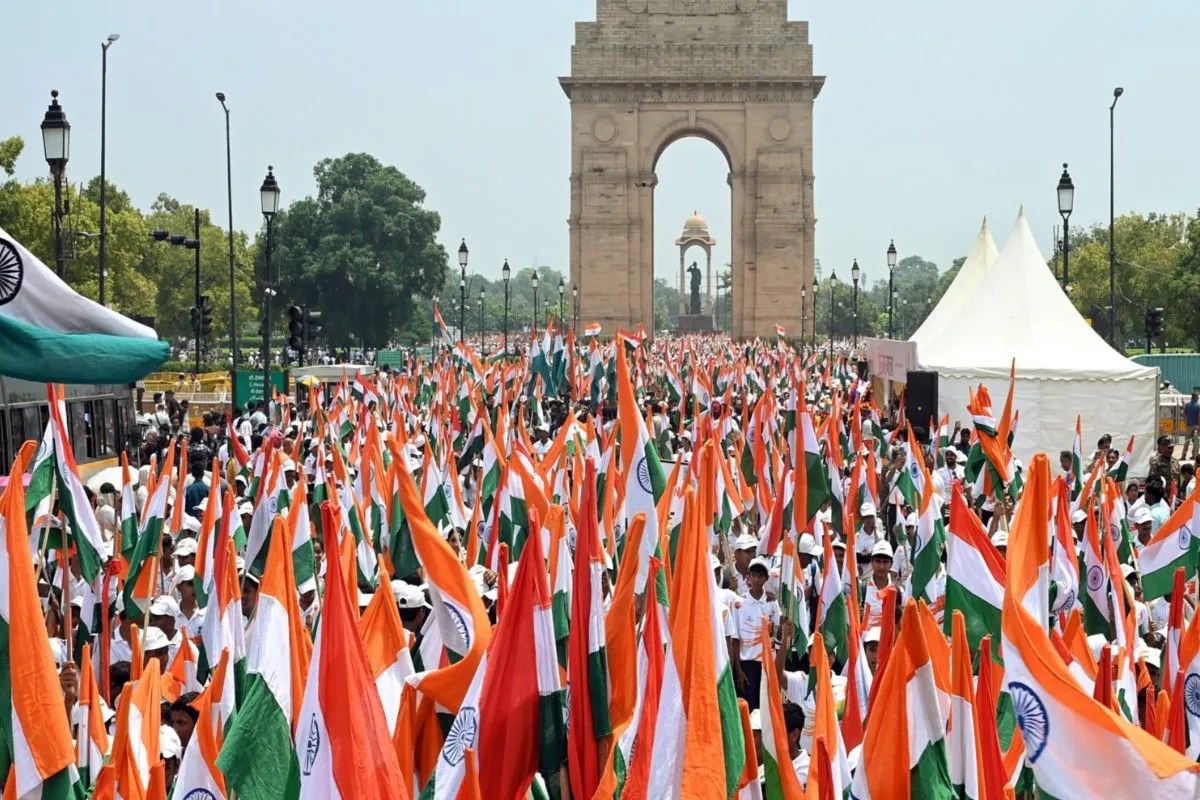
Borders are drawn with ink on old paper, but they are felt in the blood.
Stand at the edge of the Wagah border at dusk. The flags come down with practiced military theater, boots stomp into the dust, and metal gates slam shut. For decades, we have assumed that international relations are governed solely by treaties, missile counts, and trade tariffs signed by men in suits who rarely look out airplane windows. We forget that a country has a heartbeat. It breathes. It casts a shadow across oceans and neighborly fences alike. That shadow is perception. It is the intangible weight of how millions of strangers across the globe feel when they hear a single name spoken aloud.
Recently, the Pew Research Center quantified that heartbeat. They asked thousands of people across multiple nations a deceptively simple question: What do you think of India?
The resulting data points are cold numbers on a spreadsheet, yet they tell a deeply human story about proximity, history, and the heavy price of shared geography. Consider what happens next: the numbers reveal that familiarity does not always breed contempt, but it certainly complicates affection.
Let us walk across this statistical map. Let us look at the island nation of Sri Lanka, the fractured neighborhood of Pakistan, and the distant giants across the water.
The View from the Island
Imagine standing on the southern coast of Sri Lanka, where the Indian Ocean crashes against ancient rocks, smelling the salt and cardamom in the air. For centuries, this island has been India's closest sibling. They share mythologies, bloodlines, ancient trade routes, and a proximity so close you can almost hear the cultural echoes carrying across the Palk Strait.
According to the findings, Sri Lanka holds the highest positive view of India in the entire survey.
Why? Proximity is a double-edged sword, but in this case, it is forged by rescue. When economic collapse crippled the island nation recently, plunging families into darkness without fuel or medicine, massive cargo ships arrived from the northern neighbor. Rice, fuel, life-saving drugs. These were not abstract diplomatic gestures. They were plates of food on empty tables. They were hospital generators humming back to life in the dead of night.
Trust is earned in drops and lost in buckets. When a neighbor shows up with water while your house is burning, you remember. The data in Sri Lanka reflects a visceral gratitude mixed with deep cultural kinship. They know us. They know our flaws, our noise, our chaotic democracy, and our Bollywood films playing in Colombo tea shops. And yet, the scale tilts heavily toward warmth.
But cross a different border, and the air changes completely.
The Wall of Silence
Distance is easy. Hatred requires institutional architecture.
In Pakistan, the Pew data paints a stark, unyielding picture. Only seven percent of respondents express a favorable view of India. Ninety-three percent look across the Radcliffe Line and see an adversary.
Think about what it means to grow up in a place where an entire nation is filtered exclusively through the lens of threat. Imagine a young student in Lahore opening a history textbook. The pages are heavy with partition trauma, wars fought in the desert, and political rhetoric that treats diplomacy like a zero-sum game. When you are taught from childhood that your neighbor across the fence is an existential danger, your worldview hardens like concrete.
Seven percent. It is a tiny island of light in a vast sea of hostility.
Yet, beneath that statistical wall lies a tragic irony. If you pull two ordinary people from these hostile territories—say, a clerk from Karachi and a baker from Lucknow—and seat them at a tea stall in Istanbul or London, the political noise fades. They speak the same language. They laugh at the same jokes. They share a deep, ancestral cadence of hospitality, poetry, and shared culinary obsession.
Partition cut a living organism in half with a blunt knife. The seven percent favorable rating is not just a political statistic; it is the stubborn pulse of shared DNA surviving underneath decades of barbed wire and propaganda. It proves that even when governments build impenetrable walls, human recognition occasionally peers through the cracks.
The Global Mirror
Step back from the immediate neighborhood. Look further out, across the oceans to Western democracies and rising economic powers.
The global sentiment toward India is largely favorable, but it is layered with complexity. People abroad see a rising economic engine, a sprawling democracy wrestling with its own contradictions, a nation launching rockets to the moon while simultaneously grappling with deep pockets of rural poverty.
They see the contradictions. We all live them.
Being an Indian abroad today means walking through a world that has strong opinions about your home. You hear praise for the booming tech sector, the vibrant cultural exports, the sheer scale of ambition. Then, you hear questions about polarization, minority rights, and the fraying edges of secular harmony.
The global image of India is not a monolith. It is a mosaic of high-tech boardrooms in Silicon Valley, bustling spice markets in old Delhi, crowded Mumbai local trains, and quiet mountain villages. When foreigners look at India, they are projecting their own desires for a multipolar world. They want a counterweight. They want stability. They want a partner who can build things that last.
The Weight of the Reflection
We are obsessed with our image. We track stock markets, GDP growth rates, passport rankings, and global indices with the anxiety of actors waiting for reviews on opening night.
We want to be liked. We want to be respected.
When a survey reports high positivity in Sri Lanka, we puff out our chests. When it reports a mere seven percent in Pakistan, we sigh with familiar resignation.
But numbers do not tell you how to live. They only tell you where you stand in the eyes of others at a specific, frozen second in time.
Consider what happens when a nation stops performing for the international gallery and simply looks inward. The true image of a country is never forged in diplomatic cables or foreign polling data. It is forged in the quiet interactions of everyday life. It is the auto-rickshaw driver in Chennai helping a lost tourist. It is the doctor working a twenty-four-hour shift in a government hospital in Kolkata. It is the quiet resilience of farmers watching the monsoon clouds with cautious prayer.
We spend so much time worrying about how the world perceives us from the outside that we forget the interior architecture. If the foundation is strong, the reflection in the global mirror will take care of itself.
The map of neighbors and strangers will keep shifting. Borders will tighten or loosen. Governments will rise and fall, signing treaties that will be broken or honored. But the heartbeat remains.
India is neither the utopia of nationalist daydreams nor the dystopia of cynical foreign editorials. It is a living, breathing, chaotic, beautiful experiment in human coexistence. And no survey, no matter how rigorous, can ever fully capture the sound of a billion people waking up each morning and deciding, against all odds, to try again.