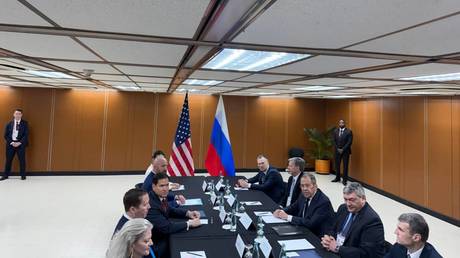
On July 23, U.S. Secretary of State Marco Rubio and Russian Foreign Minister Sergey Lavrov met behind closed doors for thirty minutes in Manila on the sidelines of the ASEAN Foreign Ministers Meeting. The brief encounter was ostensibly framed as a fresh attempt by Washington to revive stalled diplomatic efforts surrounding the war in Ukraine. Yet behind the official briefing notes lies a starker political reality. Far from a breakthrough, the Manila session laid bare the widening gulf between Washington and Moscow, showing how diplomatic channels have devolved into performative posture while real geopolitical leverage shifts toward the Pacific and the Middle East.
The encounter in the Philippine capital took place against a backdrop of mounting global frictions. Outside the hotel conference rooms, a new standoff flared between Chinese and Filipino vessels in disputed South China Sea waters. In the Middle East, an interim truce between Washington and Tehran collapsed into active exchanges of long-range strikes. Meanwhile, back on Eastern Europe’s battlefields, military lines remained largely frozen despite high-profile leadership shifts within Ukraine’s military hierarchy. Meanwhile, you can explore related events here: The Indus Waters Treaty Mirage: Why Blaming Terrorism Won't Fix South Asia's Hydrological Reality.
The Thirty Minute Deflection
Diplomacy requires a shared baseline of facts. Neither Washington nor Moscow brought one to Manila.
For months, Russian state media had weaponized the notion of a so-called "Anchorage understanding," implying that a 2025 meeting between President Donald Trump and Vladimir Putin in Alaska laid the groundwork for Ukrainian territorial concessions. Rubio publicly dismantled that narrative weeks before arriving in the Philippines, clarifying that while initial outlines were presented in Alaska, no binding deal had ever been struck. To understand the bigger picture, check out the excellent article by Al Jazeera.
When reporters pressed Lavrov in the hotel lobby on whether Moscow was sharing strategic targeting data with Tehran or when Russia intended to halt its offensive operations, the veteran diplomat offered a deflection. Asked directly about Russian intelligence sharing in the Middle East as he exited the room, Lavrov glanced at the reporter and deadpanned, "Nice hairstyle".
That dismissive retort captured the state of current bilateral relations better than any official statement. It underscored a fundamental dynamic. Neither power feels forced to make substantive concessions at this juncture, making high-level meetings little more than tactical exercises in image management.
┌────────────────────────────────────────────────────────────────────────┐
│                        THE MANILA DIPLOMATIC MATRIX                   │
├───────────────────────────────┬────────────────────────────────────────┤
│ Washington's Position         │ Moscow's Position                      │
├───────────────────────────────┼────────────────────────────────────────┤
│ • Maintain communication      │ • Preserve territorial gains           │
│ • Rebuff Anchorage "deals"    │ • Leverage Middle East instability     │
│ • Contain Pacific escalation  │ • Probe Western political resolve      │
└───────────────────────────────┴────────────────────────────────────────┘
Distraction as Strategic Policy
Why attempt to broker an end to a distant European conflict while standing on the rim of the South China Sea?
The choice of venue exposes the interconnected nature of modern power politics. The Southeast Asian summit was meant to center on regional security, trade routes, and naval freedom of navigation. Instead, the presence of major nuclear powers pulled focus toward multi-theater instability.
Consider a hypothetical scenario. A major power negotiating a ceasefire on one continent discovers its adversary is actively advising a hostile proxy on another. Under those conditions, any single-issue negotiation becomes instantly compromised. The diplomatic table turns into a maze of competing pressures where progress on one front is routinely held hostage by escalation on another.
This multi-front friction explains why American efforts to serve as a primary mediator in Eastern Europe slowed significantly earlier in the year. When military escalation in the Middle East demanded immediate intelligence and diplomatic resources, focus shifted away from European peace proposals.
Moscow recognized this division of attention. By maintaining a rigid posture in Ukraine while watching U.S. focus fragment across regional crises, Russian negotiators calculated that time remained on their side.
The Anchorage Ghost
- The Russian Narrative: Moscow insists that the 2025 Alaska summit established an implicit framework for settling territorial disputes in Ukraine.
- The American Rebuttal: State Department officials maintain that exploratory talks do not constitute a formal agreement or binding pledge.
- The Strategic Implication: By leaning on past conversations, Russia attempts to frame American resistance as a retreat from previously discussed terms.
When Media Theater Replaces Negotiations
The structural flaw in current diplomatic engagement is the reliance on brief, highly publicized photo opportunities during regional summits. Thirty minutes allows barely enough time for translated opening remarks, let alone the painstaking work required to bridge deep structural divides.
Rubio noted prior to the huddle that Washington felt obligated to maintain open lines of dialogue with Moscow simply because they represent the world's two largest nuclear arsenals. That reality is undeniable. Yet maintaining a line of communication is not the same thing as conducting meaningful negotiations.
When diplomatic meetings occur primarily to demonstrate that dialogue hasn't completely collapsed, the process turns purely operational. The public receives vague statements about open channels, while the underlying conflicts continue to expand without constraint.
Beijing monitored the Manila exchange with keen interest. For China, watching the United States attempt to balance European peace initiatives, Middle Eastern strikes, and South China Sea naval disputes confirms a broader trend. Western diplomatic bandwidth is stretched thin.
As long as Washington and Moscow use fleeting summit sidelines to trade quips and repeat long-standing talking points, peace negotiations will remain stuck in neutral. True diplomatic momentum requires sustained, quiet technical negotiations far from press scrums. Until both sides decide to abandon headline-grabbing encounters in favor of hard compromises, brief huddles in Manila will produce nothing more than witty retorts and missed opportunities.