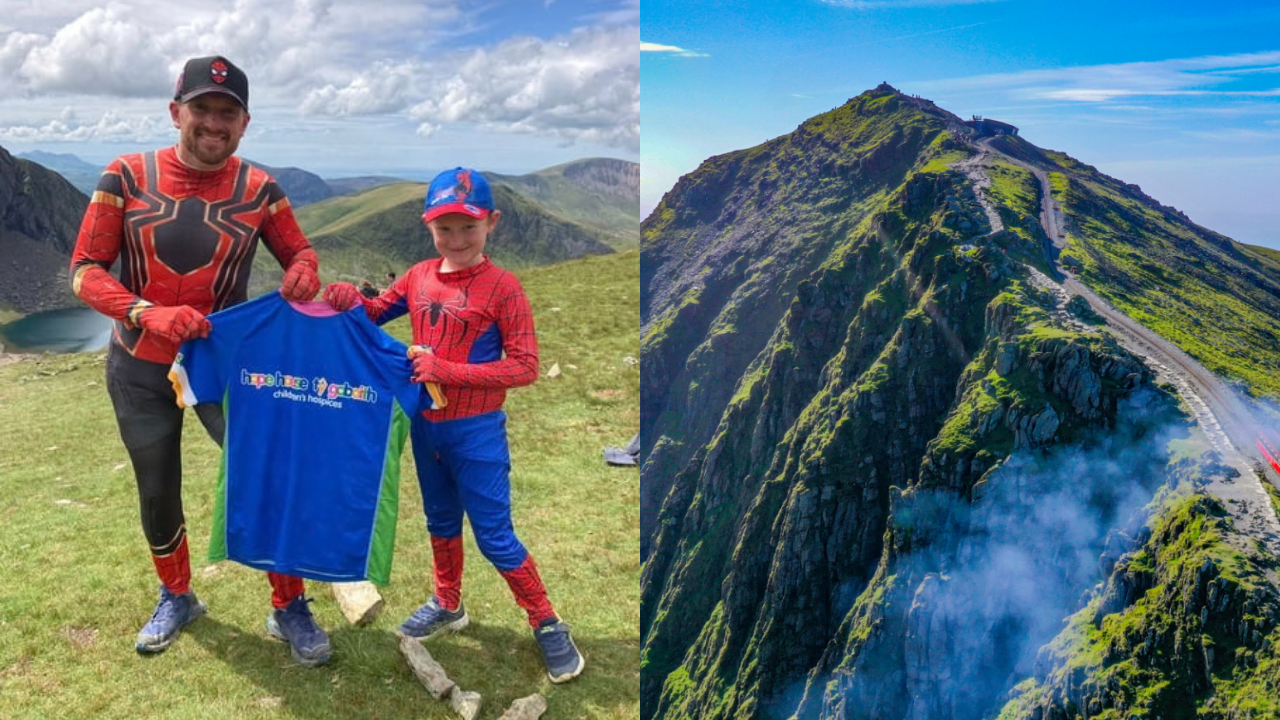
The wind on Yr Wyddfa does not care about spandex.
At three thousand feet above sea level, where the slate-gray crest of Wales splits the clouds and the Irish Sea glimmers like a bruised silver coin in the distance, the weather is a living, breathing antagonist. It howls across the Llanberis Pass. It drives horizontal sleet into raw skin. It tears at coats and turns loose scree into treacherous ball bearings. Most mortals face this landscape armored in Gore-Tex, heavy-duty hiking boots, and thermal layers engineered to keep the elements at bay.
Then there is the web-slinger.
He wears the mask because ordinary faces cannot bear the things he has seen. Or perhaps, because when you are trying to convince a shivering, frightened child that magic still exists, a normal man in a muddy jacket simply will not do. You need a superhero. Even if your superhero has aching knees, damp polyester sticking to his shins, and a mortgage in Gwynedd.
Let us speak plainly about what it means to scale a mountain. Once is an achievement. Twice is a fitness regimen. Ten times is an obsession. One hundred and forty-one times—all while entombed head-to-toe in a red-and-blue synthetic suit—is an act of quiet, stubborn madness born out of profound love.
Most people encounter mountains on postcards or during a breathless summer weekend when the car park at Pen-y-Pass overflows by seven in the morning. They talk of fresh air, stunning vistas, and conquering peaks. They romanticize the struggle. But the reality of high places is monotonous and grinding. It is the steady, rhythmic crunch of boot leather against slate. It is the burning lactic acid in the quads on the thousandth foot of vertical ascent. It is the sweat freezing on your back the moment you stop to catch your breath.
Imagine doing that wearing a full-body costume that traps moisture like a greenhouse. Imagine wrestling with nylon zippers while frozen fingers refuse to cooperate. Imagine looking up at the summit ridge for the one-hundred-and-fortieth time, knowing your hips hurt, your hamstrings are singing with pain, and the mist is rolling in thick enough to swallow the trail whole.
Why would any sane human being subject themselves to this?
The answer lies in a hospital ward six miles away from the base, or perhaps in the quiet, agonizing hours parents spend watching heart monitors beep in the dark. Life is fragile in a way that defies comprehension. We stumble through our daily routines—buying groceries, arguing over utility bills, fretting over minor inconveniences—entirely oblivious to the razor-thin margin separating ordinary existence from catastrophe. For families grappling with life-threatening illnesses, that margin is all they can see. The world narrows down to sterile walls, worried doctors, and the desperate, silent prayer for just one more good day.
When you cannot fix the underlying tragedy, what do you do? You do what you can. You pull on the ridiculous suit. You lace up your boots. You step onto the path.
Consider the arithmetic of compassion. One hundred and forty-one ascents of Yr Wyddfa. That is roughly four hundred and eighty-six thousand feet of vertical climbing—equivalent to scaling Mount Everest nearly seventeen times from sea level. It represents hundreds of hours spent battling gales, navigating fog, and enduring the silent loneliness of the long-distance trekker. And for what? For six thousand one hundred and eighty-pounds.
To a Wall Street financier, that sum is a rounding error on a Tuesday afternoon. To a major charity, it is a drop in a vast ocean. But to the children’s hospices and families relying on every single pound to fund specialized care, respite weekends, and moments of genuine joy amidst relentless medical procedures, that money is oxygen. It is the difference between isolation and community. It is the tangible proof that somewhere out there, a stranger cared enough to sweat, freeze, and bleed in a comic-book costume.
We live in an age of performative altruism. Social media feeds are flooded with curated virtue, carefully lit selfies, and viral stunts designed to inflate ego disguised as philanthropy. The digital landscape rewards the loud, the slick, and the sensational.
This was none of those things.
There was no PR firm orchestrating the climb. There were no corporate sponsors writing checks for tax write-offs. There was just a Welshman, an iconic piece of pop-culture fabric, and an unrelenting mountain that demanded respect with every single step. Hikers passing him on the trail would do double-takes. Tourists would stop, rubbing their eyes in disbelief, wondering if hypoxia had finally set in. Children would squeal with unfiltered delight, their eyes widening as they recognized their hero stumbling out of the Welsh mist, offering a tired, genuine smile behind the screen of a mask.
That is the hidden power of narrative. We do not connect with cold statistics. You can tell people that thousands of children face terminal or life-limiting illnesses every year, and their eyes will glaze over. Human brains are simply not wired to process mass suffering; we are built for the particular, the vivid, and the immediate. We feel the weight of a single story. We understand the resonance of one man refusing to stop walking until his mission is complete.
Every climb had its own distinct texture. Some days, the sun broke through the clouds, painting the valley in bruised purples and golds, making the suffering feel like a form of secular pilgrimage. Other days were exercises in pure endurance, where visibility dropped to three feet and every step forward was an act of raw willpower against the biting wind.
Rain got inside the mask. Sweat stained the chest emblem. Blisters formed, popped, and reformed.
Yet he kept going.
Because when you commit to a cause, you do not stop simply because your legs hurt. You do not quit because the weather turns foul. You remember the kids. You remember that somewhere out there, a child is fighting a battle far
The Man Who Climbed a Mountain One Hundred and Forty Times in a Suit
sports, news
*
The wind does not care about spandex. On the higher reaches of Snowdon, the highest peak in Wales, the air can strip the heat from a human face in seconds, turning breath into frost and fingers into clumsy blocks of wood. Most people encounter this mountain wrapped in Gore-Tex, weighed down by heavy waterproofs, cursing the forecast.
One man chose a different armor.
He wore red and blue. He wore webbing printed on nylon. He wore a mask that flattened his nose against the gale.
For one hundred and forty-one times, Andrew Boffey transformed into Spider-Man to scale a jagged slab of rock rising three thousand five hundred and sixty feet above sea level. This is not a story about a superhero. Comics do not survive the reality of Welsh slate, scree, and unrelenting rain. This is a story about exhaustion, blisters, children in hospital beds, and the quiet, stubborn refusal to let despair win.
Consider the physical reality of the climb. Snowdon is not a casual afternoon stroll. By the time you reach the summit via the Pyg Track or the Miners' Track, your thighs burn, your lungs scream for oxygen, and your knees protest every downward step. Now imagine doing that while wearing a full-body synthetic costume that restricts your peripheral vision, traps your sweat, and offers roughly as much thermal protection as a wet paper towel.
Andrew Boffey did not do it for glory. He did it because six thousand one hundred and eighty-eight pounds is a number that buys things a children's ward desperately needs. But numbers on a ledger fail to capture the human cost. They do not show the grey light of dawn breaking over Crib Goch. They do not capture the sound of wind whistling through the rigging of the summit cairn, or the strange, disorienting sight of a comic book icon standing alone in a sea of mist, waiting for tourists to stop and ask why.
Why the suit?
Ask any child who has spent months staring at the same white hospital ceiling. To a seven-year-old undergoing chemotherapy or recovering from a major operation, the world shrinks to the dimensions of a room and the rhythm of a heart monitor. Grown-ups in white coats talk in hushed tones. Machines beep. Fear hangs in the air like smoke.
Into that sterile environment walked a man who looked like he had stepped off a Saturday morning television screen.
Children do not care about fundraising metrics. They care about magic. They care about the absurd, beautiful fact that Spider-Man—their Spider-Man—was out there climbing a freezing Welsh mountain just for them. When Boffey visited young patients, the red mask came off, but the spirit remained. The suit was a beacon. It was a visual language that bypassed fear entirely.
The logistics of such an undertaking border on madness. One hundred and forty-one ascents. That is not a weekend hobby; it is a second, punishing job executed in the vertical plane. It requires tendon resilience that defies middle age, a tolerance for monotony, and a psychological anchor deep enough to withstand the thousandth ache in a calf muscle.
Rain fell. Snow piled up. Tourists stared. Some laughed, thinking it a prank, a stag do gone wrong, or a TikTok stunt. Then they saw his face when he reached the bottom, red-rimmed and streaming with sweat, carrying the invisible weight of every sick child he had ever met. The laughter usually died down then. Respect took its place.
We live in an era obsessed with scale. Everything must be global, viral, institutionalized. We look to corporations and governments to solve human suffering, forgetting that massive systems are notoriously bad at empathy. Empathy is local. Empathy has muddy boots and a torn mask. Empathy is one exhausted man putting one red-booted foot in front of the other, upward, again and again, until the mountain gives up and lets him reach the top.
By the time the final climb was logged, the total stood at six thousand one hundred and eighty-eight pounds raised for children's causes. That money translates to equipment, comfort, moments of relief in places where relief is scarce. But the true currency was never the pounds sterling. It was the proof that human beings are capable of ridiculous, magnificent acts of devotion for people they will never fully know.
The summit of Snowdon remains cold. The wind still howls off the Irish Sea, scouring the rock face clean. The tourists come and go, snapping their photos and retreating to the warmth of the railway cafe.
But if you stand long enough by the stone cairn at the highest point in Wales, listen closely to the rattle of the slate in the gale. You might almost expect to see a flash of red and blue moving steadily through the grey, climbing toward the clouds because someone, somewhere, needed to know they weren't forgotten.