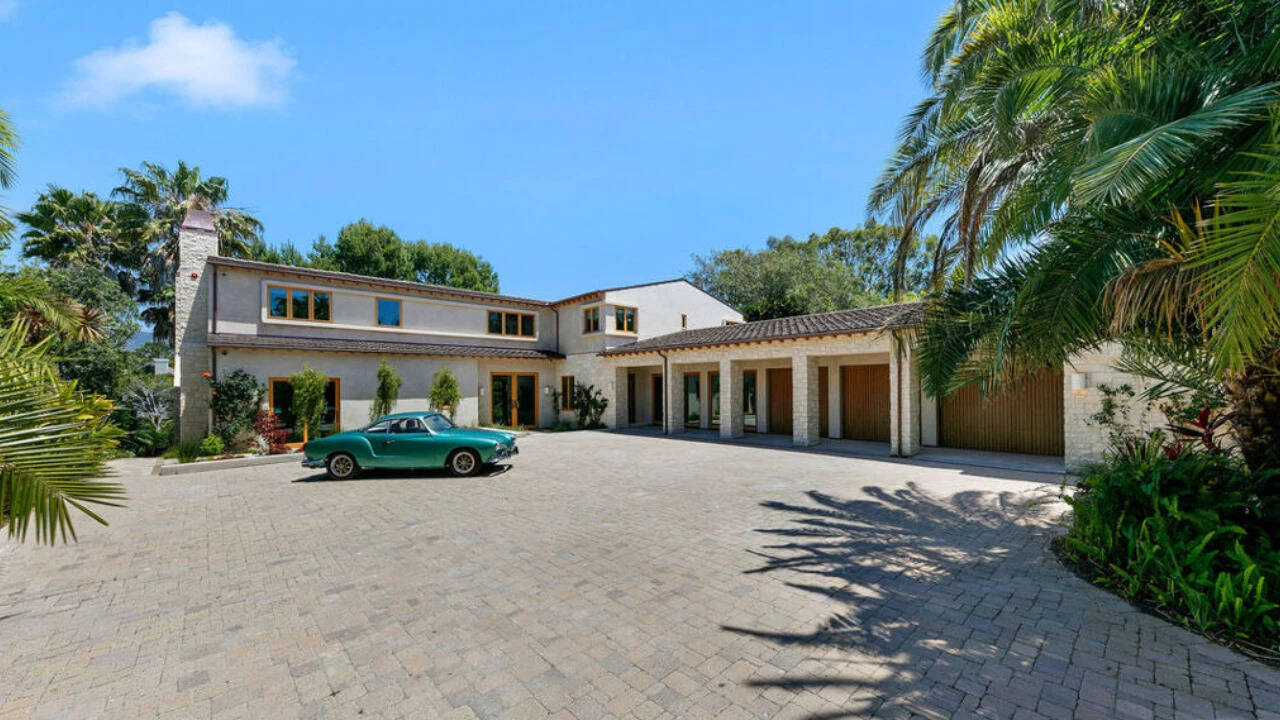
Headline coverage of a $33.5 million Malibu listing tied to Sergey Brin and Nicole Shanahan treats asking price like realized profit, obscuring capital allocation, holding costs, and entity control. Standard celebrity property reporting typically strings together three facts—a purchase price, a new asking price, and a list of interior features—while leaving the underlying real estate economics unexamined.
Real estate reports from November 2026 indicate that a roughly 1.2-acre, five-bedroom Point Dume property with keyed access to Little Dume Beach—acquired for $13.5 million in September 2020 after earlier transactions involving singer Pink—hit the market at $33.5 million following a summer rental offering at $175,000 per month. Coverage also notes that the property has been tied to a Nevada limited liability company managed by Shanahan's family office, and that the listing arrived the same week former Google CEO Eric Schmidt listed a Malibu Colony beach house for $37.5 million. A rigorous analysis separates verified transaction records from untested assumptions and evaluates how ultra-prime coastal sellers price illiquid assets.
Deconstructing Competitor Framing and Missed Causal Links
Typical coverage of ultra-high-net-worth home sales relies on a simple subtraction narrative: take the prior purchase price, subtract it from the current list price, and call the difference a windfall. For this Point Dume property, moving from a $13.5 million acquisition in 2020 to a $33.5 million ask in late 2026 creates a $20 million spread on paper.
Treating that $20 million gap as net profit breaks down across three structural omissions in standard reporting:
- Undisclosed capital expenditure: Public property summaries frequently note renovation, rebuilding, or custom interior finishes without establishing total construction outlays, permitting timelines, or soft costs. In coastal California, structural rebuilding and site work can consume millions of dollars before a single marketing photograph is shot.
- Cumulative carrying costs: Multi-year ownership of a trophy coastal asset carries property taxes, insurance premiums, landscape and pool maintenance, security, and property management expenses. Six years of holding a multi-million-dollar estate in Southern California represents a substantial cash drain that narrows net return.
- Time-value and opportunity cost: Capital locked inside physical real estate forfeits alternative deployments, whether in public equities, private ventures, or liquid yield instruments. Comparing nominal entry and ask figures ignores what that capital could have earned over six years.
Standard coverage also misses causal links between rental testing, ownership structure, and market timing. Offering a luxury residence for rent at $175,000 per month prior to a sale listing is not merely a side note; testing peak seasonal rental demand reveals whether high-end tenants will pay top-of-market rates or whether absorption is sluggish. Similarly, holding a property inside a limited liability company reflects asset partitioning, privacy, and governance mechanics—especially relevant after a high-profile divorce finalized in 2023—rather than a single individual casually clicking "sell."
The Three Pillars of Ultra-Prime Coastal Pricing
To evaluate a $33.5 million asking price in Point Dume without guessing, anchor the analysis in three pricing pillars: scarcity and micro-location, physical product specification, and liquidity and transaction friction.
Scarcity and Micro-Location
In Malibu, micro-location acts as the primary value floor because coastal land supply is constrained by geography, bluff stability, and regulatory approvals. Point Dume sits on a distinct coastal promontory with different privacy dynamics, bluff or view profiles, and beach access rules than stretches of beachfront sand such as the Malibu Colony. A parcel around 1.2 acres with ocean views and keyed access to Little Dume Beach competes in a specialized sub-segment where lot size and privacy buffer noise and visibility.
Physical Product Specification
In the ultra-prime tier above $30 million, buyers rarely settle for dated layouts or deferred maintenance. Features highlighted in listing materials—such as five bedrooms, a secondary kitchen, wellness or gym spaces, outdoor entertaining areas, and custom finishes—function to compress the buyer's post-closing execution risk. When a residence is recently rebuilt or upgraded, the seller is attempting to capture a turnkey premium by sparing the buyer years of California coastal permitting and construction delays.
Liquidity and Transaction Friction
Ultra-luxury real estate is a thin, bespoke market. At the $30 million-plus price band, the pool of qualified cash or low-leverage buyers is small, and comparable sales ("comps") are sparse because no two coastal lots or custom rebuilds are identical. High transaction friction—including transfer taxes, broker commissions, legal structuring, and extended marketing periods—means an asking price is an opening hypothesis in price discovery, not a guaranteed clearing price.
Known Facts Versus Educated Hypotheses
Disciplined analysis requires separating documented facts from analytical hypotheses so readers do not confuse reporting with proof.
| Dimension | Known Facts | Educated Hypotheses |
|---|---|---|
| Pricing and Timeline | Acquired for $13.5 million in September 2020; offered at $175,000/month as a summer rental; listed for sale at $33.5 million in November 2026. | The $20 million spread over purchase price reflects a mix of renovation/redevelopment spend and multi-year coastal appreciation rather than pure unlevered profit. |
| Ownership and Governance | Tied to a Nevada LLC managed by Shanahan's family office following the 2022 divorce filing and 2023 finalization. | Entity structure supports post-divorce asset administration, liability isolation, and privacy while allowing sale proceeds to be distributed or reallocated cleanly. |
| Broader Portfolio Context | Brin acquired other high-value properties in subsequent years, and Eric Schmidt listed a Malibu Colony home for $37.5 million on the same day. | Simultaneous Malibu listings by high-profile tech figures reflect independent portfolio rebalancing and asset-specific timing rather than a coordinated exit from California. |
Why do sellers list luxury homes for rent before putting them up for sale? A pre-sale rental stint can offset carrying costs during a transition period and signal market appetite at the top end, though frequent turnover or vacant stretches can also indicate that achieving full-year occupancy at peak rates is difficult. Why do multiple high-profile tech figures list properties in the same coastal city around the same time? Coincidental listing dates in trophy markets often stem from separate estate, tax, or portfolio decisions converging on the same broker calendar rather than a single macro signal.
Operational Realities of Trophy Asset Exits
Managing and exiting a $30 million-plus coastal property resembles running a small, illiquid capital project rather than selling a standard suburban house. From an operational standpoint, sellers face four recurring execution bottlenecks:
- Basis and tax reconciliation: Sellers and their advisors must reconcile original acquisition basis, capital improvements, depreciation or entity allocations, and potential tax exposure before setting a walk-away threshold.
- Staged market testing: Moving from a $175,000 monthly rental push to a $33.5 million outright sale shifts the buyer profile from short-term experience seekers to long-term capital allocators who scrutinize replacement cost and comparable sales.
- Price-anchoring risk: Launching at an aspirational price can anchor early buyer expectations, but sitting unsold on the market for months risks stigma and eventual price cuts.
- Closing and negotiation discipline: At eight-figure price points, concessions—such as closing timelines, furnishings inclusion, or inspection credits—frequently matter as much as headline price reductions.
These mechanics also carry clear limitations and trade-offs. Without audited construction ledgers, exact tax elections, or final closing prices, no outside observer can calculate the true internal rate of return on a private real estate listing. Furthermore, frameworks built around comparable sales and carrying costs lose precision at the extreme top of the market, where an eccentric buyer motivated by privacy, views, or specific amenities can pay above standard valuation models—just as an illiquid market can force discounts below replacement cost.
Strategic Play for Evaluating Similar Listings
When evaluating high-profile luxury listings like this $33.5 million Malibu estate, treat the asking price as an unverified claim until tested against three benchmarks: verified rebuild and carrying costs relative to the prior purchase price, true comparable sales adjusted for lot size and beach or bluff access rather than celebrity history, and time-on-market liquidity at the eight-figure tier. Rather than reading a headline listing price as a finished financial victory, track the gap between initial asking price, days on market, and eventual recorded sale price—because in ultra-prime real estate, the final clearing price is the only number that settles the thesis.