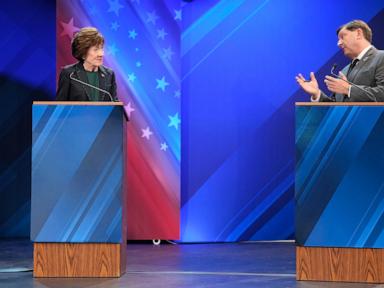
When Democratic challenger Troy Jackson barked "Oh, shut up. I don't even know that kid" at five-term Republican Senator Susan Collins on a broadcast stage in Bangor, political commentators immediately reached for their traditional rulebooks. The instant consensus declared the outburst an unforced error—a raw display of poor discipline that broke decorum and handed the incumbent a crisp narrative of partisan hostility. That reading completely misidentifies the dynamic driving modern high-stakes elections. What erupted on stage was not a random slip of bad manners; it was the inevitable collision between two incompatible strategies of political survival.
To understand why Jackson refused to apologize in the days following the event, one has to examine the exact trap Collins laid during the final televised clash of the campaign.
The disruption began when a young activist representing the climate advocacy group Sunrise Movement interrupted Collins over industrial data center expansion. As security moved to clear the room, Collins pivoted with veteran instinct. She glanced across the stage and declared the protester was "obviously one of Troy's supporters". It was a calculated maneuver designed to pin radical activism onto a Democrat who built his brand as a fifth-generation logger from Aroostook County.
In classical campaigns, a candidate hit with that kind of insinuation performs a structured defense. They wait for their microphoned turn, disavow the demonstrator, and pivot back to talking points on energy costs or municipal infrastructure.
Jackson broke the script entirely.
By snapping at Collins mid-sentence, he bypassed procedural protocol. The exchange instantly eclipsed every policy debate held that evening.
The Strategy Behind the Retort
Political consultants routinely warn candidates against raw anger on camera, especially when facing a seasoned incumbent with decades of name recognition. Yet Jackson’s refusal to walk back the phrasing highlighted a deliberate positioning strategy.
For working-class voters who view conventional political rhetoric as practiced deceit, manufactured politeness often reads as insincerity. When Collins asserted a direct link between Jackson and an uninvited demonstrator, Jackson treated the claim as an insult to his integrity rather than a routine debate tactic.
His unscripted denial resonated with voters who are exhausted by formal legislative theater.
Candidate Trajectories & Debate Dynamics

[Susan Collins] ──► Institutionalist Frame ──► Accuse Rival of Astroturfing
                                                      │
                                                      ▼
[Troy Jackson]  ──► Blue-Collar populist   ──► Reject Script ("Shut up")
The underlying conflict reflects a split in voter priorities. On one side sits institutional decorum—the belief that governance relies on strict adherence to traditional standards of debate. On the other sits authentic friction—the demand from voters that their representatives react to accusations without consulting a communications director first.
Institutional Decorum versus Populist Friction
Collins built her career on the image of a moderate legislator operating within established Senate protocols. Her instinct during the disruption was to code the event within established partisan boundaries: a left-leaning protest must belong to her left-leaning opponent.
That assumption failed to account for how modern activist groups operate. The Sunrise Movement acts independently of state party organizations, often targeting mainstream Democrats as aggressively as Republicans over energy policy.
When Collins tied the demonstrator directly to Jackson's campaign without evidence, she relied on an older political playbook where every outside disruption is presumed to be coordinated by an opposing operative.
Jackson’s response shattered that framing in five words.
| Campaign Dimension | Susan Collins Model | Troy Jackson Model |
|---|---|---|
| Primary Base | Suburban voters, institutional moderates | Rural workers, labor unions, progressive base |
| Communication Style | Measured, procedural, deliberate | Direct, colloquial, unscripted |
| Response to Disruption | Tactical attribution to opponent | Immediate personal rejection |
| Debate Objective | Project stability and experience | Project fighting instinct and authenticity |
By rejecting the accusation immediately, Jackson prevented the narrative of a orchestrated campaign stunt from taking root during the broadcast.
Why the Apology Never Came
In the aftermath of the broadcast, Republican surrogates demanded a formal apology, arguing that telling a sitting senator to "shut up" crossed an unacceptable boundary.
An apology would have restored traditional decorum, but it would have damaged Jackson's core pitch to his voters. His political strength rests on his history as a tough labor leader who does not back down when pushed by established interests. Recanting his reaction would have signaled deference to a system his supporters believe is broken.
Campaigns are no longer won purely on polished policy white papers. They are decided by split-second tests of authenticity, where voters evaluate whether a candidate's anger is genuine or manufactured. Jackson calculated that standing by his blunt refusal to be blamed for an unvetted protester mattered far more than pleasing pundits who value parliamentary etiquette over real emotion.
The outburst in Bangor proved that when traditional debate rules meet modern political frustration, politeness is often the first casualty.