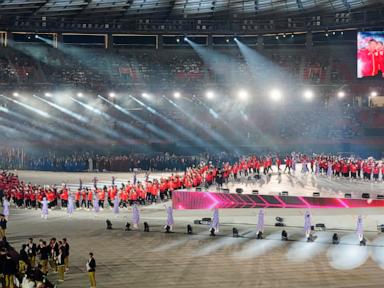
When the opening ceremony fireworks erupted over Nagoya, the raw math of international sport quietly shifted. More than eleven thousand athletes marched onto the grounds for the Aichi Nagoya continental games, eclipsing the total head count of the previous Summer Olympics in Paris. Yet numbers tell only a fraction of the story. Beneath the parade of delegations from forty five countries and regions lies an organizational labyrinth that strains municipal infrastructure, forces unorthodox housing solutions like floating cruise ships, and highlights a stark geopolitical imbalance in modern competition.
The scale of the undertaking exposes fundamental vulnerabilities in how mega sporting events operate outside the rigid Western centric blueprint. Planners originally budgeted for a manageable influx of competitors and officials, only to face an overwhelming late registration wave that pushed total arrivals closer to seventeen thousand. Municipalities cannot simply absorb armies of athletes without friction. When traditional housing falls short, ingenuity turns to necessity. Thousands found themselves bunking on an Italian luxury liner docked nearby or squeezed into modular wood container villages. Such compromises reveal the sheer strain of hosting a multi sport mammoth that refuses to shrink, testing the patience of delegations and the limits of local governance. For a different view, read: this related article.
The Accommodation Crunch and Structural Strain
Logistics remain the invisible engine of any athletic exhibition. At Nagoya, the pressure points multiplied instantly. Basketball tip offs began nine days prior to the official opening ceremony, an unprecedented scheduling stretch required simply to cram forty three sports and seventy one disciplines into a compressed calendar. Organizers looked at the stadium schedules and realized basic math dictated a longer runway. Without spreading out the preliminary rounds, venues would have suffered severe bottlenecks, locking athletes out of practice facilities and straining transport networks.
Athletes from smaller delegations navigated a patchwork of accommodations that stood in sharp contrast to the uniform villages built for Western centric championships. Some arrived to find their designated quarters incomplete or overwhelmed by late additions. The financial and operational toll falls heavily on regional hosts who inherit the mandate to impress the continent while keeping budgets from spiraling into sovereign debt crises. Further reporting regarding this has been published by CBS Sports.
Big nations deploy institutional might to buffer against these hurdles. China arrived with an armada of competitors exceeding eight hundred individuals, backed by state sports science apparatuses and deep administrative reserves. Host Japan rolled out the largest national delegation with nearly a thousand athletes. Meanwhile, smaller entities from across Asia sent leaner squads, relying on sheer grit to make their mark on a stage that matters intensely to their domestic fan bases, where government funding often hinges on regional medal counts.
Historical Weight and the Origins of Continental Power
To understand the sheer magnitude of these games, one must look backward to their inception. Established in 1951 in New Delhi, India, the visionaries of the post colonial era sought an arena where Asian nations could govern their own athletic destiny without bowing entirely to European or American sporting hierarchies. What began as a modest gathering of a few nations has metastasized into a geopolitical chessboard where soft power is measured in gold medals and organizational competence.
Over the decades, the games expanded westward and eastward, absorbing diverse political systems, economic models, and cultural traditions. Unlike the Olympic movement, which operates under centralized International Olympic Committee oversight with strict limitations on sport programs, the Olympic Council of Asia permits a fluid, host driven menu. This flexibility allows each successive host city to showcase sports that hold regional hegemony, ensuring that the games reflect the actual athletic habits of the continent rather than a standardized global template.
Yet this decentralization brings administrative turbulence. Governing bodies across forty five different countries operate under vastly disparate resource allocations. While a handful of economic powerhouses pour billions into state of the art training facilities and sports science research, athletes from developing nations frequently train with rudimentary equipment, relying on raw talent and personal sacrifice to bridge the gap.
Beyond the Olympic Blueprint
The sporting menu itself separates these continental games from standard global circuits. While track and field, swimming, and soccer anchor the marquee television windows, the secondary program preserves disciplines deeply rooted in regional history. Viewers tuned in to witness kurash, an ancient wrestling discipline originating in Uzbekistan. They watched kabaddi, a high speed sport resembling aggressive team tag that demands precise breath control and physical resilience. They tracked sepaktakraw, where competitors execute acrobatic bicycle kicks over a net using rattan spheres instead of volleyballs.
These events challenge the homogenization of elite sport. Western media often dismisses regional sports as eccentric novelties, yet for millions across Asia, these disciplines carry cultural weight that far exceeds standard track events. They represent ancestral traditions codified into modern competitive structures. Athletes who train for years in these specialized arenas receive little recognition on the global Olympic circuit, making the continental games their definitive world championship.
Elite swimmers and track stars also treat the venue as a high stakes testing ground. World records face constant pressure when regional powerhouses bring their premier talent. Swimmers who dominated global championships arrived in Nagoya ready to collect continental hardware. Yet the disparity in medal distribution remains glaring. China captured hundreds of gold medals in preceding editions, a pattern repeated as state funding and athletic pipelines convert sheer population size into podium dominance, leaving smaller nations fighting for scraps on the lower tiers of the podium.
The Quiet Cost for Elite Competitors
Elite athletes often face grueling choices when continental schedules clash with commercial global circuits. Top tennis players and track specialists frequently weigh the patriotic pull of representing their countries against the career penalties imposed by missing mandatory ranking events elsewhere. Skipping a premier tour stop to wear national colors brings financial and ranking consequences, turning what should be pure athletic celebration into a calculated career risk. When a rising star skips a lucrative tour event to represent their national flag, they risk sliding down global rankings, forfeiting sponsorship earnings, and incurring penalties from international federations.
The psychological weight on younger competitors is equally acute. Prodigies breakthrough under intense domestic scrutiny, carrying the expectations of millions before they can legally drive. When a teenager steps onto the starting blocks or court, the national media apparatus treats every false step as a collective failure. The competitive intensity matches or exceeds Olympic pressure, fueled by hyper competitive regional rivalries that simmer year round between neighbors with complex geopolitical histories.
The Financial Reality of Mega Events
Behind the athletic glory lies a sobering financial ledger. Hosting an event featuring eleven thousand athletes across forty three sports requires staggering capital expenditure. Municipalities must construct or upgrade venues that risk becoming white elephants once the closing ceremony concludes. Economists have repeatedly warned that the projected economic boost from mega sporting events rarely offsets the massive public debt incurred during construction phases.
For Nagoya and the surrounding Aichi prefecture, the financial balancing act required intense fiscal discipline. Unlike mega cities with pre existing Olympic infrastructure, regional hosts often have to build specialized venues for niche sports that local populations may never use again. The reliance on temporary structures and unconventional housing solutions like cruise ships highlights an industry wide reckoning. Cities are increasingly reluctant to bankrupt themselves for the sake of two weeks of international television coverage.
The Road Ahead to Doha
As the curtain fell on Nagoya, the baton passed westward toward Doha, Qatar, which secured the hosting rights for the upcoming edition at the end of the decade. The shift to West Asia introduces entirely new environmental and infrastructural dynamics. Desert heat management, massive stadium construction, and shifting geopolitical alliances will redefine the operational playbook for the next generation of administrators.
Yet the fundamental tension will persist. Can mega events maintain their ballooning size without collapsing under their own weight? The traditional model of building billion dollar venues for brief spectacles faces severe skepticism from economists and taxpayers alike. Continental organizers must eventually confront the reality of diminishing returns. Smaller nations struggle to justify the expenditure, while host cities discover that the promise of economic revitalization rarely matches the final ledger.
For now, the continental games survive through sheer force of will and a vast pool of athletic hunger. Athletes sprint, grapple, and swim not merely for international fame, but for local validation that the global stage rarely provides. The numbers will likely continue to climb, pushing the boundaries of what host cities can accommodate. Until the breaking point arrives, the spectacle marches forward, larger and louder than the rest of the world cares to notice.

