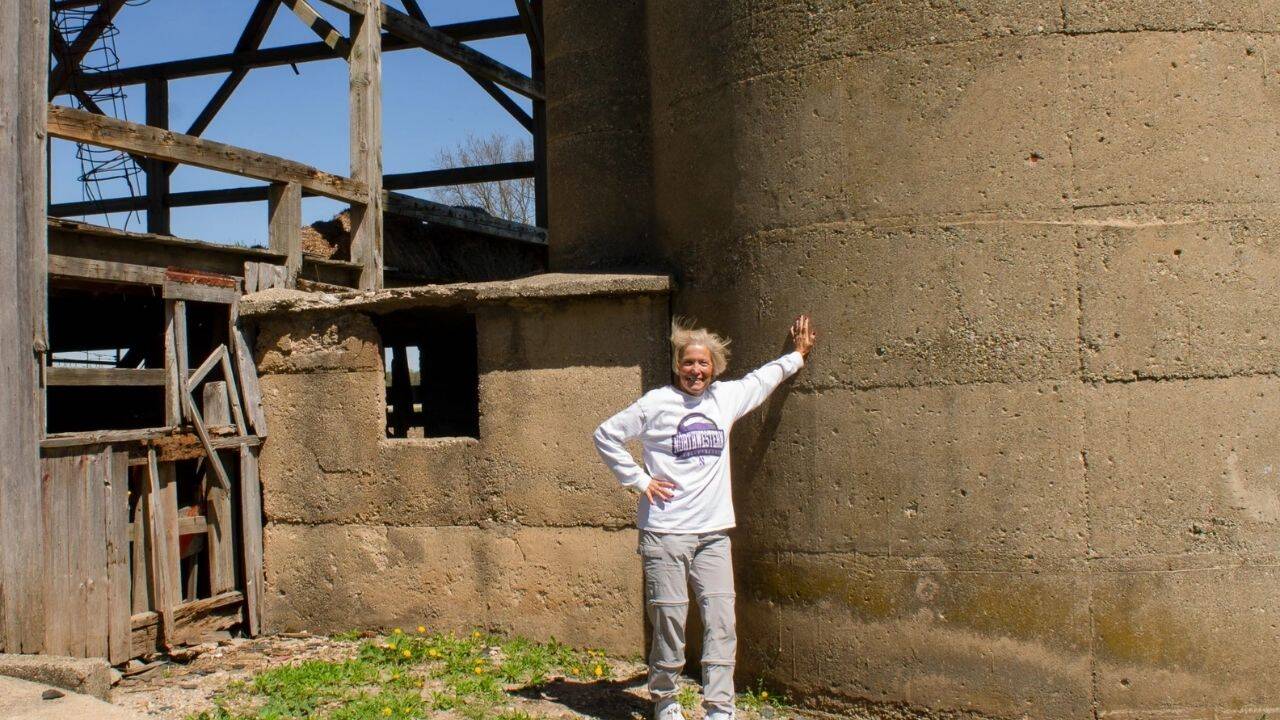
Drive through the American Corn Belt today and you will notice a quiet, steady erasure. Giant concrete cylinders tower over abandoned barns. Some stand straight. Others tilt like ancient ruins. They are monuments to an era when farming relied on gravity, muscle, and raw sweat.
For over a century, these silos defined the rural horizon. They were the skyscrapers of the prairie. But they are disappearing fast.
A quiet movement is underway to document these structures before they are gone forever. At the heart of this effort is a deeply personal quest. One woman has spent years tracking down nearly 200 concrete silos built by her own grandfather. It is a race against time, decay, and the relentless march of industrial agriculture.
Her project shows us that these towering relics are not just hollow tubes of concrete. They are a physical map of family legacy and a style of farming that changed the world.
The Birth of the Sky High Farm
American farms did not always have these towers. In the mid-1800s, farmers struggled to keep green feed fresh through brutal winter months. Leaving grass or corn out in the elements meant ruin.
In 1873, an Illinois farmer named Fred Hatch built what is widely considered the first modern silo. He dug a pit inside his barn to store green fodder. The concept worked. By sealing the green crops away from oxygen, they fermented instead of rotting. This process, known as ensilage, kept the feed nutritious for cattle all winter long.
But early silos were rectangular and built of wood. This was a structural disaster.
The pressure of packed, wet silage is immense. Rectangular wooden walls bowed under the strain. Air leaked into the corners, causing the feed to rot. Wooden structures also rotted from the moisture of the silage or burned down in frequent barn fires.
Farmers needed a better shape and a stronger material.
By the late 1800s, builders realized that round silos distributed the outward pressure evenly. Wood gave way to brick, glazed clay tile, and eventually, concrete.
The Brutal Art of the Concrete Stave
Building these giants was backbreaking work. In the early to mid-20th century, local builders traveled from farm to farm. They did not have giant cranes or computerized machinery. They had scaffolding, ropes, mules, and their own hands.
One of the most popular methods relied on concrete staves. These were interlocking concrete blocks, roughly ten inches wide and thirty inches long. A single silo required hundreds of them.
Builders stacked these staves one by one, forming a perfect circle. To hold the structure against the immense outward pressure of the fermented corn, they wrapped the exterior in heavy steel hoops. As the silo climbed higher, the spacing between the hoops grew tighter at the bottom where the pressure was greatest.
Another method was the poured-in-place monolithic concrete silo. Crews set up circular wooden or metal forms, poured concrete, waited for it to cure, and then jacked the forms up to pour the next ring.
It was dangerous, exhausting labor. Men worked dozens of feet in the air on shaky platforms. A single mistake could mean a fatal fall or a collapsed wall. Yet, these builders left behind structures designed to last for centuries.
The Search for a Grandfather Legacy
When you look at a concrete silo today, you probably see a weathered utility building. You do not see the names of the men who mixed the concrete.
But for one researcher, these towers are a family tree. By tracking nearly 200 silos built by her grandfather, she has turned agricultural history into a personal archive.
Finding these structures is not easy. There are no master registries. Many sit on private land, tucked behind modern steel buildings or hidden by overgrown trees. The hunt requires looking at old plat maps, digging through historical newspaper archives, and driving thousands of miles down gravel roads.
When you find one, the connection is immediate. You can see the specific pattern of the staves. You can see the maker's marks stamped into the concrete. You can even find the initials of the crew carved near the foundation.
This project is a blueprint for how we can preserve rural history. It shows that the most valuable historical records do not always live in museums. Sometimes they are standing in a cow pasture, slowly being reclaimed by wild vines.
Why the Towers Are Falling
Why are these durable monuments disappearing? The answer is simple. Farming changed.
The classic upright tower silo is largely obsolete. Modern farms are massive corporations that require speed and high volume. Climbing a silo to unload feed is slow, dangerous, and physically punishing. Silo gas, which is mostly nitrogen dioxide, can accumulate inside the towers and suffocate a farmer in minutes.
Today, farmers use different methods. They pack feed into giant horizontal trenches called bunker silos. Or they stuff silage into long, white plastic bags that snake across the ground. These bags are cheap, flexible, and easy to unload with a tractor.
Left unused, the old concrete towers become liabilities.
Water gets into the concrete pores. During freezing winters, the water expands, cracking the structure. The steel hoops rust and snap. Eventually, the silo becomes a safety hazard. Property owners tear them down to avoid rising insurance costs or to clear space for larger modern equipment.
We are losing these landmarks at an alarming rate. When a wooden barn collapses, it feels like a natural part of decay. But when a concrete silo is demolished, a piece of the horizon is permanently altered.
How to Track and Document Your Own Local History
You do not need to be a professional historian to save these stories. You can start in your own county.
First, talk to older landowners. Oral history is incredibly fragile. Once a farmer passes away, the knowledge of who built a specific barn or silo often goes with them. Ask about the builders, the construction years, and any family stories connected to the buildings.
Second, use satellite imagery. Tools like Google Earth allow you to spot old silos from above. Look for the distinct circular shadows next to old farmsteads.
Third, check local property records and historic newspapers. Local papers from the early 1900s frequently ran small social notes about who was building a new silo on their property. These archives are goldmines for matching names to structures.
Finally, take photographs. Document the overall structure, but also get close. Capture the texture of the concrete, the rusting hardware, and any stamps or signatures. Upload these photos to local historical societies or digital archives.
These concrete towers survived a century of wind, ice, and changing times. They deserve more than a quiet disappearance. By documenting them now, we keep the grit and ingenuity of early builders alive for the generations to come. Go find a gravel road, look to the horizon, and start recording before the last giant falls.