The blue light of a smartphone screen does something strange to the human face at three o'clock in the morning. It hollows out the eyes. It turns skin a pale, ghostly white. For millions of people across the country, that glow is the last thing they see before sleep, and the first thing that greets them in the dark.
Donald Trump knows this light well. He commands it. For an alternative perspective, read: this related article.
On a recent quiet evening, while the rest of Washington, D.C. slept, a flurry of digital activity ignited on Truth Social. It wasn't just a handful of posts. It was an absolute blitz. Dozens of re-shares, memes, and videos cascaded down the platform in rapid succession. To the casual observer, it might look like chaotic scrolling. But to the people watching closely—the loyal followers waiting for a sign and the researchers tracking the undercurrents of American politics—it felt like a drumbeat.
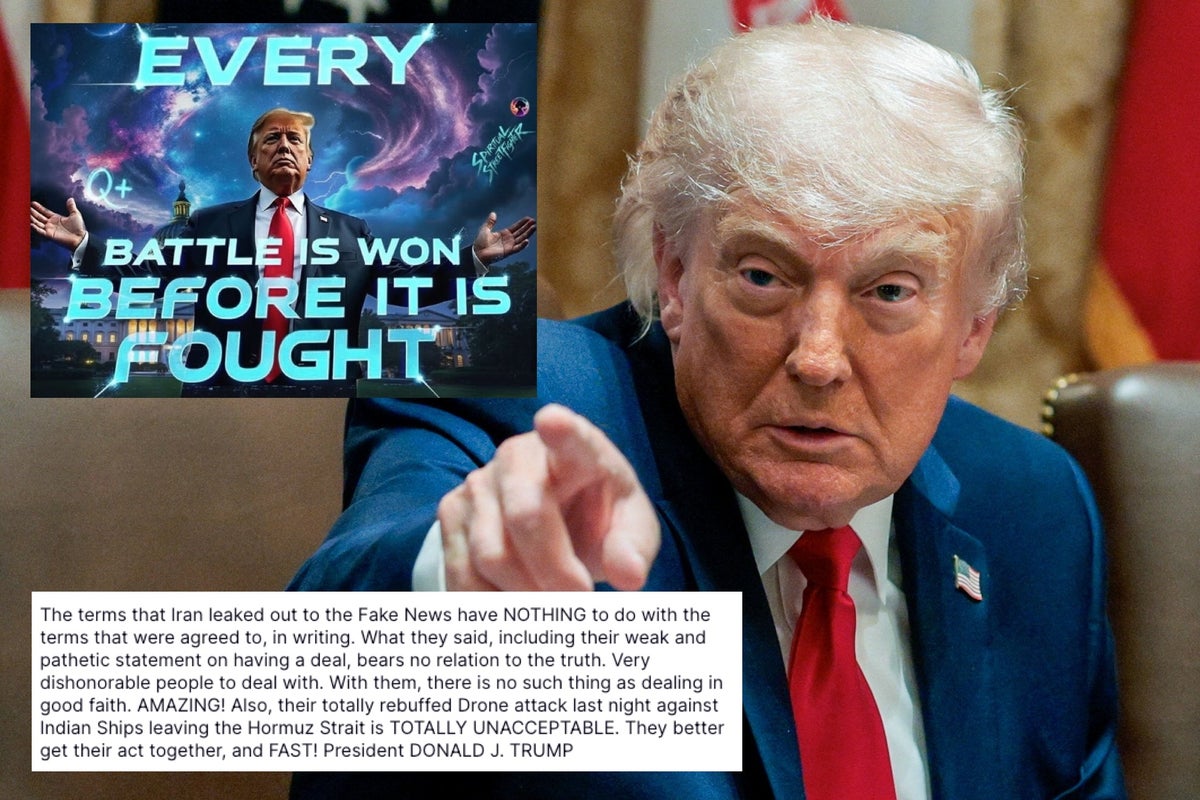
Among the flurry of images, two distinct themes emerged, interwoven like threads in a complex tapestry. First, there were highly stylized, AI-generated images depicting a massive, systemic overhaul of the nation's capital. Think bulldozers clearing out bureaucratic offices, grand architectural renderings of a redesigned federal city, and a sense of sweeping, cinematic cleansing. Second, and far more unsettling to mainstream observers, was the explicit inclusion of imagery and memes deeply tied to the QAnon conspiracy theory. One specific image featured Trump wearing a Q lapel pin, accompanied by slogans long associated with the movement. Related coverage regarding this has been published by BBC News.
The immediate reaction from standard news outlets was predictable. The headlines focused on the bizarre nature of the blitz, treating it as a political curiosity or a standard piece of campaign theater. They listed the number of posts. They quoted the captions. They moved on.
But listing the facts misses the entire point of how modern political mythology is built.
To understand what happened during that midnight digital blitz, we have to look past the screen and into the living rooms of the people consuming it. Consider a hypothetical voter named Greg. Greg is a retired logistics manager in Ohio. He feels the country he grew up in has slipped through his fingers. The economy feels unpredictable, institutions feel distant, and the political process feels like a game played by elites who don't know his name.
When Greg wakes up at 4:00 AM and opens his phone, he isn't looking for a policy white paper. He is looking for a story. He is looking for validation that his sense of alienation is real, and more importantly, that someone is fighting to fix it.
When an image pops up on Greg's feed showing Donald Trump standing defiantly against a backdrop of a dismantled Washington bureaucracy, it triggers an emotional response. It isn't about the literal feasibility of moving federal agencies out of D.C. It is a metaphor for taking power back. The technical term for this is political semiotics—the study of signs and symbols in political communication. In simpler terms, it is the art of speaking in code so that your friends understand you perfectly while your critics waste time arguing about the literal meaning of the words.
This brings us to the most controversial element of the blitz: the QAnon imagery.
For years, political analysts have debated whether Trump’s nods to this specific subculture are accidental or deeply calculated. The reality is likely found in the mechanics of digital attention. In the attention economy, ambiguity is a superpower. By sharing a meme with a QAnon symbol, a politician accomplishes two things simultaneously. To the dedicated believer, it is a dog whistle—a secret handshake confirming that they are seen and valued. To the critic, it is a provocation, guaranteed to spark outrage and drive media coverage.
The cycle is self-sustaining. The media outcries over the posts reinforce the belief among Trump's base that the establishment is terrified of him. The outrage becomes proof of concept.
But what about the images of a remodeled Washington?
This isn't just about optics; it connects to a tangible political strategy known as Schedule F. This was an executive order briefy enacted at the end of Trump's presidency that aimed to reclassify tens of thousands of civil servants, making it easier to fire them. When the Truth Social blitz showcases images of a literally reconstructed capital, it is the visual manifestation of this policy goal. It transforms a dry, bureaucratic mechanism into an epic battle of renewal.
Imagine a massive construction site where the old, crumbling foundations of an ancient building are being jackhammered away to make room for something brand new. That is the mental image these posts cultivate. It replaces the agonizingly slow reality of legislative governance with the immediate, satisfying imagery of demolition and creation.
The danger of analyzing these events purely through a factual lens is that it underestimates their power. Human beings are not entirely rational creatures driven by data points. We are narrative-driven animals. We understand our lives through the stories we tell ourselves about who we are, who our enemies are, and where we are going.
When a political figure goes on an epic digital blitz, they aren't just sharing content. They are editing the national script. They are providing their audience with a daily framework to interpret the world.
The real story of that midnight blitz isn't the specific memes or the exact count of the re-shares. It is the enduring power of digital intimacy. A former president can reach directly into the palm of a voter's hand in the dead of night, bypass every traditional gatekeeper, and deliver a message that feels intensely personal.
As the sun comes up, the notifications fade, and the daily news cycle grinds into motion, the images remain in the minds of those who saw them. The grand designs for a new capital, the symbols of a secret war, the promise of a reckoning. The blue light turns off, but the narrative is already set in stone.