The rain in the cloud forest does not fall. It hovers. It clings to your skin like a damp wool blanket, heavy with the scent of rotting moss and ancient earth. When you breathe out, your breath joins the mist. When you stop walking, the silence is so absolute it makes your ears ring.
Deep within this suffocating green maze, on a ridge line that feels like the edge of the world, stands a solitary figure. It is not a person. It is a tree.
Specifically, it is Pennantia baylisiana—the Three Kings Kaikomako. For decades, it enjoyed a tragic, lonely distinction listed in the Guinness Book of World Records: the rarest tree on Earth. Only one remained in the wild. A single, aging survivor clinging to a scree slope on a remote island off the coast of New Zealand.
To look at it was to look at extinction in the mirror. It was a living ghost, a botanical dead end. If that solitary organism withered, an entire evolutionary lineage spanning millions of years would vanish overnight. No backup copies. No hidden seeds in the dirt. Just nothingness.
We live in an era obsessed with scale. We measure success in billions of data points, trillions of dollars, and massive global systems. But the true weight of our planet’s survival often rests on a scale so small it defies comprehension. It rests on a single root system. It hinges on the stubbornness of a few human beings who refuse to let a stranger die.
The Island at the Bottom of the World
To understand how we almost lost this tree, you have to understand Great Island. It is part of the Three Kings archipelago, a cluster of jagged volcanic rocks jutting out of the Pacific Ocean where the Tasman Sea crashes into the Pacific. It is a brutal, unforgiving place.
In the nineteenth century, humans did what humans do best: they introduced goats.
The goats did what goats do best: they ate everything. They devoured the lush coastal forests, stripping the hillsides bare down to the bedrock. By the time scientists realized the ecological disaster unfolding on the islands, the native ecosystem had been chewed to dust. In 1946, a botanical expedition scrambled up the cliffs to survey the wreckage.
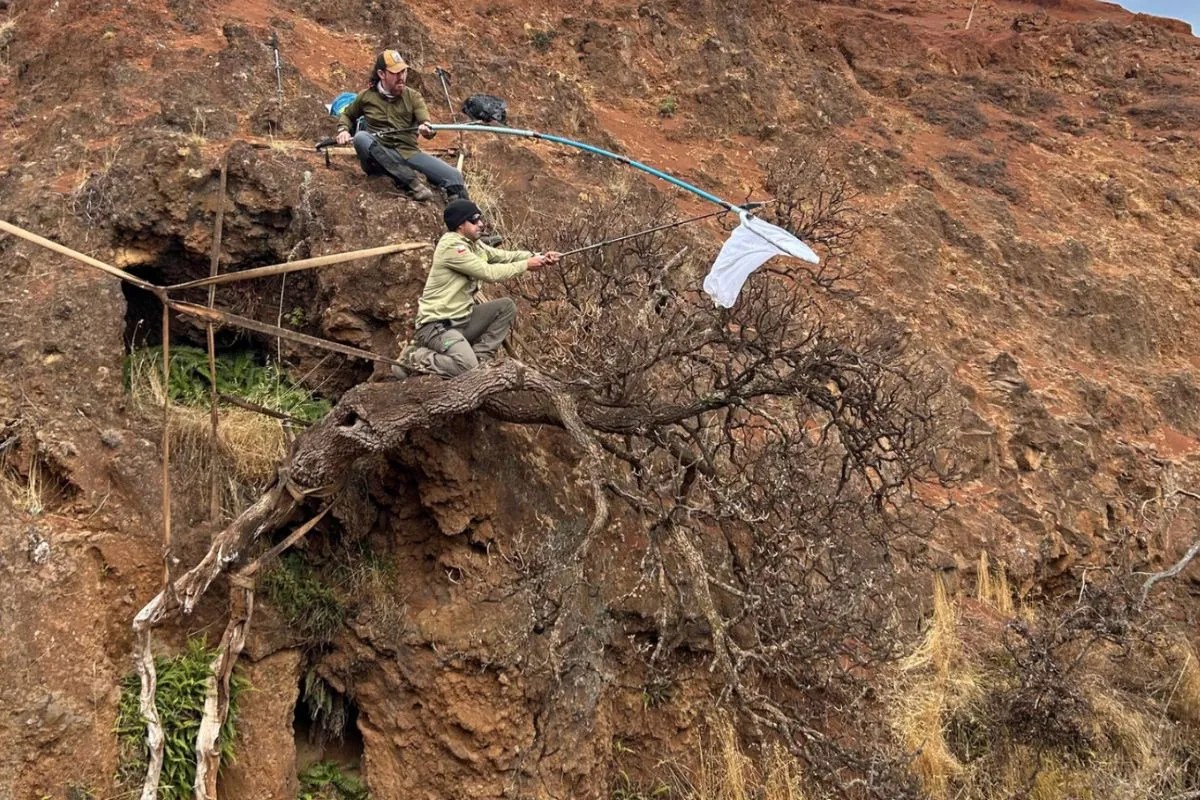
Among the devastation, a botanist named Professor Geoff Baylis spotted something peculiar. Growing out of a rocky crevice, shielded from the ravenous goats by a sheer drop-off, was a tree with large, glossy, dark-green leaves. It looked like nothing else on the island. It looked like nothing else on Earth.
It was the last of its kind.
The goats were eventually removed, allowing the island's vegetation to heal, but for the lone Kaikomako, the damage was done. The tree was a female. To produce fertile seeds, it needed pollen from a male tree. But there were no males left. For nearly forty years, the tree flowered with agonizing regularity, dropping unfertilized, useless fruit into the dirt. It was a biological tragedy playing out in slow motion.
Imagine standing in an empty room, shouting into the dark, knowing with absolute certainty that no one will ever answer. That was the reality for this plant.
The Secret Life of Plants
Science often presents itself as a clinical, detached endeavor. We picture sterile labs, white coats, and emotionless data entry. But talk to any botanist who has spent weeks sleeping in a muddy tent just to check on a dying seedling, and you will find a quiet, fierce passion that borders on obsession.
By the 1970s and 80s, a small group of determined researchers decided that a peaceful surrender to extinction was unacceptable. If the tree could not find a mate, they would have to force it to talk to itself.
The breakthrough did not come from a massive tech breakthrough. It came from careful, tedious observation. Scientists took cuttings from the wild survivor and brought them to mainland nurseries. They nurtured these clones, waiting for them to mature and flower.
Then came the realization that changed everything. The tree was technically dioecious—meaning it typically has separate male and female plants. However, under extreme stress or specific environmental conditions, nature sometimes leaves a backdoor open. The female flowers possessed tiny, residual male organs that produced microscopic amounts of viable pollen.
It was an evolutionary whisper. A tiny spark hidden in the embers.
Researchers used chemical stimulants to encourage these faint male characteristics. Armed with fine-tipped paintbrushes and magnifying glasses, they spent hours under the laboratory lights, manually transferring the minuscule grains of pollen to the female stigmas. It was delicate, frustrating work. One slip of the hand could destroy a flower that took a year to grow.
Then, the waiting began.
In the wild, the fruit would wither and drop. But in the nursery, under the anxious gaze of its human caretakers, the green berries held on. They swelled. They turned a deep, vibrant purple. Inside those berries were seeds. Fertile seeds.
Against every mathematical probability, the dead end had become a crossroad.
Why One Leaf Matters
It is easy to look at an effort like this and ask, Why bother?
With thousands of species sliding toward extinction every year, why spend decades, thousands of dollars, and endless human hours to save a single type of tree on a rock in the middle of the ocean? It does not produce timber we can sell. It does not cure cancer. It just sits there.
The answer lies in the invisible web that holds our world together.
When you pull a single thread from an old sweater, the whole sleeve doesn't unravel immediately. You just get a loose string. So you pull another. And another. For a long time, the sweater still functions. It keeps you warm. But eventually, you hit a critical threshold. You pull one thread too many, and the entire garment falls apart in your hands.
Every species is a thread. The Three Kings Kaikomako evolved over millennia to fit into a specific ecological niche, interacting with insects, birds, and soil fungi in ways we are only beginning to decipher. When we lose a species, we don't just lose an organism; we lose a library of genetic information, a unique solution to the problem of survival that took millions of years to write.
Consider the complexity of the tree's survival mechanism:
| Factor | Legacy State | Recovery State |
|---|---|---|
| Wild Population | 1 solitary tree | Multiple wild seedlings emerging |
| Genetic Status | Functional sterility (Female only) | Self-fertilization unlocked via intervention |
| Location Profile | Highly vulnerable island cliff | Secured mainland nurseries & island habitats |
| Threat Level | Critical / On the brink | Stable and expanding |
To lose the Kaikomako would be an admission of defeat. It would mean accepting that our footprint on this planet is purely destructive. Saving it is a declaration that human ingenuity can be a force for healing, a counterbalance to our historic carelessness.
The Return of the Forest
Today, the story looks entirely different. Those first precious seeds grown in the lab have grown into mature trees. Those trees have produced seeds of their own.
The descendants of the loneliest tree on Earth are no longer confined to a single cliff face. They are growing in botanical gardens across New Zealand. More importantly, conservationists have begun planting them back on Great Island, returning them to the soil where their ancestors once thrived.
The silence of that ridge line is now broken by the rustle of young leaves.
This is not a victory won by a single breakthrough or a sudden influx of cash. It was won in inches. It was won by people who cared about something that could never thank them, people who saw value in a solitary green spark and decided to blow on the coals until a fire caught.
The next time you walk past a tree, look at the leaves. Notice the intricate veins routing water to the edges, the way it drinks the sunlight, the quiet stillness of its existence. Every plant you see is a survivor of an unbroken chain of life stretching back to the dawn of time.
We came perilously close to breaking that chain for the Kaikomako. We held the link in our hands, frayed and slipping. But we didn't let go. And because a few people refused to look away, the rarest tree on Earth is finally surrounded by family.