The key did not turn. That was the first warning.
For eighty-seven years, the iron lock on Number 14 had yielded to the worn brass teeth of Maricarmen’s key. It had yielded through the death of a husband, through the birth of grandchildren, through the slow, quiet erosion of a neighborhood that once knew every face by its morning greeting. But on a Tuesday morning in Madrid, the lock refused. The world outside had changed its mind about who belonged.
When the bailiffs arrived, they did not come with noise. They came with the cold, administrative efficiency of a spreadsheet materialized in the physical world. Papers were stamped. Signatures were verified. And Maricarmen—a woman whose life spanned nearly a century of Spanish history, whose hands had kneaded bread for a changing country—was told that her home was no longer hers. Not because she had stopped paying rent, but because the mathematical abstractions of the global property market had outbid her existence.
Spain woke up to that locked door. And then, Spain broke.
The Math of Exile
To understand why thousands poured into the streets, why the chants echoed off the sun-baked stone of Madrid and Barcelona, you have to look past the political slogans and look at the ledger.
Housing was once a shelter. Now, it is an asset class.
In the wake of economic shifts, golden visas, and the ravenous appetite of short-term rental platforms, urban centers across Spain transformed. Neighborhoods like Lavapiés or Malasaña stopped being communities and started becoming portfolios. Apartments that once sheltered families through generational transitions were converted into digital commodities—rented by the night to tourists who leave coffee rings on wooden tables they will never learn to love.
Consider the mechanics of displacement. When a property management fund acquires a residential block, the human element becomes an inefficiency. An eighty-seven-year-old tenant paying a regulated, historic rent is not a person with memories rooted in the plaster; she is a drag on yield. The eviction notice is simply a portfolio optimization.
When Maricarmen was carried out, or rather, when she walked out under the weight of an unyielding system, she did not just leave an apartment. She left behind the physical proof of her life. And the city realized: if an eighty-seven-year-old grandmother can be cast aside for a better return on investment, no one is safe.
When the Streets Find Their Voice
Silence is the weapon of the dispossessed. For years, the rise in housing costs was treated as a weather pattern—an unfortunate, inevitable storm that everyone complained about but no one could stop. Rents crept up. Salaries stayed flat. Young people in their thirties lived with their parents not out of cultural preference, but out of absolute financial impossibility.
Then came Maricarmen.
The outrage was immediate because the narrative was naked. There was no complex financial jargon to hide behind. There was only a frail woman, a suitcase, and a locked door.
Across the country, the protests began. They were not organized by rigid political parties at first; they were summoned by the sheer exhaustion of a generation that realized they were working harder only to afford less space. Placards bore simple, devastating truths. A house is a home, not a hedge fund. We are people, not tenants.
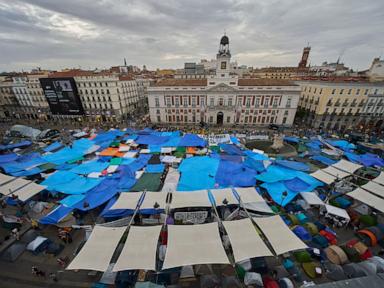
The demonstrations filled the plazas. Smoke flares stained the blue evening sky red and orange. Banners hung from wrought-iron balconies where laundry once dried. The police stood in lines of riot gear, shields reflecting the flashing lights of an angry, sleepless city. But the crowd did not disperse. They stood shoulder to shoulder—students who will never own a flat, middle-aged workers facing sudden rent hikes, and elders who remember a very different Spain.
This was not a riot born of lawlessness. It was a riot born of abandonment.
The Invisible Architecture of the Crisis
We talk about housing markets as if they were acts of God. We speak of supply and demand as weather systems that happen to us rather than systems we built.
Let us strip away the economic veil.
In Madrid and Barcelona today, finding a stable home requires a miracle or an inheritance. Entire neighborhoods have been hollowed out. Walk down certain streets at night, and you will notice something terrifying: the windows are dark. Not because people are asleep, but because the apartments are empty, held as speculative digital gold bars by investors sitting in London, New York, or Singapore.
The social fabric is fraying at the seams. When housing consumes sixty, seventy, or eighty percent of a monthly wage, everything else collapses. You stop going to the local café. You stop buying books. You stop having children—Spain’s birth rate has plummeted in lockstep with the skyrocketing cost of square footage. You survive. You calculate. You endure.
And then you reach a breaking point.
The housing protests are the physical manifestation of a society realizing that its future has been sold to the highest bidder. The eviction of Maricarmen was the spark, but the tinder had been piling up for decades. It was the累積 of broken promises, of doors slammed shut, of a generation being priced out of their own geography.
The Echo in the Plaza
As night falls over the demonstrations, the chanting changes. It becomes a rhythmic, pounding roar that vibrates through the pavement.
The government responds with promises. Committees are formed. Regulations are debated. Caps on short-term rentals are whispered about in legislative corridors. But the cranes keep turning, and the prices keep climbing, and somewhere across the city, another key is turning in another lock for the very last time.
Maricarmen’s name is painted on walls now. It is stencil-sprayed onto construction barriers and chalked onto the asphalt of grand avenues. She wanted only what human beings have sought since we first learned to build walls against the wind: a place to grow old, unmolested by the algorithm of profit.
The street lights flicker on. The banners ripple in the midnight breeze. The crowd begins to thin, but the anger remains, suspended in the cool air like smoke after a fire, waiting for the dawn.