Rust does not scream. It whispers.
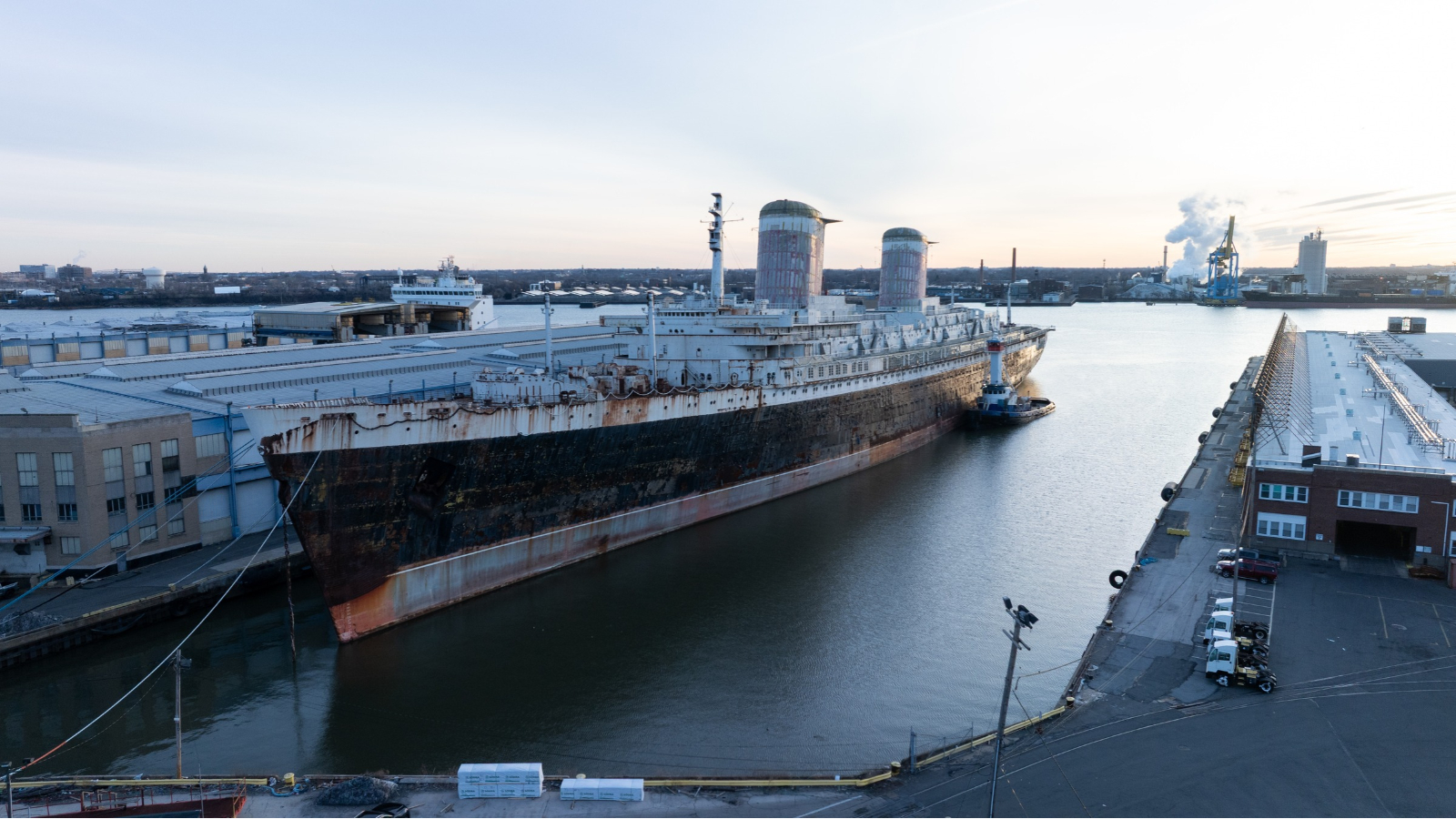
Stand on the edge of Pier 82 in South Philadelphia on a gray November morning, and you can hear the Delaware River slapping gently against a wall of flaking, oxidized red-and-black steel. Look up, and your neck aches before your eyes reach the top of the funnels. She is 990 feet long—nearly a hundred feet longer than the Titanic—and for nearly three decades, the SS United States has sat here like a forgotten cathedral, tethered to a rotting dock across the street from an IKEA parking lot.
To most commuters racing down Columbus Boulevard, she was just an oversized piece of industrial clutter. To maritime historians, she was the undisputed queen of the Atlantic, the vessel that shattered the transatlantic speed record on her maiden voyage in 1952 and never gave it back.
Now, her final voyage is underway, and it does not end in a dry dock or a luxury museum. It ends at the bottom of the Gulf of Mexico.
Okaloosa County, Florida, purchased the aging ocean liner in a multi-million-dollar deal designed to solve a pressing ecological and economic crisis along the Emerald Coast. Their plan is audacious, controversial, and mathematically staggering: strip her down to her bare aluminum and steel bones, tow her nearly 1,800 miles south, and sink her roughly 20 nautical miles off the coast of Destin-Fort Walton Beach.
When the demolition charges finally blow and the sea rushes into her hull, the SS United States will cease to be a ship. She will become the largest artificial reef on the planet.
The Ghost in the Harbor
To understand why sinking a national treasure feels like both a funeral and a resurrection, you have to stand on the deck of a dive boat six miles off Pensacola at dawn.
Consider a hypothetical charter captain named Marcus, a third-generation Gulf fisherman who has spent forty years watching the sandy seabed of the Florida Panhandle turn into an underwater desert. The northern Gulf of Mexico has a geographical problem that tourists rarely think about while sipping drinks on white-sand beaches. Unlike the Florida Keys, which sit atop ancient, jagged limestone coral formations, the seabed off Destin and Fort Walton Beach is mostly flat, shifting quartz sand.
Marine life hates an empty room. Without vertical structure—ledges, crevices, overhangs, and shadows—baitfish have nowhere to hide from predators. Without baitfish, red snapper, grouper, amberjack, and pelagic hunters like mahi-mahi and cobia simply keep swimming. Over decades, hurricanes have flattened natural hard-bottom habitats, while surging coastal tourism has put relentless pressure on the reefs that remain.
For Marcus, a new reef is not a tourist brochure talking point. It is the difference between a thirty-minute run to full coolers and a three-hour fuel-burning slog into deep federal waters just to find a single productive ledge.
"People think we're just throwing trash in the ocean," Marcus might tell a passenger rigging a heavy jig on the stern. "They don't see what happens six months later. That steel turns into an apartment building for the entire food chain."
This is the invisible stakes behind the SS United States' final chapter. While preservationists in Philadelphia and New York mourned the loss of mid-century American engineering—the ship that carried four U.S. presidents, Grace Kelly, Marlon Brando, and the Mona Lisa—marine biologists in Florida saw something else entirely. They saw 990 feet of vertical real estate.
How a Titanic-Sized Ship Becomes a Living Reef
Sinking an ocean liner is not as simple as pulling a plug and watching her slip beneath the waves. If you sink a dirty ship, you create an ecological disaster. If you sink an unstable ship, you create a death trap for recreational divers.
Before the SS United States can touch the sand roughly 180 feet below the surface of the Gulf, she has to undergo an exhaustive, year-long surgical gutting in Mobile, Alabama.
Think of the process like preparing an organ for transplant. Every ounce of fuel, oil, hydraulic fluid, and grease must be pumped, scrubbed, and steam-cleaned from her bilges and engine rooms. Miles of copper wiring, plastics, loose paneling, and hazardous materials—most notably the asbestos insulation that made her virtually fireproof during the Cold War—have to be meticulously removed under strict Environmental Protection Agency oversight.
What remains is a hollowed-out leviathan of high-grade marine steel and the largest aluminum superstructure ever built.
Once the tugboats haul that stripped hull to her final coordinates—roughly 20 nautical miles south of the Destin-Fort Walton Beach coastline, sitting neatly between Pensacola and Panama City—engineers will use precision-placed cutting charges to breach the lower hull compartments. Water will flood the lower decks evenly, guiding the leviathan straight down so she lands upright on her keel, facing into the prevailing current.
Here is how the biological clock starts ticking the exact second she hits bottom:
Hour One: Silence. The silt settles around a massive, alien canyon of metal rising nearly 100 feet off the ocean floor—bringing her upper decks within 80 feet of the surface, well within reach of advanced recreational scuba divers.
Week One: Biofilm arrives. Microscopic bacteria, diatoms, and algal spores coat every square inch of bare steel, creating a slimy, nutrient-rich skin that signals to passing larvae that a permanent home has arrived.
Month Three: The crustacean invasion begins. Barnacles, hydroids, bryozoans, and tube worms cement themselves to the hull, transforming smooth industrial plates into a rough, textured carpet. Clouds of tiny baitfish—cigar minnows, round scad, and menhaden—begin hovering inside the shadowed companionways and blown-out portholes, using the superstructure as a shield against open-water predators.
Year Two and Beyond: The apex predators move in. Sponges, soft corals, and bivalves encrust the railings and davits. Goliath grouper claim the cavernous engine rooms. Red snapper and triggerfish stack up in dense, shimmering columns above the bridge, while sea turtles wedge themselves under the massive propellers to sleep.
To grasp the scale of this transformation, look at the reigning champion just down the coast. In 2006, the Navy sank the aircraft carrier USS Oriskany off Pensacola. At 888 feet long, the "Great Carrier Reef" became a global mecca for wreck divers and generated tens of millions of dollars in annual local tourism revenue.
The SS United States is more than a hundred feet longer. She will eclipse the Oriskany, dethroning her to become the undisputed heavyweight champion of artificial reefs worldwide.
The Cold War Secret Hidden in Her Hull
There is an irony in watching an ocean liner become a public playground for divers, because for the first twenty years of her life, almost everything about how she moved was classified top secret.
Commissioned in the tense early years of the Cold War, the SS United States was never designed merely to ferry wealthy socialites between New York and Southampton. She was built with a $50 million subsidy from the U.S. Navy as a dual-purpose weapon. In peacetime, she was a luxury liner. In wartime, her interior bulkheads could be stripped out in 48 hours to transform her into a troop transport capable of carrying 14,000 soldiers—nearly an entire infantry division—10,000 miles without refueling.
Her naval architect, William Francis Gibbs, was a man possessed by a singular, terrifying obsession: speed and fire. Having watched ships burn at sea, Gibbs refused to allow a single splinter of wood aboard the vessel. No wooden deck chairs. No wooden paneling. Even the grand pianos in the ballroom were crafted from fireproof aluminum, and the butcher blocks in the galley were synthetic.
Underneath her sleek, black-and-white exterior lay four Westinghouse steam turbines originally engineered for Essex-class aircraft carriers, driving four massive propellers whose exact blade pitch remained a state secret until the late 1970s.
In July 1952, on her very first crossing, she tore through the North Atlantic at an average speed of 35.59 knots—roughly 41 miles per hour—shattering the Hales Trophy record held by the RMS Queen Mary by more than ten hours. She didn't just beat the competition; she humiliated them. No conventional passenger liner has ever come close to matching her pace.
I remember standing near her bow years ago when her red funnel paint was still bright enough to catch the afternoon glare off the Delaware River. Even dead in the water, tethered by thick mooring lines, the sheer knife-edge sharpness of her prow made every modern cruise ship look like a bloated floating hotel. She looked built to slice through steel, not water.
Yet that same Cold War perfection ultimately sealed her fate.
Why Nobody Could Save Her
For decades, dedicated conservators, philanthropists, and maritime buffs fought a bruising, uphill battle to keep the SS United States afloat. Every few years, a new rendering would surface: the ship reborn as a floating hotel in Manhattan, a tech campus in Miami, a casino in Brooklyn, or a museum anchored in San Francisco.
Every single plan collapsed under the crushing weight of reality.
The problem was never a lack of love; it was the unforgiving math of marine engineering. Restoring a 990-foot vessel built in 1952 to modern building codes, fire suppression standards, accessibility laws, and environmental regulations would cost upwards of $500 million to $1 billion. Worse, after decades of sitting idle in saltwater and brackish river currents without cathodic protection, her hull plates had thinned, and her asbestos-lined interior made even basic demolition a regulatory minefield.
To make matters worse, her landlord in Philadelphia, Penn Warehousing, doubled her daily dockage fees and sued to have her evicted after a bitter legal dispute. A federal judge gave the SS United States Conservancy a hard deadline to move the ship—with nowhere left to take her.
The choice was no longer between a luxury museum and an artificial reef. The choice was between a reef and the scrapyard.
Had she been sold to shipbreakers in Brownsville, Texas, or Alang, India, giant acetylene torches would have sliced her into anonymous girders, melted down to become rebar for highway overpasses and appliances. Her name would have vanished from the map entirely.
Instead, Okaloosa County stepped in with a roughly $10 million package—covering the purchase of the vessel, environmental remediation, towing, deployment, and a land-based museum in Destin-Fort Walton Beach dedicated to telling her story using salvaged artifacts, including one of her iconic 65-foot funnels.
A New Map on the Ocean Floor
When divers eventually descend down the mooring lines into the cobalt-blue water 20 miles off the Florida Panhandle, they will not be swimming through a graveyard. They will be navigating an underwater metropolis with its own distinct geography.
Because the ship will rest upright on a flat sandy bottom at roughly 180 feet, she will offer a rare tiered ecosystem that caters to different levels of human exploration and marine biology simultaneously.
At 80 to 100 feet below the surface, the upper sun decks, promenade rails, and wheelhouse will sit comfortably inside the depth limits of recreational divers holding standard deep-water certifications. Sunlight penetrates clearly at this depth in the northern Gulf during summer months, illuminating clouds of iridescent damselfish and schools of amberjack patrolling the superstructure like silver torpedoes.
Drop down past 130 feet—into the realm of technical divers breathing mixed gases—and the scale becomes cathedral-like. Divers will glide past the cavernous openings cut into the hull to allow safe interior access and strong water flow, peering into the gutted ballroom where Duke Ellington once played and the massive turbine spaces that once propelled her faster than any liner in history.
And down at 180 feet, where the massive keel meets the quartz sand, giant red grouper and nurse sharks will carve out territories beneath the twin rudders.
Economists in Okaloosa County project the wreck will generate millions of dollars annually in dive charters, hotel stays, restaurant tabs, and fishing trips. More importantly, it will relieve intense fishing and diving pressure on natural reefs across the northern Gulf, acting as a biological pressure valve that allows fragile native coral and sponge beds room to recover.
It is easy to feel a sharp pang of grief watching an American icon stripped of her interiors and sunk into the sea. Nostalgia demands that we keep our heroes frozen in amber, polished and dry behind velvet ropes.
But ships are not meant to rot behind chain-link fences beside highway off-ramps. They are built to move, to endure the salt, and to belong to the ocean.
Soon, the last mooring lines will be cast off, and the fastest ocean liner ever built will make one final crossing under tow. When the charges fire and the Gulf of Mexico closes over her bow, she will never again slice through the waves at forty miles an hour. Instead, she will stand perfectly still in the dark water—anchored to the earth, teeming with life, holding her ground against the current forever.