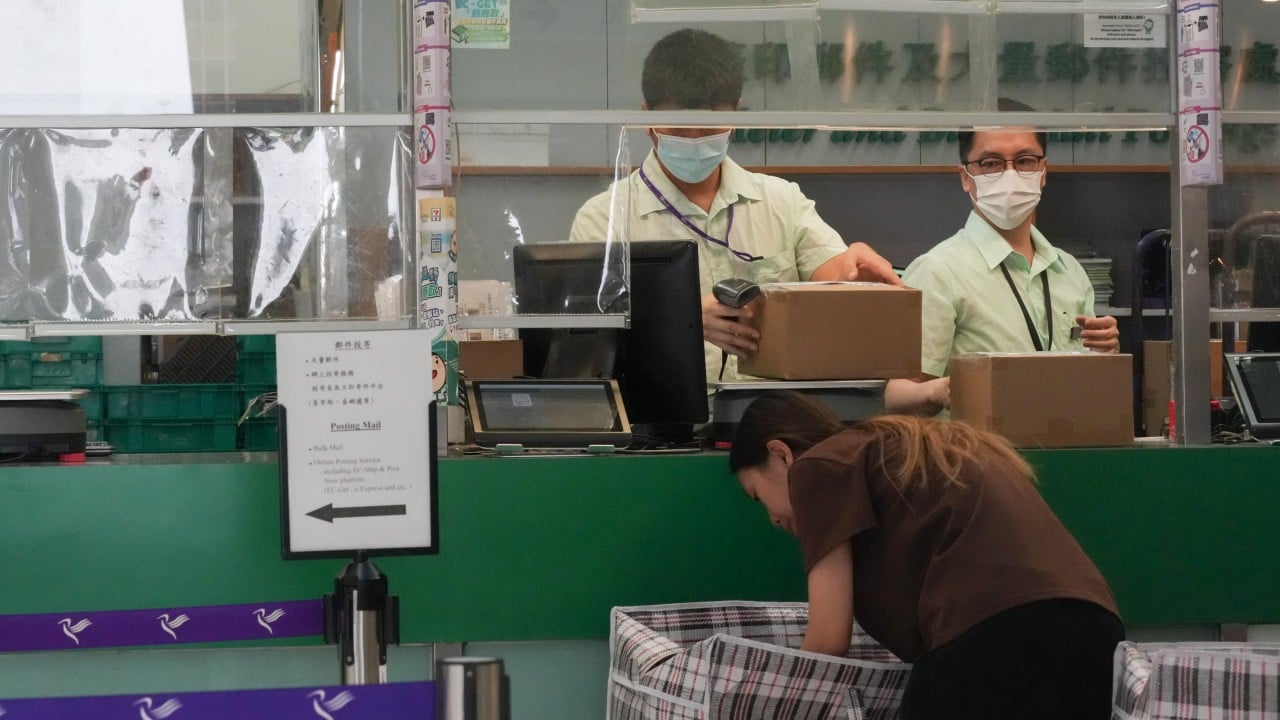
The fluorescent tubes above the sorting desk hummed with a low, medicinal drone that had not changed in twenty years. Outside, the Hong Kong humidity pressed against the frosted glass of the postal depot like a damp palm, blurring the neon signatures of Victoria Harbour into smeared ribbons of amber and cyan.
At desk four, Wai-kin sat hunched over a stack of registered parcels, his thumb flicking against the corner of a cardboard box with the mechanical precision of a metronome. He knew the weight of these boxes before he lifted them. He knew the rhythm of the city by the density of its junk mail. For twelve years, his relationship with the post office had been defined by a quiet, unassuming contract: loyalty in exchange for stability. A permanent position. A pension line item. A small, sturdy anchor in one of the most volatile real estate markets on earth. Expanding on this idea, you can also read: The App Store Profit Engine Is Breaking Down.
Then the memo arrived.
It was printed on standard-issue, unceremonious bond paper. No fanfare. No preliminary town halls. Just a cold structural realignment: permanent contracts for incoming postal workers were officially a relic of the past. Moving forward, new hires would step into a system built on transience—fixed-term agreements, contingent timelines, and the perpetual, quiet anxiety of renewal. Observers at Harvard Business Review have provided expertise on this situation.
Financial strain, the administrators called it. A necessary recalibration in an era of declining traditional mail volumes and soaring operational overheads.
To a spreadsheet, it was a clean subtraction. To the people sorting the mail at three in the morning, it was an earthquake.
The Anatomy of an Institution Under Pressure
To understand why the shift at Hongkong Post matters, we have to look past the bureaucratic jargon of balance sheets and deficit projections. Postal services are rarely just businesses. They are civic infrastructure, stitched into the daily rituals of urban survival. They are the arteries through which legal notices, medical test results, birthday cards, and small-business livelihoods flow.
For decades, the public sector in Hong Kong offered a specific social bargain. The wages might not compete with the dizzying heights of investment banking or corporate law in Central, but they offered something infinitely scarcer: permanence. In a city built on sand and speculation, a civil service job was a concrete foundation. It meant you could look a landlord in the eye and sign a two-year lease. It meant you could plan for a child, a university fund, or a quiet retirement in the New Territories.
When that foundation is quietly replaced by temporary scaffolding, the shockwaves travel far beyond the sorting room floor.
Consider what happens to institutional memory when the people holding the institution are always keeping one eye on the exit. Wai-kin remembers every winding alleyway in his district, every broken buzzer, every elderly resident who needs their pension slip handed directly into their trembling hand rather than shoved into a jammed metal box. That kind of localized intuition cannot be downloaded from a training manual. It is accumulated over years of steady, uninterrupted presence.
When new workers enter under fixed-term conditions, knowing their tenure expires in twenty-four months, the psychological contract changes. Why memorize the unmapped quirks of a neighborhood if you might not be here next autumn? Why invest emotional bandwidth into a community that treats your employment as a temporary line item?
The Global Squeeze on Public Service
Hong Kong is not alone in this reckoning. Across the globe, historic postal systems are caught in a brutal economic vise. The digital migration has cannibalized their most profitable revenue streams. Physical letters have plummeted, replaced by instantaneous emails and encrypted messaging apps, while parcel delivery—booming due to the relentless surge of e-commerce—is fiercely contested by hyper-agile, venture-backed logistics giants operating on razor-thin labor margins.
Faced with mounting deficits, public agencies find themselves trapped between two impossible choices: raise postage rates to politically toxic levels or trim the fat from their largest operational expense—human labor.
Opting for fixed-term contracts for new staff is the administrative equivalent of putting a tourniquet on a leaking vessel. It lowers fixed overheads, dodges long-term pension liabilities, and offers maximum flexibility as delivery demands fluctuate. On paper, it looks responsible. It looks like modernization.
Yet, this logic contains a profound structural flaw. It mistakes human labor for a replaceable widget.
When you casualize the workforce of a foundational public institution, you begin a slow erosion of trust. The postal worker is often the only face of government that marginalized or elderly citizens see on a regular basis. They are the human element in an increasingly automated, algorithmic world. When that face changes every six months, the community feels it. The safety net frays at the edges.
Walking the Line Between Resilience and Erosion
Talk to a newly minted postal recruit in Kowloon, and you will hear a different register of anxiety. Let us call him Marcus. Marcus is twenty-six, possesses a degree in supply chain management, and sorts parcels for twelve hours a day. He is quick, tech-savvy, and deeply exhausted.
"It is not that I mind working hard," Marcus told me over a steaming bowl of beef brisket noodles, the steam fogging his wire-rimmed glasses. "I expect to grind. But there is a difference between working hard toward a future and running on a treadmill that you know is about to be unplugged."
Marcus lives with three roommates in a subdivided flat where the kitchen is barely large enough to turn around in. For him, the lack of a permanent contract isn't just an employment detail; it is an existential paralysis. He cannot secure a bank loan for further education. He cannot fathom marriage. Every renewal cycle hangs over his head like a seasonal storm cloud.
This is the invisible cost of financial restructuring. It shifts the burden of macroeconomic volatility directly onto the shoulders of the youngest and most vulnerable workers. The institution balances its books by transferring its insecurity to the individual.
And so, the work gets done, but the soul of the work shifts. The veteran staff, like Wai-kin, look at the revolving door of young faces with a mixture of pity and detachment. They have watched the culture change from a brotherhood of public servants into a fragmented workforce of temporary contractors, all running the same route, but running alone.
The Unspoken Horizon
Weighing the survival of a public utility against the humane treatment of its workers is one of the defining ethical dilemmas of our modern urban age. Efficiency is a relentless god. It demands sacrifice, optimization, and the ruthless pruning of anything that resembles redundancy.
Yet, redundancy is sometimes another word for resilience. A little excess capacity, a little structural security, is what keeps a system from shattering when the unexpected happens.
As the night shift bled into the pale, bruised gray of an August dawn, Wai-kin finished rubber-banding his final bundle of letters. His back ached with the familiar, grinding stiffness of a man who has spent decades bending over metal trays. He slipped his pen into his breast pocket, picked up his satchel, and walked out into the awakening roar of the city.
Behind him, at desk four, a vacant chair waited for tomorrow's temporary hire. The fluorescent lights hummed on. The letters kept coming. And the city, bright, relentless, and quietly trembling, waited to see who would be there to deliver them next year.