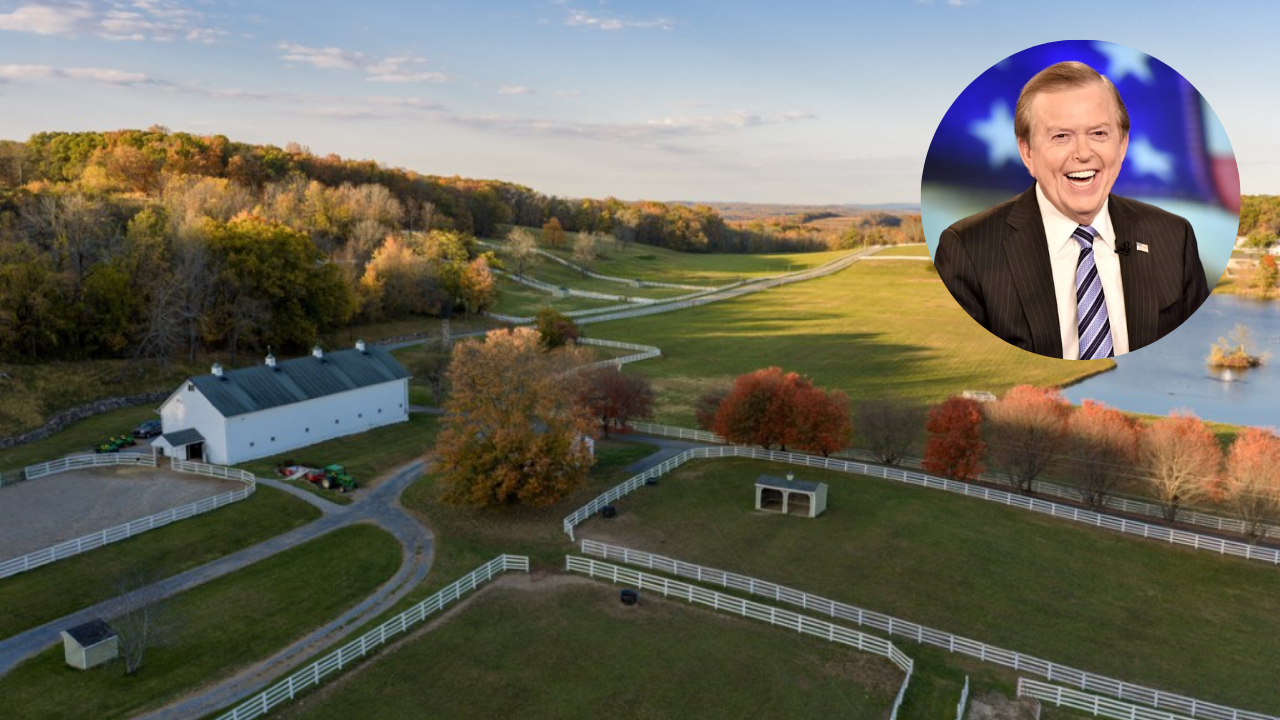
Capital allocation in rural real estate rarely follows a linear trajectory, instead relying on opportunistic aggregation and long-term holding power. When evaluating large-scale rural asset assembly, the multi-decade consolidation executed by the late broadcaster Lou Dobbs on the New York-New Jersey border offers a clean case study in parcel aggregation. Spanning forty years from its initial 1984 acquisition to its post-mortem offering at $6 million, the 283-acre Sussex County footprint known as Hickory Hollow Farm illustrates the underlying mechanics of rural land accumulation, infrastructure scaling, and optionality pricing.
The primary driver behind multi-parcel assembly is the liquidity discount inherent in smaller, non-contiguous rural tracts versus the scarcity premium commanded by unified large-scale acreage. Individual suburban or rural landowners often sell small parcels piecemeal due to localized financial pressure or generational transition. By systematically absorbing adjacent plots over a forty-year horizon, an accumulator avoids the hyper-inflationary pricing that occurs when a single buyer attempts a simultaneous large-scale assemblage. For a closer look into similar topics, we suggest: this related article.
Understanding the economic profile of this type of asset requires examining the structural components that dictate its valuation: raw land cost basis, functional agricultural improvements, lifestyle capital expenditures, and development optionality.
The Composition of Rural Asset Value
An estate of 283 acres in Wantage Township, New Jersey, operates under a distinct cost function compared to standard commercial or residential real estate. The valuation is not derived strictly from the square footage of the primary dwelling, though the 5,419-square-foot colonial structure establishes a baseline residential utility. Instead, the asset's economic weight rests on specialized infrastructure and land optionality. For additional information on this issue, detailed reporting is available on Financial Times.
The infrastructure footprint dictates whether a rural property functions as an economic liability or a productive enterprise. Hickory Hollow Farm was engineered specifically as an equestrian facility, featuring an 11-stall main barn, secondary barn configurations, 17 grass paddocks with turnout sheds, and a 150-by-200-foot fenced riding arena. Constructing these assets independently involves heavy upfront capital outlays, zoning hurdles, and environmental compliance costs. In land assembly economics, pre-existing agricultural infrastructure transfers at a steep depreciation discount to the buyer, meaning the capital embedded in the soil and barns is acquired well below replacement cost.
Water rights and topographical features introduce additional valuation variables. The inclusion of an 11-acre spring-fed pond alongside freshwater streams provides a localized hydrological resource that elevates the utility of the acreage for both livestock management and micro-climate temperature moderation. Water scarcity or lack of reliable irrigation infrastructure routinely caps the valuation of surrounding rural properties.
The Mechanics of Parcel Accumulation
Assembling contiguous acreage requires navigating local municipal zoning boards, shifting property tax regimes, and opportunistic seller negotiations. In northwestern New Jersey, agricultural assessments often provide property tax mitigation under farmland preservation acts, keeping operational holding costs manageable over long holding periods—evidenced by annual taxes hovering around $37,000 for the entire 283-acre footprint.
The risk profile of long-term land accumulation centers on capital lockup and opportunity cost. Real estate is fundamentally illiquid. Tying up capital in rural dirt across four decades exposes the holder to localized municipal zoning shifts, environmental remediation liabilities, and regional economic stagnation. However, these risks are offset by the deflationary hedge that real estate provides against currency devaluation.
When a property reaches the scale of Hickory Hollow Farm, it transitions from a recreational retreat into an institutional-grade private compound. This introduces a bifurcated exit strategy for future owners: continuation of agricultural or equestrian operations, utilization as a multi-generational family estate, or execution of a subdivision and residential development playbook.
Optionality Pricing and Exit Strategies
The $6 million asking price, when evaluated against the total acreage, translates to approximately $21,200 per acre inclusive of all structures, or roughly $1,107 per square foot for the primary residential improvements. This metric reveals the core tension in rural estate valuation: the residential improvements carry the bulk of the immediate price per square foot, while the underlying land operates as a call option on regional suburban expansion.
Suburban migration patterns from the New York metropolitan area periodically place upward pressure on rural land values in Sussex County. Properties exceeding 200 contiguous acres are structurally scarce, rendering them targets for high-net-worth buyers seeking privacy or developers eyeing low-density residential subdivision potential, subject to municipal approvals.
To maximize the yield of a rural asset portfolio upon exit, an owner or estate executor must avoid marketing the property solely to lifestyle buyers. The addressable market narrows significantly at multi-million dollar price points for rural acreage. Positioning the asset requires highlighting its dual capability: immediate operational readiness for agricultural or equestrian enterprise paired with the clean legal title of an unencumbered land bank.
Evaluate prospective rural acquisitions through the lens of replacement cost for infrastructure versus raw acreage acquisition velocity. Prioritize properties where water rights, access roads, and zoning classifications are already secured to eliminate regulatory friction before deploying capital into structural buildouts.