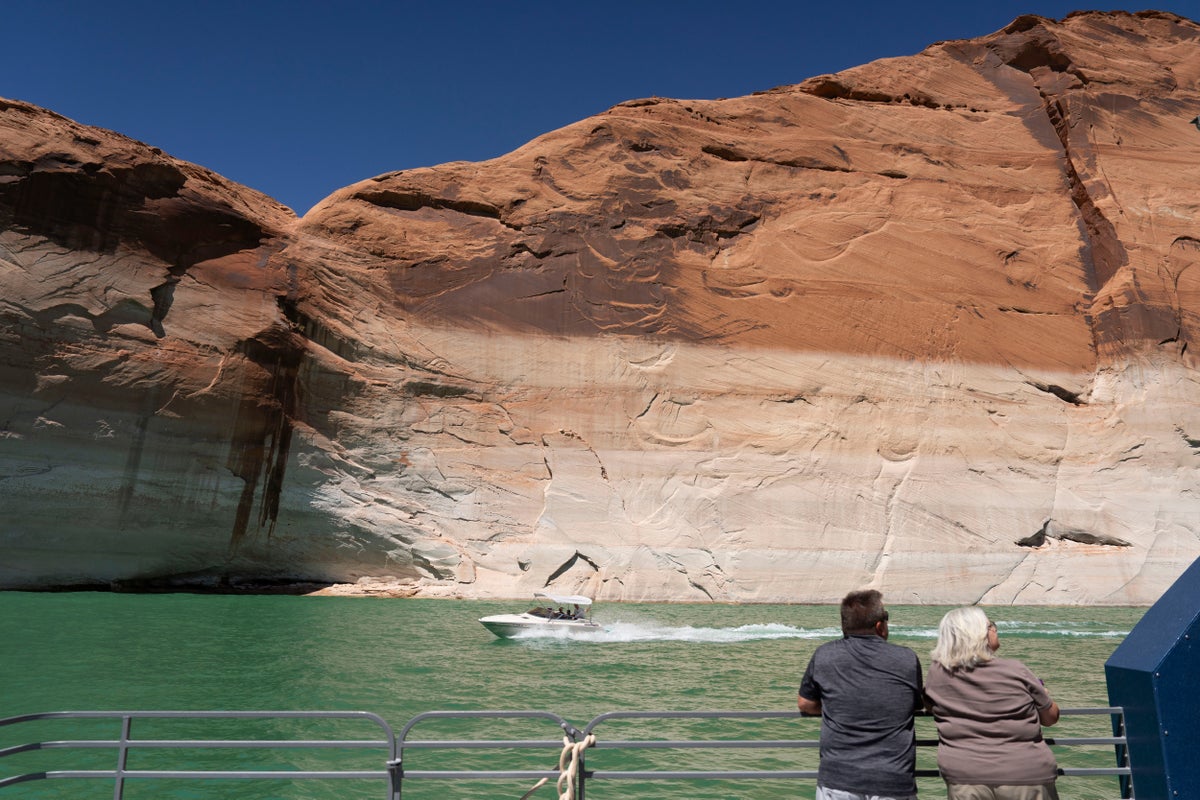
Lake Powell does not have to run completely dry for the lights to go out across the American Southwest. It just needs to drop another 37 feet.
Right now, the second-largest reservoir in the United States is hovering dangerously close to a crisis point. A brutal combination of record-low mountain snowpack and an unprecedented heatwave shattered early-season water projections. The reservoir sits at about 22% capacity, a historic low that has federal engineers scrambling.
If the water level hits 3,490 feet above sea level, the Glen Canyon Dam reaches its "minimum power pool". At that exact line, the eight massive turbines generating hydroelectric power must shut down immediately. If they don't, the vortexes of air and water will tear the machinery apart from the inside out.
The grid goes dark long before the mud appears. This is not a hypothetical scenario for the distant future; federal 24-month studies project the reservoir could slide below this critical threshold by the end of the year without drastic intervention.
The 5 Million Person Power Lie
You have probably read headlines claiming that a Lake Powell shutdown threatens the power supply for up to six million people. That number sounds terrifying. It conjures images of major metropolitan skylines blinking out of existence, leaving millions in the dark.
But that is not how the Western grid works.
Las Vegas, Phoenix, and Los Angeles will not lose power if Glen Canyon Dam stops spinning. Those major cities have deeply diversified energy portfolios, drawing from natural gas, solar, nuclear, and other regional plants. They can buy replacement power on the open market in a heartbeat.
The real victims of a Glen Canyon shutdown are the people living in small, rural communities, tribal nations, and local electrical cooperatives. The Western Area Power Administration (WAPA) distributes this cheap, subsidized hydropower to roughly 130 wholesale customers across six states, including 53 tribes.
When the dam stops producing, towns like Page, Arizona; Farmington, New Mexico; Gallup, New Mexico; and Cortez, Colorado lose their primary source of affordable electricity. These communities rely on long-term, 20-year contracts for cheap federal power. Without it, local utilities have to buy expensive replacement energy from fossil-fuel-burning plants on the spot market.
Studies show that residential electricity bills in municipal hubs like St. George, Utah might only see nominal annual increases, but the financial strain on small rural cooperatives and tribal communities will be sharp and immediate. The financial buffer is gone.
The Antiquated Plumbing of Glen Canyon Dam
The engineering behind Glen Canyon Dam was celebrated as a triumph of human ingenuity when it was completed in 1963. Today, it is a glaring liability. The dam was built during an unusually wet era of the 20th century, under the assumption that the Colorado River would always run thick and fast.
The structural crisis boils down to two sets of pipes:
- The Penstocks: These are the 15-foot-wide tubes that suck water from the reservoir and drop it into the turbines. They sit high up on the dam face. When the lake drops below 3,490 feet, these intakes risk pulling in air, causing devastating physical damage to the infrastructure.
- The River Outlet Works (ROW): These are four smaller, 8-foot-wide bypass tubes located lower down on the dam structure. If the penstocks close, these four pipes become the only way to send water downstream to Lake Mead, Arizona, California, and Mexico.
Here is the catch: the River Outlet Works were never designed for permanent, long-term use. They are emergency bypasses.
During an experimental high-flow release, federal engineers ran massive volumes of water through these lower tubes. The extreme pressure created vacuum bubbles that collapsed violently against the inside of the steel, a destructive physical process called cavitation. The pipes suffered severe pitting and structural tearing.
Engineers had to patch the tubes with epoxy, but the warning was clear: if we rely solely on the River Outlet Works to pass water to the millions of people downstream, the dam's internal plumbing could physically disintegrate.
Federal Triage and Shifting Water Scarcity
The Bureau of Reclamation is currently playing a high-stakes game of reservoir triage. To stop Lake Powell from dropping past the point of no return, the federal government initiated emergency operations to artificially prop up the water level.
The feds are releasing up to one million acre-feet of water from the Flaming Gorge Reservoir upstream near the Utah-Wyoming border, sending it rushing down to fill Powell. Simultaneously, they are slashing the amount of water sent downstream from Lake Powell into Lake Mead.
This federal band-aid will temporarily raise Lake Powell's elevation by about 54 feet, keeping the turbines spinning for a little longer. But it triggers a massive domino effect. By holding water back in Powell, the government is intentionally starving Lake Mead downstream. Projections show this choice will accelerate the decline of Lake Mead, potentially knocking out up to 40% of Hoover Dam's hydropower capacity.
We are simply robbing Peter to pay Paul, moving scarcity around a map instead of fixing the root issue.
The Hard Truth About Living with Less
The structural blueprints of the American West are broken. The 1922 Colorado River Compact allocated more water to states than the river actually produces annually. For a century, we ignored the math because the massive reservoirs acted as giant shock absorbers. Those shock absorbers are now empty.
If you live, work, or run a business in the West, you cannot wait for federal agencies to resolve their bureaucratic gridlock. You need to adapt your operations immediately to handle a higher-cost, lower-water reality.
Audit Your Local Energy Mix
Do not assume your lights will stay on just because you live in a booming Western city. Call your local electrical cooperative or utility provider. Ask exactly what percentage of their wholesale power comes from the Colorado River Storage Project (CRSP). If that number is high, look closely at their transition plan for market-rate replacement power and brace for rate adjustments.
Accelerate On-Site Power Generation
For rural businesses, agricultural operations, and remote properties, self-reliance is the safest bet. Transitioning capital into localized solar arrays paired with battery storage systems reduces your vulnerability to regional grid instability and spiking spot-market energy prices.
Shift to Extreme Water Efficiency
If your livelihood depends on regional water supplies, the era of cheap abundance is over. Agricultural operations must transition away from flood irrigation toward precision drip systems. Urban properties need to eliminate non-functional turf entirely. The federal government will likely initiate mandated, permanent water cuts across both the Upper and Lower basins; getting ahead of those mandates now prevents sudden operational shocks later.
The crisis at Lake Powell isn't an engineering failure; it's a structural reckoning. The water is drying up, the climate is warming, and the rules of the river are changing permanently.