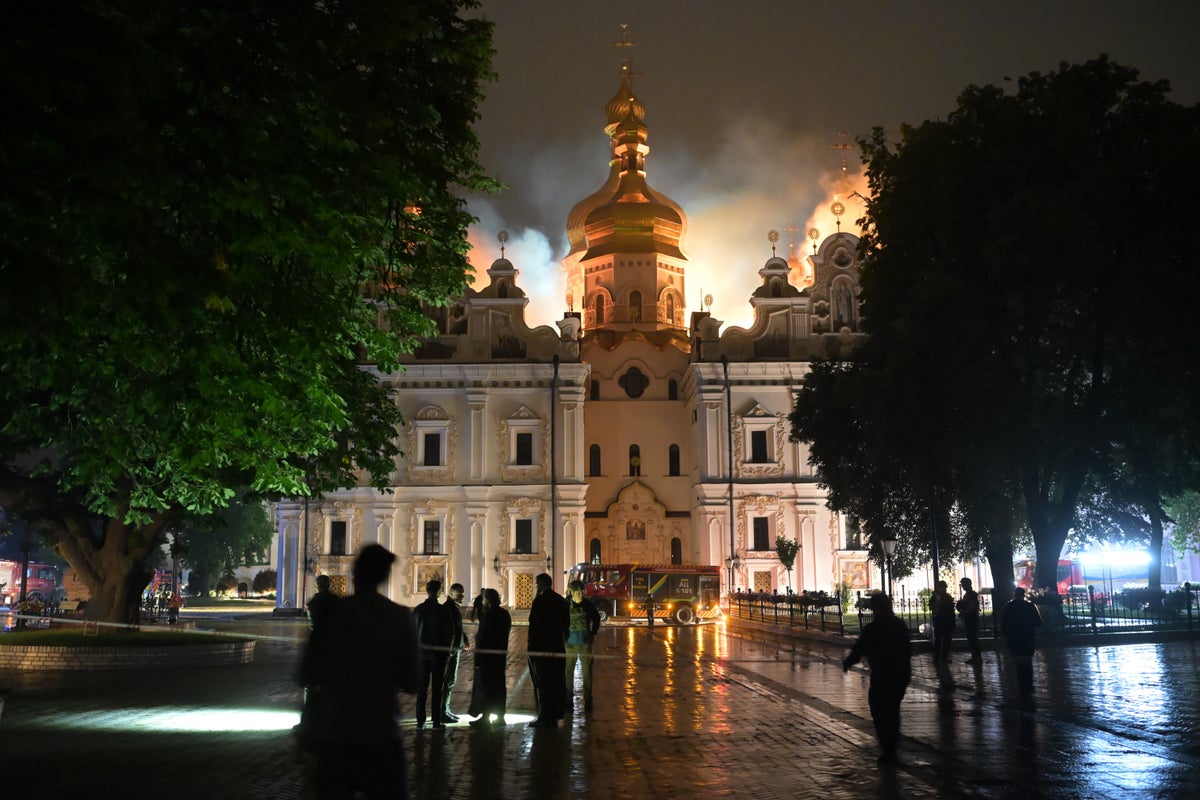
War strips away illusions. For years, the Kremlin has wrapped its bloody geopolitical ambitions in the language of shared history, common roots, and Orthodox Christian brotherhood. But a wave of Russian ballistic missiles and Shahed drones shattered that facade completely.
The roof of the Dormition Cathedral at the Kyiv-Pechersk Lavra burned. Flames licked up toward the golden domes of a thousand-year-old sanctuary.
This isn't just another statistic in a brutal war. It's an direct hit to the cultural and spiritual core of Ukrainian identity. The monastery complex, founded in the 11th century, is a UNESCO World Heritage site. It has survived Mongol invasions, fires, and the czars. It survived the Bolsheviks. Until now, it hadn't faced a direct military assault since World War II.
By targeting the heart of the "Monastery of the Caves," the Kremlin didn't just strike civilian infrastructure. It targeted its own stated heritage, proving that nothing is sacred when it comes to subjugating Ukraine.
The Night Kyiv Burned
The assault began under the cover of darkness. Air sirens wailed across the capital as the Ukrainian Air Force tracked dozens of incoming targets. In less than 30 minutes, five strikes slammed into civilian areas within the Shevchenkivskyi district alone.
The damage across the city is staggering.
- A 25-story apartment high-rise was gutted.
- A busy local market and a grocery store went up in flames.
- In the Obolonskyi district, a nine-story residential building took a direct hit.
- Falling debris severed power lines, leaving 140,000 residents in the northern part of the capital without electricity.
According to Tymur Tkachenko, head of the Kyiv City Military Administration, at least four people died in the capital, and 25 others were injured, including two children.
But the most shocking footage came from the right bank of the Dnipro River. Thick black smoke billowed from the Kyiv-Pechersk Lavra. The Dormition Cathedral, rebuilt with painstaking detail after being destroyed during World War II, was on fire.
Emergency crews rushed to the scene, dodging the threat of secondary strikes. Priests and volunteers scrambled to execute an emergency evacuation of historic icons, antimensia, and ancient religious relics. They carried centuries of history out of the smoke into the chaotic night.
Double Taps and Calculated Brutality
This wasn't an isolated accident or a case of poor targeting. It was part of a coordinated, country-wide blitz. While Kyiv's skies lit up with air defense interceptions, the city of Kharkiv faced an even grimmer reality.
A Russian strike hit a residential area in Kharkiv, drawing emergency responders to the scene. As firefighters and rescue workers dug through the rubble, a second Russian missile struck the exact same location. This tactic, known as a "double-tap," is designed specifically to kill first responders. Five rescuers died instantly in the blast, and five more were wounded.
"Kyiv is under the main strike. There is significant destruction of civilian infrastructure," stated Interior Minister Ihor Klymenko. Tkachenko was even more direct, labeling the Russian forces "the barbarians of the 21st century."
The sheer scale of the attack—which involved dozens of missiles fired in a tight one-hour window—shook windows in the city center and sent thousands of residents fleeing into the labyrinthine underground metro stations for survival.
Erasing History Under the Guise of Faith
To understand why the attack on the Lavra matters so deeply, you have to understand its history. The Kyiv-Pechersk Lavra is the cradle of Eastern Slavic Christianity. Founded in 1051 by the monks Anthony and Theodosius, it predates the very existence of Moscow by a century. Its underground caves, stretching over 600 meters, hold the mummified remains of saints, chroniclers, and heroes.
For centuries, it has been a holy pilgrimage site. Ironically, it was also a cornerstone of the Russian Orthodox Church's spiritual claims over Ukraine. For years, Moscow used its influence within parts of the Lavra to push a narrative of unity.
When the roof of the Dormition Cathedral caught fire, that narrative burned with it.
Metropolitan Epiphanius, the head of the Orthodox Church of Ukraine, didn't hold back his fury. He called the strike a crime "against humanity, against history, against Christianity." Ukraine's Prime Minister, Yulia Svyrydenko, put it even more bluntly, sharing images of the flaming monastery and writing, "A brutal assault on our people and our heritage. This is the true face of Russia's Orthodox values."
This strike shows a terrifying shift in strategy. When a military willingly destroys the very monuments it once claimed as its own holy ground, it means they are no longer trying to capture a culture. They are trying to erase it.
The Geopolitical Fallout
The timing of this massive barrage isn't random. It follows intense political maneuvering on the international stage. Just days before the attack, Ukrainian President Volodymyr Zelenskyy spoke with Donald Trump to discuss frameworks for ending the war. Concurrently, rumors of potential peace frameworks mediated in Europe have been swirling.
Vladimir Putin had recently warned that Moscow would launch "systemic" strikes, likely to project strength amid Russia's own mounting battlefield setbacks and economic strain. By launching a high-consequence strike on a UNESCO World Heritage site, Moscow is signaling that it intends to maximize terror and destruction to force a surrender on its own terms.
The attack has rattled neighboring countries. Poland scrambled fighter jets and placed its ground-based air defense systems on high alert as Russian missiles flew dangerously close to NATO airspace.
Documenting the Destruction
If you want to support the preservation of Ukrainian heritage or stay informed on the ground realities, tracking official channels is vital. Vague news summaries don't capture the full picture.
Monitor updates from the State Emergency Service of Ukraine for real-time casualty and rescue data. Follow UNESCO’s cultural heritage monitoring reports, which document the precise structural damage to the Lavra to prepare for future restoration.
Don't let the scale of the destruction numb you to the individual losses. Talk about the targeted high-rises, the killed rescuers in Kharkiv, and the burning churches. Documenting these attacks is the first step toward future accountability. The golden domes of Kyiv will be rebuilt, but the world must remember the night they tried to burn them down.