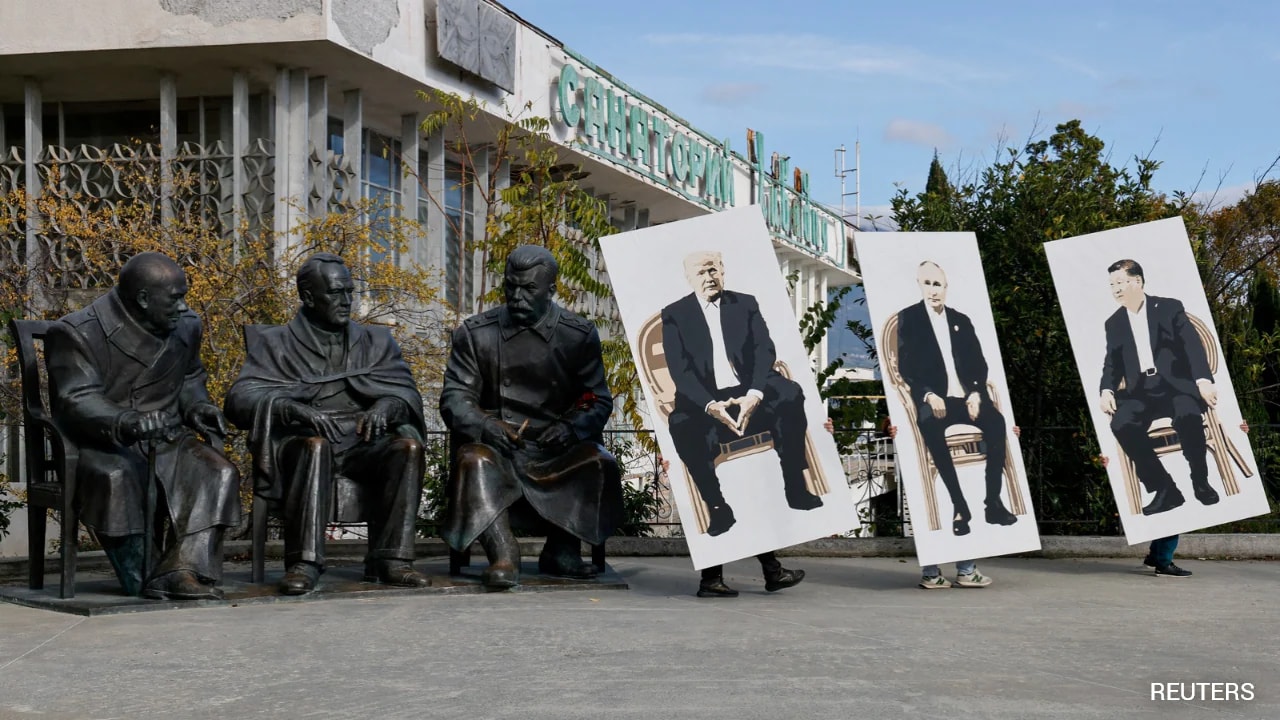
Every few months, a geopolitical commentator floats the idea of a "new Yalta." It sounds dramatic. Three superpowers sit in a room, pull out a map, and divide the globe into neat spheres of influence while smaller nations watch from the sidelines.
Moscow isn't buying it. You might also find this connected article useful: Why Counting Airstrike Casualties in West Kordofan Misses the Real War.
When recent discussions around potential trilateral talks between the United States, China, and Russia drew comparisons to the 1945 Yalta Conference, the Kremlin pushed back immediately. Kremlin spokesman Dmitry Peskov dismissed the parallel outright, pointing out that the global power structure of 2026 looks nothing like the smoking ruins of World War II.
And honestly? Peskov is right about the history, even if his motives are entirely strategic. As discussed in latest articles by NPR, the effects are notable.
What Actually Happened at the 1945 Yalta Conference
To understand why Moscow rejected the Yalta comparison, you have to look at what Yalta actually was.
In February 1945, Franklin D. Roosevelt, Winston Churchill, and Joseph Stalin met at the Livadia Palace in Crimea. Nazi Germany was collapsing. Imperial Japan was on the ropes. Those three leaders held almost total military and economic dominance over the Allied war effort, giving them the raw power to dictate postwar borders across Europe and Asia.
They didn't ask Poland for permission before redrawing its frontiers. They didn't consult Berlin before splitting Germany into occupation zones. At Yalta, three men carved up the world because nobody else had the military muscle to stop them.
Today's diplomatic environment operates under completely different rules.
A potential US-China-Russia summit isn't a victory lap after a global war. It's a crisis-management exercise between nuclear-armed competitors who deeply distrust each other and lack the unilateral power to force the rest of the world into compliance.
Why Moscow Hates the Yalta Label Right Now
You might assume Russia would love being placed on equal footing with Washington and Beijing as one of three global architects. After all, Russian foreign policy has spent decades chasing recognition as an indispensable great power.
So why turn down the compliment? Three practical reasons explain the Kremlin's rejection.
1. Yalta Implies a Rigid Cold War Bloc System
Calling a modern summit a "new Yalta" suggests the US, China, and Russia want to split the world into three closed, competing camps. Moscow's entire diplomatic pitch to the Global South relies on the exact opposite message.
Russia markets itself as a champion of multipolarity. When Russian officials speak at BRICS summits or United Nations gatherings, they tell countries in Africa, Latin America, and Asia that the era of a few capitals dictating terms to everyone else is dead. If the Kremlin embraces a Yalta comparison, it hands Western critics instant proof that Moscow just wants to bring back 20th-century imperialism under a new name.
2. Middle Powers Won't Accept Being Carved Up
In 1945, Europe was devastated and most of Asia and Africa were still under colonial rule. In 2026, middle powers hold real economic and military leverage.
India isn't waiting for Washington, Beijing, or Moscow to decide its security future. Neither is Brazil, Saudi Arabia, Turkey, or the European Union. Even smaller states have learned how to play major powers off one another to extract trade deals, weapons, and infrastructure funding.
Any attempt by three leaders to draw hard spheres of influence today would collapse the moment they left the conference room. Regional powers simply have too many ways to say no.
3. The Power Balance Between the Three Isn't Equal
At Yalta, Stalin commanded the largest land army in Europe, giving him massive leverage over Roosevelt and Churchill. In a modern US-China-Russia meeting, the economic math is brutally lopsided.
The United States and China are the world's two largest economies by a massive margin. Russia's economy, while resilient under sanctions, is a fraction of the size of either Washington's or Beijing's. Entering a summit framed as a "three-way division of the world" exposes Russia's economic asymmetry rather than hiding it.
Moscow prefers issue-specific negotiations—like strategic nuclear arms control or regional de-escalation—where Russia's massive nuclear arsenal puts it on strict parity with the United States.
What a US-China-Russia Meet Would Actually Cover
If it isn't Yalta, what is the real point of getting Washington, Beijing, and Moscow in the same room?
Nuclear stability sits at the top of the list. For decades, bilateral arms control treaties between the US and Russia kept nuclear arsenals predictable. With old frameworks like New START expired or hollowed out, and China rapidly expanding its own nuclear warhead stockpile, bilateral treaties no longer cover the full picture.
Washington has argued for years that any future nuclear arms control framework must include Beijing. Beijing has historically resisted, pointing out that its arsenal is still much smaller than those of the US and Russia. Getting all three at one table is the only realistic way to establish basic guardrails against accidental nuclear escalation, AI-integrated launch systems, and space-based weapons.
Beyond nuclear risk, trilateral talks serve a basic communication function:
- Preventing miscalculation in flashpoints: Direct channels help avoid accidental military collisions in the Baltic Sea, the Black Sea, the Taiwan Strait, and the Arctic.
- Setting rules for emerging tech: Autonomous military drones, cyber warfare, and hypersonic missiles currently operate with almost zero international guardrails.
- Managing global supply shocks: Energy transit routes, critical mineral supply chains, and maritime shipping lanes suffer immediately whenever tensions spike between these three capitals.
Stop Reading Modern Diplomacy Through a 1945 Lens
Journalists and think-tank analysts reach for the "Yalta" comparison because it makes for an easy headline. It evokes smoky rooms, secret deals, and dramatic turning points in history.
It's also lazy analysis.
When you frame modern great-power diplomacy as a repeat of 1945, you miss how messy and decentralized global politics has actually become. You overestimate what three presidents can accomplish in a weekend summit, and you underestimate the agency of every other country on the planet.
If you want to evaluate any upcoming trilateral talks between Washington, Beijing, and Moscow accurately, ignore the historical nostalgia and watch three concrete indicators instead:
- Look at the agenda, not the photo op. If the meeting produces technical working groups on nuclear risk reduction or military-to-military hotlines, it's serious diplomacy. If it's just vague statements about "global stability," it's pure theater.
- Watch how Beijing positions itself. China rarely agrees to formats where it can be ganged up on by Washington and Moscow, or where it gets dragged into Russian disputes with Europe. Beijing's level of participation tells you immediately how much substance the talks actually carry.
- Track the reaction from regional capitals. Pay close attention to New Delhi, Tokyo, Brussels, and Riyadh. Their response will tell you whether the summit actually shifted reality on the ground or just generated a few days of cable news chatter.
History doesn't repeat itself on a neat schedule, and the Kremlin knows better than to step into a 1945 script that no longer fits the modern world.