In the smoky, ash-choked shadow of lower Manhattan, rescue workers did not survive on grit alone. They survived on braised short ribs, massive vats of chili con carne, truckloads of fresh-baked bread, and hot coffee handed across makeshift counters by the city’s most elite culinary figures.
When commercial aviation halted and Manhattan south of 14th Street turned into a restricted disaster zone on September 11, 2001, the city's hospitality industry faced an immediate, existential choice. High-end dining rooms emptied. Walk-in refrigerators bulged with perishables destined to spoil. Rather than retreating into self-preservation, top-tier restaurateurs and line cooks weaponized their commercial kitchens. They built an underground logistics network that fed tens of thousands of exhausted ironworkers, police officers, and firefighters around the clock for months.
This was not a casual bake sale. It was a massive, decentralized supply chain operation born out of chaos.
The Anatomy of an Emergency Kitchen
Within hours of the towers' collapse, industry leaders gathered in Midtown Manhattan under the guidance of figures like restaurateur Tim Zagat. The mandate was brutally simple: first responders needed protein, warmth, and calories, and commercial kitchens were sitting idle.
Chefs who normally spent their mornings debating the provenance of French butter or microgreens suddenly found themselves routing industrial shipments of meat and produce toward the perimeter of Ground Zero.
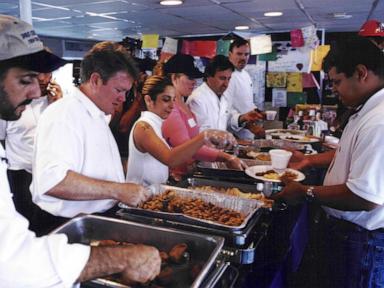
Logistics ruled the operation. Moving food past police checkpoints required diplomatic maneuvering, forged passes, and sheer audacity. Delivery trucks were repurposed into mobile supply units. Tribeca Grill chef Don Pintabona secured use of sightseeing boats from Spirit Cruises, transforming a triple-decker vessel into a floating, 24-hour kitchen that ferried hot meals directly from Chelsea Piers to the World Financial Center marina.
Menus evolved from necessity. Fine dining ingredients met emergency relief cooking. Chefs improvised with whatever distributors dropped off at their loading docks.
- Breakfast: Thousands of eggs, dense loaves of artisan bread, and industrial quantities of drip coffee.
- Lunch & Dinner: Slow-cooked stews, massive trays of lasagna, roasted poultry, and heavy starches designed to sustain physical labor through twelve-hour shifts in toxic dust.
- Comfort Items: Hand-delivered pastries, dim sum brought by neighborhood delivery cyclists, and coolers of chili sent by culinary icons like Jean-Georges Vongerichten.
Beyond Calories The Psychology of a Hot Meal
Physical exhaustion was only half the enemy at the disaster site. The psychological toll on recovery workers cataloging the wreckage was unprecedented.
Improvised cafeterias like David Bouley’s Green Tarp Café—named for the plastic sheeting covering broken storefront windows on Liberty Street—offered more than nutritional replenishment. They provided a psychological decompression chamber. For twenty minutes, a sanitation worker or structural engineer could sit on a folding chair, step away from the toxic dust, and experience a semblance of human dignity.
Food served as an emotional anchor. When rescue crews walked into Nino’s on Canal Street or stepped onto Daniel Boulud’s floating mess halls, they were met by civilians who looked them in the eye. The exchange of a hot meal bridged the terrifying gap between the surreal catastrophe outside and ordinary human life.
The Hard Truth of Post-Disaster Aid
The romantic narrative of community solidarity often obscures the sheer friction of crisis management. Early relief efforts were plagued by bureaucratic paralysis. Turf wars broke out between official disaster relief agencies and independent culinary volunteers.
Health inspectors wrestled with the liability of serving unvetted food in a biohazard zone. Many chefs bypassed official channels entirely, relying on personal relationships with precinct captains and union delegates to smuggle provisions past barricades.
Money vanished quickly. Insurance payouts for shuttered restaurants took months or years to materialize. Many establishments that poured their capital into feeding rescue workers drained their cash reserves, forcing long-term closures or permanent restructuring. The philanthropy was entirely grassroots, driven by ego-free collaboration in an industry typically defined by fierce competition.
A Legacy Etched in Stainless Steel
When the emergency kitchens finally wound down months later, the physical tokens remained. At Nino’s, rescue workers pinned department patches, union pins, and municipal badges onto the walls and staff aprons. Those fragments of fabric became a permanent archive of an industry that refused to stand on the sidelines.
The culinary response to the disaster redefined how urban centers handle catastrophic disruption. It proved that commercial kitchens are critical civic infrastructure, capable of pivoting instantly from luxury service to mass humanitarian relief when society fractures at its core.
Daniel Boulud on Feeding First Responders in the Aftermath of 9/11
This video explores how prominent New York chefs mobilized immediately after the 9/11 attacks to provide sustained relief and hot meals to frontline rescue workers.