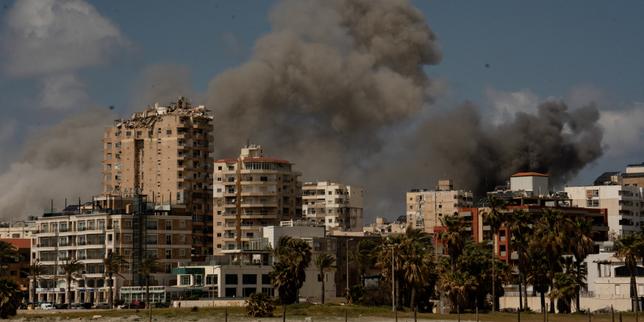
The current post-ceasefire environment in Southern Lebanon is not a state of peace, but a high-stakes calibration of strategic signaling. When the Israel Defense Forces (IDF) conduct kinetic strikes during a cessation of hostilities, they are not necessarily signaling a collapse of the agreement. Instead, they are enforcing a Buffer Integrity Protocol. These strikes function as immediate feedback loops intended to prevent the re-establishment of Hezbollah’s pre-conflict tactical positions. The survival of the ceasefire depends less on the absence of violence and more on the shared understanding of what constitutes a "prohibited movement."
The Mechanics of Kinetic Enforcement
Ceasefires in asymmetric warfare suffer from a fundamental information asymmetry. One side (the state actor) operates with visible conventional forces, while the non-state actor (Hezbollah) often utilizes civilian infrastructure and clandestine movement to reconstitute. To counter this, the IDF employs a strategy of Proactive Friction.
The logic follows a three-stage escalation matrix:
- Surveillance and Identification: Persistent ISR (Intelligence, Surveillance, and Reconnaissance) platforms identify movement within restricted zones, specifically the area south of the Litani River.
- Verbal/Non-Kinetic Warning: In several instances, the IDF uses localized messaging or warning shots to signal that a specific geographic point is currently off-limits.
- Surgical Kinetic Intervention: If the target (personnel or vehicle) continues to approach sensitive military infrastructure or attempts to retrieve cached assets, a strike is authorized.
These strikes are designed to be high-precision and low-yield. The objective is rarely the total destruction of the adversary's remaining manpower, but the enforcement of a No-Go Boundary. This creates a psychological and physical barrier that replaces the need for a continuous, static wall of soldiers.
The Litani Buffer and the Security Dilemma
The central tension of the current arrangement rests on the interpretation of UN Resolution 1701 and its modern enforcement mechanisms. The security dilemma here is acute: if the IDF does not strike at perceived "violations," Hezbollah perceives a lowering of the cost for re-armament. If the IDF strikes too frequently or hits the wrong targets, the Lebanese Armed Forces (LAF) and the international community view it as a breach of sovereignty, potentially triggering a broad escalation.
The "Red Line" variables currently being monitored include:
- Re-entry Velocity: The speed at which displaced populations and suspected operatives return to border villages.
- Infrastructure Reconnaissance: Any attempt to repair tunnels, bunkers, or rocket launch sites that were partially destroyed during the kinetic phase of the war.
- Weaponry Salvage: The recovery of Anti-Tank Guided Missiles (ATGMs) or Short-Range Ballistic Missiles (SRBMs) from hidden depots.
The IDF’s tactical strikes serve as a deterrence tax. By making the cost of returning to specific zones unpredictable and potentially lethal, they slow the rate of Hezbollah’s reconstitution.
The Role of the Lebanese Armed Forces (LAF)
A ceasefire’s durability is tied to the Security Transfer Efficiency. For Israel to cease its unilateral strikes, the LAF must demonstrate a capability to occupy the vacuum. However, the LAF faces structural constraints that limit its effectiveness:
- Capacity Deficit: The LAF lacks the heavy armor and sophisticated electronic warfare suites required to forcibly disarm entrenched militias.
- Political Fragility: Because Hezbollah is a domestic political entity, the LAF risks internal fragmentation if it acts as a direct proxy for Israeli security interests.
- Coordination Latency: The time required for Israel to report a violation to UNIFIL/LAF and for the LAF to respond is often longer than the window needed to prevent the violation.
This latency is the primary driver of Israeli kinetic intervention. When the "Observation-to-Action" cycle of the official monitoring body is too slow, the IDF defaults to its own kinetic enforcement loop.
Quantifying Breach Thresholds
Analyzing these strikes requires distinguishing between a Tactical Breach and a Strategic Collapse.
A Tactical Breach is localized. It involves small groups of personnel moving into prohibited areas. These are managed through the localized strikes seen in recent footage. They do not necessarily lead to a return to full-scale war because neither side has signaled a desire to resume high-intensity operations.
A Strategic Collapse occurs when the command-and-control (C2) structure of either side decides that the ceasefire no longer serves their long-term interests. Indicators of this would include:
- Saturation Fire: Resuming rocket barrages into Northern Israel.
- Deep Extraction Strikes: Israeli air strikes hitting Beirut or the Bekaa Valley, moving beyond the immediate border enforcement zone.
- Total Withdrawal from Monitoring: The expulsion or intentional targeting of UNIFIL observers.
Current data suggests we are firmly in the Tactical Breach phase. The strikes are "surgical," meaning they are targeted at specific individuals or vehicles rather than broad civilian or military infrastructure. This indicates a calibrated effort to maintain the status quo through restricted violence.
The Economic and Logistics of Attrition
While the focus is on the kinetic strikes, the underlying pressure is logistical. Hezbollah’s ability to sustain another round of combat is hampered by the degradation of its supply lines from Syria. The Israeli strikes on border crossings and specific transit routes—even during the ceasefire—are intended to maintain this Logistical Isolation.
From a consulting perspective, the "Product" being sold to the Israeli public is Security through Distance. The "Product" for the Lebanese state is Sovereignty through Presence. These two goals are currently in direct competition. The strikes are the mechanism by which the IDF attempts to ensure that "Sovereignty" does not become a cover for "Militant Re-entry."
Strategic Recommendation for Stability Monitoring
Observers and analysts should shift their focus from the fact of the strikes to the geography and payload of the strikes.
- Vertical Escalation: Watch for strikes hitting higher-ranking commanders. This signals a shift from enforcement to decapitation.
- Horizontal Escalation: Watch for strikes expanding into the North of Lebanon. This signals a lack of confidence in the Litani buffer's relevance.
The most effective path to stabilizing the region involves the rapid deployment of technical sensors (acoustic and seismic) along the border, coupled with a pre-cleared "Engagement Matrix" for the LAF. Until the LAF can prove it has the kinetic will to match the IDF’s enforcement standards, unilateral Israeli strikes will remain the primary—albeit volatile—tool for maintaining the ceasefire's integrity. The current friction is the price of avoiding a return to total war, acting as a pressure release valve for a system that is still fundamentally broken.