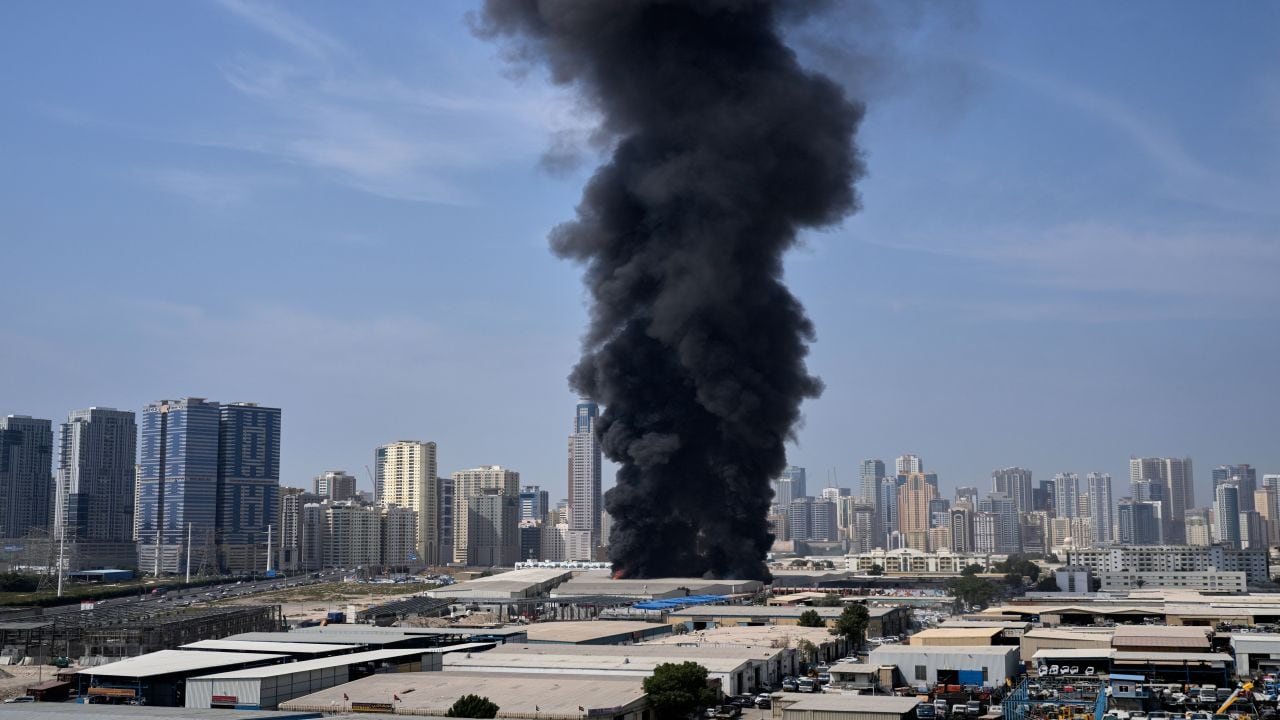
The recent kinetic strikes originating from Iranian territory against targets within the United Arab Emirates (UAE) represent a fundamental shift in regional risk profiles, moving from proxy-led grey-zone warfare to direct state-actor attribution. While the immediate human toll—three fatalities and 58 injuries, including an Indian national—serves as the tragic baseline for reporting, the strategic implications lie in the failure of localized air defense umbrellas to achieve a 100% intercept rate against high-volume, low-cost saturating munitions. This event exposes a critical bottleneck in the security architecture of global logistics hubs: the widening gap between offensive missile technology and the cost-per-kill ratio of defensive countermeasures.
The Mechanics of Saturation and Interception Failure
The success of any strike on a high-value target in the UAE is rarely the result of a single superior weapon system. Instead, it is a function of Saturative Overload. When an adversary deploys a mix of cruise missiles and loitering munitions (drones) simultaneously, the defensive radar systems face a "classification tax." Each incoming signal must be identified, tracked, and assigned an interceptor.
- Sensor Saturation: The inability of ground-based radar to maintain high-fidelity tracks on multiple low-altitude targets.
- Processor Lag: The time delay between target identification and the firing solution, which increases exponentially with each additional projectile.
- Kinetic Depletion: The exhaustion of ready-to-fire interceptors (such as the Patriot or THAAD missiles), leaving the site vulnerable to a second wave of slower, less sophisticated drones.
The injury of 58 individuals in a concentrated strike zone suggests that the impact occurred in a high-density industrial or residential area, indicating either a deliberate choice of target to maximize psychological disruption or a failure of the terminal phase intercept. If an intercept occurs too late—specifically in the "Terminal Low" phase—the resulting debris field remains lethal. The kinetic energy of a neutralized missile traveling at Mach 2 does not vanish; it converts into a high-velocity fragmentation cloud that can cause significant casualties on the ground, even if the primary warhead is deactivated.
The Triad of Regional Destabilization
To understand the broader impact, the event must be mapped across three distinct analytical pillars: The Logistics Corridor, The Diaspora Variable, and The Energy Premium.
The Logistics Corridor
The UAE operates as a global pivot point for the "East-West" trade route. Any kinetic activity within its borders introduces a Geopolitical Risk Surcharge to maritime and air insurance premiums. When a strike hits, the immediate cost is not just the repair of infrastructure but the recalibration of "Safe Harbor" status. Logistics firms begin rerouting assets to avoid the Strait of Hormuz, increasing fuel consumption and delivery lead times.
The Diaspora Variable
The presence of an Indian national among the injured highlights the internationalized nature of the Gulf workforce. The UAE's economy relies on a demographic structure where over 80% of the population consists of expatriates.
- Labor Capital Flight: Sustained insecurity triggers a brain drain of highly skilled technical workers who view the region as a high-reward, but now high-risk, environment.
- Diplomatic Friction: Direct harm to foreign nationals forces third-party giants (like India) to shift from neutral observers to active participants in regional security dialogues, complicating the Iranian diplomatic position.
The Energy Premium
The strike is a direct signal to the global energy markets. Even if no oil infrastructure is damaged, the potential for future strikes creates a floor for crude oil prices. This "Fear Premium" acts as a regressive tax on global manufacturing, particularly in energy-dependent economies.
Asymmetric Warfare and the Cost-to-Death Ratio
The Iranian strategy utilizes an asymmetric cost model. A loitering munition may cost as little as $20,000 to produce, while the interceptor missile used to down it can cost upwards of $2 million. This 100:1 cost ratio is unsustainable for a defending state.
The three fatalities recorded in this strike demonstrate the lethal efficiency of this asymmetry. When defense systems are forced to choose between protecting high-value military assets and civilian population centers, "Defensive Gaps" emerge. The strikes demonstrate that Iran has refined its guidance systems to a degree where GPS-denied environments—common in electronic warfare zones—no longer provide total protection.
The Problem of Attribution and Plausibility
Previously, Iran utilized Houthi proxies in Yemen to provide a layer of "deniable involvement." The shift toward direct strikes signals a willingness to bypass the diplomatic safety net of proxy warfare. This suggests that the internal political calculus in Tehran has shifted to favor Overt Deterrence over Covert Sabotage. This is a high-stakes gamble: it proves capability but invites direct conventional retaliation, a scenario that would fundamentally break the current global supply chain.
Structural Limitations of Current Defense Doctrines
The reliance on "Point Defense" (protecting specific spots) rather than "Area Defense" (protecting entire regions) is a known vulnerability. In a compact geography like the UAE, the distinction between a military target and a civilian center is often less than five kilometers.
- The Multi-Spectral Challenge: Radar alone cannot solve the problem. Infrared and acoustic sensors must be integrated to detect "dark" drones that emit low thermal signatures.
- The Human Element: Operators under stress during a saturation attack are prone to "Target Fixation," where they focus on a high-speed missile and ignore a slow-moving, high-explosive drone until it is within the terminal strike zone.
The 58 injuries suggest a wide-area fragmentation effect. This occurs when a warhead is designed with a pre-scored casing to maximize the radius of damage. This is not a precision tool; it is an area-denial weapon intended to cause mass casualty events and overwhelm local medical infrastructure.
Tactical Realignment for Industrial Hubs
For multinational corporations and state actors operating in the Gulf, the strategy must move beyond passive reliance on state air defenses.
- Hardening of Secondary Assets: Infrastructure must be reinforced with physical barriers (slat armor or concrete shielding) to mitigate the effects of fragmentation from intercepted debris.
- Redundant Communication Nodes: Ensuring that localized kinetic events do not trigger a total operational blackout for logistics and financial services.
- Dynamic Evacuation Protocols: Shift from "Shelter in Place" to "Distance-Based Evacuation" when early warning systems detect launch signatures from the north.
The current trajectory indicates that the Persian Gulf has entered a "Post-Proxy" era. The threshold for direct engagement has lowered, and the technical barrier to entry for high-impact strikes has collapsed. Future stability will not be found in better diplomacy alone, but in the rapid deployment of Directed Energy Weapons (lasers) that can reset the cost-per-kill ratio and neutralize the saturative advantage of low-cost munitions. The strategic play is no longer about avoiding the strike, but about making the strike too expensive for the aggressor to maintain through the total neutralization of their kinetic inventory before it reaches the target's perimeter.