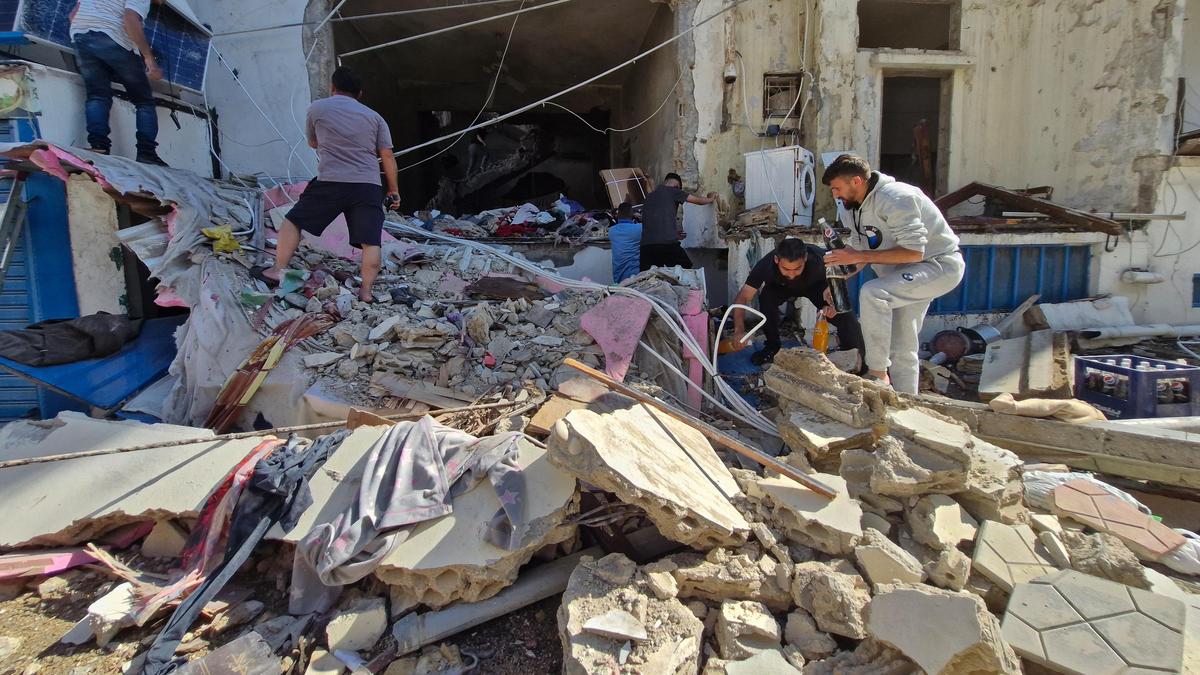
Pre-negotiation kinetic ramping serves as a calculated mechanism to establish escalation dominance, directly shaping the zone of possible agreement (ZOPA) before diplomatic engagement begins. The intensification of Israeli military operations across southern Lebanon on May 28, 2026—resulting in at least 14 fatalities, including civilians and a Lebanese Armed Forces (LAF) soldier—is not an isolated breakdown of the nominal April 17 ceasefire. Instead, it represents an intentional execution of a strategic posture designed to maximize bargaining leverage prior to the bilateral security talks in Washington.
By analyzing this escalation through the lens of game theory and operational security design, we reveal how both state and non-state actors utilize tactical friction to establish strategic boundaries. Understanding this dynamic requires evaluating the primary operational triggers, the structural breakdown of the current negotiation matrix, and the asymmetric asymmetric cost-imposition strategies employed by Israel and Hezbollah.
The Micro-Tactical Catalyst: Fiber-Optic Exploding Drones and the Cost Function
The primary operational trigger for Israel's expanded targeting matrix is Hezbollah’s deployment of fiber-optic exploding drones. This specific hardware variant introduces a shift in the local electronic warfare landscape. Standard radio-controlled or GPS-guided unmanned aerial vehicles (UAVs) are vulnerable to electronic jamming, spoofing, and frequency disruption, allowing defensive systems to intercept or divert them before impact.
Fiber-optic guided munitions operate via an un-jammable physical tether. This architecture isolates the guidance system from the electromagnetic spectrum, nullifying traditional electronic countermeasures. The deployment of this technology has altered the operational cost function along the Litani River and northern border towns by yielding two distinct outcomes:
- Mitigation of Counter-UAS Networks: It bypasses ground-based electronic jamming arrays, ensuring high-fidelity terminal guidance up to the point of impact.
- Targeted Attrition: It enables precise targeting of armored units and troop concentrations, as demonstrated by the strike that killed an Israeli soldier and wounded two reservists in northern Israel on May 28.
To re-establish a credible deterrent, the Israeli military expanded its targeting parameters from localized border interdictions to structural interdictions within urban centers like Tyre and Sidon. Prime Minister Benjamin Netanyahu’s directive to expand military operations is a direct effort to impose an asymmetric cost penalty on Hezbollah's operational rear guard, balancing out the tactical vulnerabilities introduced by these un-jammable assets on the front lines.
The Asymmetric Targeting Matrix: Geography and Casualty Distribution
The kinetic activity observed on May 28 highlights a calculated approach to targeting, balancing civilian displacement against specific operational objectives across three distinct geographic zones:
The Coastal Hub (Tyre)
Prior to launching strikes, the Israeli military utilized targeted evacuation warnings for eight specific structural assets within the city. This signaling serves a dual purpose: it reduces immediate civilian casualties within dense urban areas, and it systematically dismantles the physical logistics infrastructure utilized by Hezbollah’s regional command elements.
The Transit Corridor (Adloun and Sidon)
Strikes in these areas demonstrate the challenges of intercepting moving targets and high-density structures using remote precision guided munitions. A drone strike on a vehicle in Adloun resulted in six fatalities, while an interdiction against an apartment unit in Sidon killed five individuals, including a former correspondent for Iran’s al-Aalam network. These strikes indicate a focus on high-value targets moving through or embedded within civilian displacement centers, altering the risk profile for non-combatants moving northward.
The Sovereign Buffer Zone (Nabatiyeh)
Near Nabatiyeh, an Israeli drone strike killed a Lebanese Armed Forces soldier on a motorcycle. This incident highlights the friction inherent in operations where state militaries and non-state actors occupy the same space. The presence of the LAF near the Litani River introduces a complicating factor to the rules of engagement, as accidental targeting risks shifting Beirut's political stance from managing internal non-state actors to actively defending state sovereignty.
The Washington Negotiation Architecture: Structural Impasses and Divergent ZOPAs
The diplomatic framework established for the Washington security talks features a misalignment of strategic objectives among the participating entities. While the April 17 nominal ceasefire remains structurally fragile, the proposed security talks operate under fundamentally incompatible definitions of stability.
| Stakeholder | Primary Strategic Objective | Minimum Acceptable Outcome |
|---|---|---|
| Israel | Complete disarmament of Hezbollah south of the Litani River; verifiably secure northern border zones. | Enhanced enforcement mechanisms with unilateral rights to interdict verified violations. |
| Lebanon (Salam Government) | Preservation of state sovereignty; international funding for LAF expansion; enforcement of weapon monopolies. | Full Israeli withdrawal from southern territories and a return to structured border demarcations. |
| Hezbollah / Iran | Preservation of kinetic capabilities; linking the Lebanese theater directly to broader regional talks. | Rejection of unilateral disarmament; maintaining operational structures under an Iranian diplomatic umbrella. |
This structural impasse creates a clear bargaining bottleneck. The Lebanese government, led by Prime Minister Nawaf Salam, seeks to use international diplomatic support to build up the LAF's capacity, aiming to establish a state monopoly on force inside the country. However, this strategy assumes the LAF can successfully disarm Hezbollah—a task it has historically avoided to prevent internal sectarian conflict within its own ranks.
Concurrently, Hezbollah has dismissed the direct Washington talks entirely. By aligning its stance with Iran—which conditions a resolution in Lebanon on its own Pakistan-brokered negotiations with Washington—Hezbollah aims to bypass local Lebanese state authority. This strategy effectively turns the southern Lebanese kinetic theater into a bargaining chip for Tehran's broader regional ambitions.
Kinetic Ramping as a Pre-Negotiation Signaling Tool
The surge in strikes ahead of negotiations follows a established pattern of behavior in asymmetric conflicts. When a diplomatic timeline is fixed, adversaries often increase kinetic operations to alter the baseline assumptions of the negotiation before the first session begins.
Israel’s tactical objective is to establish a reality on the ground where its military presence extends north of the Litani River into towns like Zawtar al-Sharqieh. By expanding its physical presence and intensifying air operations immediately before the Washington talks, Israel aims to shift the baseline of the negotiations. This tactics repositions their current operational footprint from an aggressive expansion to a potential bargaining chip, allowing them to offer a withdrawal to previous positions in exchange for structural concessions regarding Hezbollah's disarmament.
Conversely, Hezbollah's deployment of drone attacks and short-range anti-armor ambushes is designed to demonstrate that holding these positions will carry a continuous cost in casualties. This counter-strategy aims to undermine Israel's escalation dominance by showing that territorial gains correspond directly to steady attrition, hoping to weaken Israel's leverage at the negotiating table.
Strategic Forecast: The Friction of Fractional Enforcement
Given the current operational layout, a comprehensive, self-enforcing treaty is unlikely to emerge from the Washington talks. The structural limitations of both the LAF and international monitoring bodies mean any agreement will likely face significant enforcement challenges.
The most probable outcome is the negotiation of a temporary framework focused on localized limits, rather than a permanent settlement. This approach would likely involve defining specific geographical zones where Israeli air operations are temporarily paused or restricted, tied directly to the deployment of LAF units tasked with removing illegal weapons caches.
However, this framework contains an inherent flaw: it relies on a state military that lacks the political mandate to forcefully disarm a highly integrated non-state actor. Consequently, any agreement that lacks a clear timeline and verifiable, independent enforcement mechanisms will likely function as a temporary pause, allowing both sides to rearm and adapt to new technologies before the next inevitable escalation cycle.