For nearly eighty years, Europe had a comfortable arrangement. Washington paid the lion's share of the security bill, parked troops across the continent, and provided the nuclear umbrella, while European governments spent their tax revenues on healthcare, infrastructure, and social programs. That era is officially over.
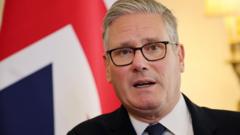
UK Prime Minister Keir Starmer recently delivered a blunt message to his continental neighbors. Europe can no longer expect the United States to "bankroll" its defence. It's a sharp departure from the polite diplomatic phrasing British leaders usually favor when talking about transatlantic relations, and honestly, it's long overdue.
When Starmer says Europe needs to step up, he isn't just reacting to shifts in Washington's foreign policy or electoral cycles. He's pointing at a cold mathematical reality. American strategic attention has been pivoting toward the Indo-Pacific for over a decade, and the war in Ukraine has drained Western ammunition stockpiles faster than factories can replace them. If Europe wants to deter aggression on its own doorstep, European taxpayers have to foot the bill.
What Starmer Actually Said About European Defence
Starmer's remarks cut straight through the usual NATO summit platitudes. Speaking on the need for European nations to take primary responsibility for their own security, the British Prime Minister argued that the continent has leaned on American military spending for far too long.
He framed the issue around fairness and survival. American voters—whether they lean Democrat or Republican—are increasingly tired of subsidizing wealthy European democracies that refuse to invest adequately in their own armed forces. Starmer's point is simple. You can't expect US troops and US dollars to rescue Europe every time a crisis flares up if European capitals aren't willing to fund their own deterrence first.
This isn't about abandoning the transatlantic alliance. Britain remains fiercely committed to NATO, and Starmer has repeatedly stressed that the US-UK security relationship is irreplaceable. Rather, it's an acknowledgment that a one-sided alliance isn't sustainable. If Europe wants Washington to stay engaged in European security, Europe has to prove it's a serious partner rather than a dependent client.
The Decades-Long Spending Gap Nobody Likes to Admit
To understand why Starmer's warning hits so hard, look at the numbers from the post-Cold War period. After the Soviet Union collapsed in 1991, European governments cashed in what economists called the "peace dividend." They slashed military budgets, mothballed tank divisions, and shrunk naval fleets.
For years, NATO's benchmark of spending 2% of GDP on defence was treated as an optional suggestion rather than a binding commitment. As recently as 2014, when Russia annexed Crimea, only three NATO members—the United States, the United Kingdom, and Greece—actually met that 2% target. Germany, Europe's largest economy, was spending around 1.2%.
Meanwhile, the United States consistently spent well over 3% of its massive GDP on defence. According to NATO's own financial reports, the US still accounts for roughly two-thirds of total alliance defence expenditure. Even after Russia's full-scale invasion of Ukraine in 2022 jolted European capitals awake, the structural gap remains massive. Buying a few dozen fighter jets doesn't erase thirty years of underinvestment in logistics, air defence, satellite intelligence, and heavy manufacturing.
Why Europe's Defence Industry Can't Keep Up Right Now
Throwing money at the problem sounds easy on paper. In practice, Europe's defence industrial base has atrophied to an alarming degree.
When European governments tried to ramp up artillery shell production for Ukraine, they ran straight into a wall of bureaucratic red tape, fragmented national procurement rules, and gutted supply chains. Unlike the United States, which operates a unified military-industrial complex with massive economies of scale, Europe is a patchwork of competing national champions.
Think about how absurd the duplication is. European armies operate more than a dozen different types of main battle tanks, multiple competing infantry fighting vehicles, and different artillery systems that don't always share standardized parts. The US military relies on one primary tank—the M1 Abrams. That fragmentation drives up costs and slows down manufacturing.
There's also the problem of "strategic enablers." Even when European nations deploy troops abroad, they frequently rely on the US military for heavy airlift, aerial refueling, satellite reconnaissance, and electronic warfare capabilities. Without American logistics backing them up, most European militaries would struggle to sustain a high-intensity combat operation for more than a few weeks.
Britain's Own Defence Dilemma Under Starmer
Starmer's lecture to Europe carries a heavy dose of domestic pressure, too. You can't tell Paris, Berlin, and Madrid to spend more on defence without facing tough questions about the state of the British armed forces.
The UK spends around 2.3% of its GDP on defence, putting it ahead of many European peers. Starmer has pledged to set a path toward 2.5%, though he has avoided locking in a strict deadline until his government completes its Strategic Defence Review. Critics, including former military chiefs and opposition politicians, argue that 2.5% isn't nearly enough to rebuild a hollowed-out military.
Look at the British Army's current headcount. It has shrunk to roughly 73,000 full-time trained soldiers—its smallest size since the Napoleonic era. The Royal Navy has struggled with crew shortages and ships laid up for maintenance, while the Royal Air Force faces tight budgets as it tries to modernize its fleet.
Starmer knows that if Britain wants to lead Europe's security transformation—especially now that the UK sits outside the European Union—it has to lead by example. Rhetoric won't deter Moscow. Ready brigades, stocked munitions depots, and active warships will.
The Political Trap Facing European Leaders
If the strategic logic is so obvious, why haven't European leaders moved faster? Because defence spending is political poison in countries already squeezed by sluggish growth and aging populations.
Every euro or pound spent on air defence missiles or artillery factories is money that can't be spent on pensions, public healthcare, or green energy subsidies. In countries like Germany, strict constitutional debt brakes have sparked fierce coalition fights over how to fund the military once Berlin's special €100 billion defence fund runs dry in 2027. In France, soaring public deficits have forced the government into painful budget cuts, limiting how much extra cash Paris can throw at its armed forces.
Voters in Western Europe spent generations believing that major land wars on their continent were relics of history textbooks. Convincing them to accept tax hikes or public service cuts to pay for deterrence requires political courage that many leaders simply lack. Starmer is betting that laying out the harsh truth now is less dangerous than waiting until a security crisis catches Europe completely unprepared.
What Real European Burden-Sharing Looks Like
Fixing this isn't just about hitting a percentage target on a spreadsheet. True burden-sharing requires fundamental changes in how Europe plans, buys, and deploys military power.
First, European nations have to pool their purchasing power. Joint procurement contracts—where ten or fifteen countries buy the exact same air defence system or artillery shell in bulk—give defence contractors the long-term certainty they need to build new factories and hire workers. Without multi-year guaranteed orders, private companies won't risk their capital expanding production lines.
Second, Europe needs to fix its regulatory bottlenecks. Defence firms across the UK and EU regularly complain that environmental rules, strict banking compliance policies, and slow permitting processes block them from opening new plants or securing private investment. Several European banks still classify defence manufacturing alongside controversial industries, making it harder for smaller suppliers to get basic business loans.
Third, the UK and the European Union need a formal security pact. Post-Brexit politics kept London and Brussels at arm's length on defence cooperation for years, which made zero strategic sense. Starmer has made resetting relations with the EU a top priority, and aligning British defence industrial capacity with continental supply chains is the most practical place to start.
Watch What Happens to Defence Budgets Next
If you're tracking how serious Europe actually is about Starmer's warning, ignore the speeches after NATO summits and watch three specific indicators over the next year.
- National budget revisions: Look at whether major economies like Germany, Italy, and Spain raise their baseline defence budgets past 2% using permanent tax revenue rather than one-off accounting tricks.
- Multi-year munitions contracts: Track whether European defence ministries sign binding five-to-ten-year production agreements with manufacturers like BAE Systems, Rheinmetall, and MBDA instead of small, piecemeal orders.
- UK-EU security agreements: Watch whether London and Brussels finally allow British defence companies full access to EU-funded joint procurement programs.
Starmer's message strips away decades of comfortable illusions. Washington isn't going to rescue Europe from its own underinvestment anymore, and the continent's security now depends entirely on whether European leaders are willing to pay for it themselves.