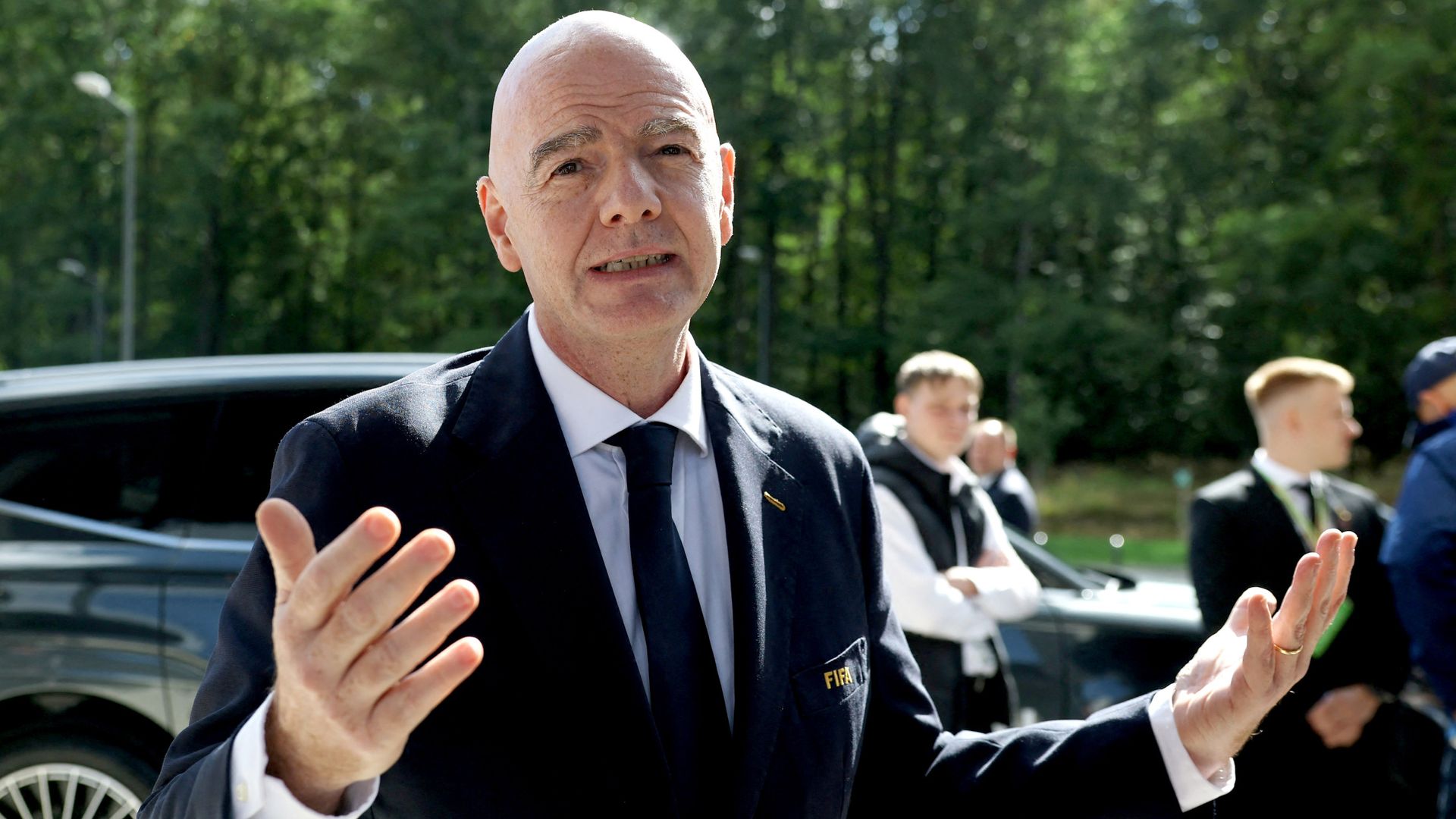
Football managers rarely say the quiet part out loud during international breaks, yet Germany head coach Jurgen Klopp did exactly that before a Nations League match against the Netherlands. Sitting in front of reporters, the former Liverpool and Borussia Dortmund boss looked straight at the state of world football's governing body and dropped a quote that instantly echoed from Zurich to every stadium in Europe.
"We never thought things could get any worse after Sepp Blatter, and yet someone actually managed to make it worse," Klopp said.
That isn't casual press-conference chatter. It's a direct indictment of FIFA president Gianni Infantino, delivered right as the governing body hurtles toward a contentious presidential election in March 2027. Most coverage treats Klopp's remarks as another celebrity coach venting about fixture congestion. It goes much deeper than match schedules. Klopp is pointing directly at a fundamental shift in how football is governed—and who actually owns the game.
What Jurgen Klopp Actually Said About FIFA Leadership
To understand why Klopp's words landed so hard, you have to look at the exact context of his remarks. Speaking in mid-November ahead of Germany's clash with the Netherlands—and just days before the formal deadline for candidates to declare against Infantino—Klopp didn't hedge or hide behind diplomatic phrasing.
He framed his criticism around a growing consensus inside the sport. "My opinion is now quite firm that a change would make a lot of sense," Klopp told journalists. He then went a step further, questioning the motives of the people currently steering the ship. According to Klopp, football desperately needs leaders "who care deeply about the future of football and who don't have any financial interests at stake". If people like that stepped forward and one of them took the presidency, he argued, it would be "absolutely helpful".
Notice what he didn't do. Klopp didn't endorse a specific politician. When asked about former Arsenal manager Arsene Wenger—whose name had circulated in European football circles before Wenger reportedly stepped back from running—Klopp simply noted that Wenger is "a good man," while admitting he couldn't say whether the Frenchman would ever enter that arena. Klopp's target wasn't endorsing a friend. His target was an institutional culture that treats the world's most popular sport like a private equity asset.
Why Comparing Infantino to Sepp Blatter Is Such a Big Deal
In football politics, Sepp Blatter is the ultimate benchmark for institutional disgrace. Blatter resigned in 2015 amid a sprawling corruption investigation that saw federal prosecutors indict top officials and FIFA's own ethics committee ban him from the sport. Though a Swiss court later acquitted Blatter in a separate criminal trial over a two-million-Swiss-franc payment to Michel Platini, his name remains shorthand for backroom deals and regulatory decay.
When Gianni Infantino was elected in February 2016, he campaigned explicitly as the reformer who would clean up Blatter's mess and restore trust. Ten years later, Klopp is arguing that the cure has become worse than the disease.
Why would an experienced manager make that comparison? Because Blatter's era was defined by traditional organizational corruption—bribes for hosting rights, opaque kickbacks, and personal patronage—whereas Infantino's critics see something far more permanent and structural. Under Blatter, the scandals were illegal deviations from the rules. Under Infantino, critics argue, the rules themselves are being rewritten to permanently hand control of football's crown jewels to outside financiers.
The $20 Billion World Cup Sell-Off That Triggered the Backlash
You can't separate Klopp's anger from the biggest crisis of Infantino's presidency. In July 2026, FIFA attempted to push through a plan called FIFA Forward Enterprise. The proposal was straightforward on paper and explosive in practice: FIFA wanted to spin off a new commercial entity holding competition rights—including the World Cup—and sell a 20% stake to private investors to raise roughly $4.2 billion against a $20 billion valuation.
Then came the details that nearly tore the organization apart.
Leaked internal FIFA memos revealed that the proposed contract with private investors wasn't a short-term sponsorship deal. It was structured to bind football's flagship tournaments to private equity firms for up to 96 years. Even worse, when European, North American, and Asian federations pushed back against mortgaging nearly a century of World Cup revenue, Infantino reportedly issued an ultimatum warning member associations they risked losing 75% of a massive funding package if they blocked the deal.
The revolt was swift enough that Infantino had to scrap the plan and offer a rare apology at a FIFA Council meeting. Yet the damage was done. For coaches like Klopp, who watch players break down from expanded tournament calendars while administrators try to sell off 96-year stakes in the World Cup, the message was unmistakable. The governing body was no longer acting as a custodian of the game. It was acting like a distressed-asset brokerage.
Add in controversies like FIFA's sudden mid-tournament decision to overturn U.S. striker Folarin Balogun's World Cup suspension earlier in the year, and a clear pattern emerges. Decisions at the top look increasingly arbitrary, commercially driven, and detached from competitive integrity.
Why Football Insiders Have Stayed Quiet Until Now
If so many people inside football share Klopp's frustration, why haven't more active coaches and federation bosses spoken up?
It comes down to money and dependency. Over the past decade, Infantino has mastered the art of distributing FIFA's cash reserves directly to the 211 member associations. When he took office in 2016, a typical national federation received roughly $250,000 per year—or $1 million over a four-year World Cup cycle. Heading into the 2027 cycle, that payout has ballooned to $25 million per association over four years.
For smaller federations across Africa, Asia, the Caribbean, and Oceania, those funds pay for youth academies, stadium lighting, travel, and staff salaries. Opposing the incumbent president means risking political isolation—or watching development grants dry up. Even Confederation of African Football president Patrice Motsepe openly praised Infantino's financial loyalty in late November, pointing directly to that $25 million four-year guarantee as proof of a "proven track record".
That financial leverage explains why club and national team managers usually bite their tongues. Klopp, however, occupies a rare position. He has already conquered club football with Borussia Dortmund and Liverpool, holds immense moral authority with fans worldwide, and doesn't rely on FIFA development grants to keep his job. When he calls for leaders "who don't have any financial interests at stake," he is calling out the exact patronage system that keeps Infantino insulated from criticism.
Who Is Actually Running Against Infantino in March 2027
Klopp's intervention landed just days before FIFA confirmed the official slate of candidates for the March 2027 presidential election. For the first time since Infantino consolidated power, he actually faces contested opposition rather than an unopposed coronation.
Two challengers have officially entered the race:
- Philippe Diallo: The president of the French Football Federation stepped forward with quiet backing from European football circles after UEFA president Aleksander Ceferin and Paris Saint-Germain chief Nasser Al-Khelaifi ruled themselves out. Diallo represents the traditional European administrative establishment—an insider trying to pull FIFA back from reckless commercialization.
- Kohzo Tashima: The veteran Japanese football executive and former JFA president brings deep experience in Asian football governance and FIFA Council committees. His candidacy signals that discontent isn't limited to Europe, especially following friction between Infantino and several Asian football chiefs.
Still, unseating Infantino remains a steep uphill climb. Because every one of FIFA's 211 member associations gets a single equal vote—meaning Montserrat or Djibouti carries the exact same weight as Germany or Brazil—Infantino's $25 million-per-federation war chest gives him a massive structural advantage. When Diallo visited the Confederation of African Football assembly in Abuja in late November to introduce himself, he wasn't even given a formal slot to address the congress.
What You Should Watch Before the FIFA Vote
Klopp's outburst won't magically rewrite FIFA's voting math, and pretending otherwise ignores how sports politics actually works. What it does do is shatter the illusion of unanimity that Infantino relies on whenever he claims to speak for "all of football".
If you care about where the global game is heading over the next four years, keep an eye on three specific developments leading up to March 2027:
- Legal challenges to Infantino's term limits: Watch whether European federations follow through on pushing a case to the Court of Arbitration for Sport over how Infantino's partial first term (2016–2019) is counted under FIFA's twelve-year term-limit rules. A ruling against him would upend the race overnight.
- Whether Tashima and Diallo consolidate: With two opposition candidates splitting the anti-incumbent vote, pay attention to whether Kohzo Tashima eventually withdraws to throw his weight behind Philippe Diallo in a straight one-on-one contest.
- Resurrection of private equity deals: Even though FIFA Forward Enterprise was shelved in July, watch the fine print of FIFA's financial reports. If Infantino wins a fourth mandate, expect revised attempts to bring outside investors into club or international competitions.
Pay attention to how your own national football association votes when March arrives—because every federation president will have to choose between short-term cash payouts and the long-term independence of the sport.