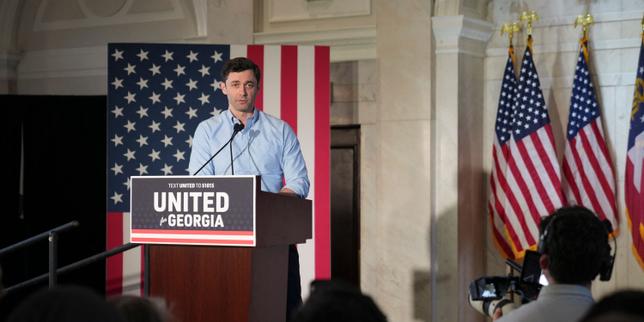
In the November 2026 midterm elections, Democratic Senator Jon Ossoff won re-election in Georgia, securing a full second term in a state that remains one of the most fiercely contested battlegrounds in American politics. That victory immediately vaulted the 39-year-old lawmaker into the top tier of contenders for the 2028 Democratic presidential nomination. While national pundits spent the past two years treating Georgia as a political coin flip, Ossoff’s campaign executed a localized, discipline-heavy strategy that withstood traditional midterm headwinds and proved he can build a winning coalition across urban, suburban, and rural divides.
The conventional wisdom in Washington had largely written off Democratic chances in swing-state Senate races during a cycle expected to punish the party in power. History rarely favors incumbent senators from the sitting president's party during midterms. Yet Ossoff did not merely survive the cycle. He outperformed expectations by decoupling his personal brand from national partisan noise and focusing relentlessly on granular, state-level economic and infrastructure issues. You might also find this related article useful: Inside the Post-Midterm Press Room How Trump Reframed Republican Losses Before the Cameras.
The Anatomy of a Battleground Survival
To understand how Ossoff held Georgia in 2026, you have to look past the cable news chyrons and examine the precinct-level mechanics of the state. Georgia is no longer a monolithic red state, nor has it transformed into a reliable blue stronghold. It is a hyper-elastic electoral environment where margins are measured in tens of thousands of votes and turnout operations dictate everything.
Ossoff’s team recognized early on that nationalizing the race would be fatal. Rather than campaigning on broad ideological abstractions, the senator spent the bulk of his first term and his 2026 campaign cycle embedded in local chambers of commerce, agricultural hubs, and logistics corridors. He leaned heavily into tangible legislative deliverables—specifically federal investments tied to the CHIPS and Science Act and the Bipartisan Infrastructure Law that funneled billions of dollars into Georgia’s electric vehicle battery plants, solar manufacturing facilities, and the Port of Savannah. As extensively documented in recent reports by The Washington Post, the results are significant.
Money mattered. And Ossoff had plenty of it. Building on the massive small-dollar fundraising apparatus he constructed during his 2020-2021 runoff campaign, Ossoff entered the final stretch of the 2026 cycle with a war chest that allowed him to dominate the airwaves across every media market in the state, from Atlanta to Macon, Augusta, and Albany.
This financial advantage enabled a dual-track messaging strategy. In the metro Atlanta suburbs—counties like Cobb, Gwinnett, and Fayette—the campaign emphasized institutional stability, reproductive rights, and economic modernization. In rural South Georgia, the messaging shifted entirely to agricultural subsidies, rural broadband expansion, and maternal healthcare access. The goal was never to win deep-red counties outright. The goal was to shave five to seven percentage points off the Republican margins in rural areas while maximizing turnout in the urban core.
Cracking the Suburban Ceiling
Suburban voters in Georgia have grown increasingly skeptical of political extremism, yet they remain deeply sensitive to inflation, interest rates, and the cost of living. Republican strategists spent tens of millions of dollars attempting to tie Ossoff to every economic anxiety felt by middle-class families in North Fulton and Cherokee counties.
It did not stick. Ossoff countered by positioning himself as an investigative watchdog—a nod to his background as a documentary filmmaker and investigative journalist. Throughout his tenure on the Senate Homeland Security and Governmental Affairs Committee, he led high-profile inquiries into federal prison conditions, military housing failures, and supply chain vulnerabilities. By framing himself as an auditor of government waste rather than a traditional partisan warrior, he neutralized the standard Republican attacks against big-government spending.
Why Georgia Is the Ultimate Presidential Proving Ground
Winning a Senate seat in California, New York, or Illinois proves very little about a candidate's viability in a general election. Those states are structural lockboxes for the Democratic Party. Winning twice in Georgia—once in a high-turnout presidential runoff and again in a difficult midterm environment—is an entirely different credential.
The demographic composition of Georgia mirrors the exact coalition any Democrat must assemble to win the Electoral College in 2028. A successful statewide candidate in Georgia must simultaneously inspire high turnout among Black voters, appeal to college-educated suburban moderates, engage a rapidly growing Asian American and Hispanic electorate, and remain culturally fluent enough not to alienate working-class rural voters.
Ossoff has now demonstrated that he can hold that fragile coalition together under immense pressure. That track record gives him an immediate structural advantage over potential 2028 rivals from safely blue states, such as California Governor Gavin Newsom or Illinois Governor JB Pritzker. When Democratic primary voters inevitably ask the central question of every nomination fight—who can actually win the swing states—Ossoff has empirical proof rather than theoretical polling.
The Generational Contrast
Age has become one of the most potent, unspoken variables in American politics. After years of gerontocratic leadership at the top of both parties, voters across the ideological spectrum have signaled an acute fatigue with octogenarian politicians.
Born in 1987, Ossoff represents a clean generational break. If he runs in 2028, he will be 41 years old—younger than John F. Kennedy and Barack Obama were when they entered the White House. That youth is not merely a biographical footnote; it alters how he communicates. Ossoff is fluent in digital media ecosystems, comfortable in long-form unscripted interviews, and capable of projecting energy without relying on the tired rhetorical cadences of 20th-century politics.
Yet youth cuts both ways. Critics within his own party have occasionally questioned whether he possesses the deep foreign policy gravitas or executive management experience required for the presidency. Serving in the Senate is fundamentally different from running a state government or a federal agency. Governors have to balance budgets, manage emergencies, and oversee massive bureaucracies. Senators cast votes and hold hearings.
The Structural Vulnerabilities Ahead
Elevating Ossoff to presidential frontrunner status requires an honest assessment of his vulnerabilities. A Senate victory in Georgia, however impressive, does not guarantee smooth sailing in a national Democratic primary.
First, there is the ideological friction within the Democratic Party itself. To win Georgia, Ossoff had to govern and campaign as a pragmatic moderate. He avoided the maximalist slogans of the progressive wing, maintained strong ties with the business community, and occasionally broke with party orthodoxy on regulatory and trade issues. While that positioning is gold in a general election, it can become a liability in a primary electorate dominated by progressive activists in states like Iowa, New Hampshire, and Michigan.
Progressive groups will scrutinize his voting record on corporate taxation, environmental regulations, and foreign policy—particularly his nuanced, often cautious approach to Middle East diplomacy. Ossoff will have to prove to the party's left flank that his moderation is a tactical necessity for winning tough states rather than a lack of core conviction.
Second, there is the question of charisma versus competence. Ossoff is widely respected in Washington as disciplined, intelligent, and relentlessly prepared. He rarely makes unforced errors on the campaign trail. However, disciplined competence does not always translate into the kind of visceral, movement-building enthusiasm that propels dark-horse candidates through a crowded primary field.
Consider a hypothetical scenario during a 2028 primary debate in Detroit or Las Vegas. If Ossoff is sharing a stage with fiery populist orators who speak in sweeping moral imperatives, his measured, analytical style could risk coming across as overly rehearsed or bloodless. Voters want competence in the Oval Office, but they often demand inspiration during the primaries.
The Crowded 2028 Field and the Southern Firewall
If Ossoff decides to enter the 2028 presidential race, he will not have the field to himself. The Democratic bench is deep, ambitious, and eager to claim the post-2024 mantle. Alongside governors like Newsom, Pritzker, Gretchen Whitmer of Michigan, and Josh Shapiro of Pennsylvania, Ossoff will likely face competition from his own Georgia colleague, Senator Raphael Warnock, should Warnock choose to run, as well as figures like Transportation Secretary Pete Buttigieg.
In that crowded environment, Ossoff’s primary strategic asset is the Southern Firewall.
In recent Democratic primary cycles, the early nominating contests have increasingly centered on states with large Black electorates, particularly South Carolina and Georgia. A candidate who cannot win Black voters cannot win the Democratic nomination. Period.
Ossoff’s deep institutional ties to Georgia’s Black political establishment—forged through his early career working for civil rights icon John Lewis and strengthened through two statewide victories powered by Black voter turnout—give him a natural base of support in the South. If South Carolina and Georgia hold early spots on the 2028 primary calendar, Ossoff could theoretically sweep the Southern primaries, starve his rivals of delegates and media oxygen, and lock down the nomination before the race even reaches the West Coast.
The Senate Seat Dilemma
Running for president while holding a newly won Senate seat in a swing state carries immense political risk for the Democratic Party as a whole. Under Georgia law, if a sitting U.S. senator resigns to become president, the sitting governor appoints a temporary replacement until a special election can be held.
Depending on the outcome of Georgia's 2026 gubernatorial race, vacating that Senate seat could hand the Republicans a free pickup in the upper chamber, potentially flipping the balance of power in Washington. Democratic primary voters are notoriously strategic; they are hyper-aware of Senate math. Before throwing their weight behind Ossoff for president, party insiders and donors will demand assurance that a presidential run would not inadvertently hand the Senate majority back to the GOP.
What the 2026 Georgia Result Actually Tells Us
Strip away the horse-race speculation for a moment, and the 2026 Georgia Senate race offers a sobering lesson for political operatives in both parties. The era of sweeping, uniform national wave elections is fracturing. Voters are increasingly differentiating between national party brands and individual candidates who demonstrate genuine local utility.
Ossoff won because he treated governing as a series of verifiable deliverables rather than an endless performance on social media. He brought factories to rural counties, fixed broken federal oversight mechanisms, and refused to let national pundits dictate his local campaign strategy.
Whether Jon Ossoff ultimately decides to launch a presidential bid in 2027 or chooses to consolidate his power in the Senate, his 2026 victory has permanently altered the Democratic Party's strategic calculus. Any Democrat hoping to win the White House in 2028 will have to copy his Georgia blueprint—or figure out how to beat the man who wrote it.