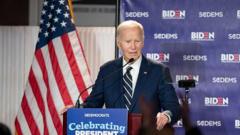
Joe Biden just sued the Justice Department. He wants to stop the government from releasing roughly 70 hours of audio and transcripts. These aren't official state recordings. They are highly personal, intimate kitchen-table tapes recorded back in 2016 and 2017 by his ghostwriter, Mark Zwonitzer, while working on the memoir Promise Me, Dad.
The Department of Justice, now operating under the Trump administration, recently made a quiet U-turn. It notified Biden that it plans to hand the full collection over to the Republican-led House Judiciary Committee and the conservative Heritage Foundation on June 15. Biden's legal team is trying to slam the brakes on that handoff.
This legal battle isn't just a minor squabble over old archives. It cuts straight to the core of personal privacy versus public disclosure. If you think this is just a repeat of the 2024 executive privilege fight over Robert Hur’s interview tapes, you're missing the bigger picture. This new lawsuit focuses on entirely different recordings that were swept up in a criminal investigation.
The Ghostwriter Tapes at the Center of the Storm
To understand why Biden is fighting so hard, you have to look at what these tapes actually are. They aren't formal government logs or official transcripts.
Between 2016 and 2017, right after his vice presidency ended, Biden sat down in his private Delaware home with Zwonitzer. They talked for dozens of hours. The resulting book, Promise Me, Dad, dealt heavily with the agonizing death of his eldest son, Beau Biden, from brain cancer. The recordings contain raw, emotional, and deeply personal family reflections.
Then came the special counsel investigation. In 2023, Attorney General Merrick Garland appointed Robert Hur to investigate classified documents discovered at Biden’s Delaware home and the Penn Biden Center. As part of that criminal probe, Hur’s team subpoenaed and obtained the 70 hours of audio files from Zwonitzer to see if Biden had read classified notes aloud to his writer.
Hur’s final 345-page report dropped in February 2024. He declined to recommend criminal charges, famously describing Biden as a "sympathetic, well-meaning, elderly man with a poor memory." But Hur also claimed Biden had shared some classified snippets with his ghostwriter. Biden vehemently denied doing so.
Now, those underlying investigative files are the target of Freedom of Information Act (FOIA) requests and congressional demands.
Why the DOJ Shifted Its Position
The real twist in this case is the Justice Department’s sudden change of heart.
Under Biden's own presidency, the DOJ spent months fighting the Heritage Foundation and House Republicans in court to keep these tapes private. Government lawyers explicitly argued that releasing the audio would be a severe, unwarranted invasion of Biden’s personal privacy. They maintained that the files were exempt under federal public records laws.
Everything flipped in early 2026. According to the lawsuit filed in the U.S. District Court for the District of Columbia, the DOJ under the new administration notified Biden’s legal team in February 2026 that it was abandoning its defense. It decided to release the records, with minor redactions, to both Congress and conservative activists.
Biden’s attorney, Amy Jeffress, pulled no punches in the complaint. She accused the department of an abrupt, unexplained "about-face" that throws out standard legal protections.
"Every American, including a sitting or former Vice President, has a right to privacy in the personal conversations he has within his own home," Biden's legal team stated in the filing. "And when the U.S. Department of Justice obtains that private information through a criminal investigation, the Department bears a particular responsibility to protect it from disclosure."
The Legal Argument Over FOIA Exemptions
Can the government just give away private diaries or book interview tapes because they were looked at during an investigation? That’s the big legal question.
Biden’s team argues that cooperating with a federal investigation shouldn't mean you forfeit your basic privacy rights forever. Biden handed over the tapes voluntarily to prove he didn't intentionally compromise state secrets. His spokespeople emphasize that he did so on the explicit condition that the material would remain confidential.
Legally, FOIA Exemption 6 and Exemption 7(C) are designed to protect personal privacy in law enforcement records. Usually, the government hides the names and private details of people mentioned in investigative files. Biden’s lawyers say the House Judiciary Committee's request is purely political and shouldn't override those standard statutory exemptions.
Republicans see it differently. They argue that the public has a right to know exactly what the special counsel looked at. They want to check if the DOJ gave Biden a free pass compared to Donald Trump, whose own classified documents case in Florida was dismissed by Judge Aileen Cannon.
What Happens Next
The clock is ticking loudly on this case. The Justice Department set a hard deadline of June 15 to release the files.
Biden’s legal team is moving quickly to get a federal judge to issue an injunction. If the court blocks the release, the tapes remain under lock and key while the broader lawsuit plays out. If the judge refuses to step in, 70 hours of raw, unedited audio of the former president talking about his family, his grief, and his political career will become public property overnight.
Watch the federal court docket in Washington over the next two weeks. Biden's lawyers must successfully argue that the immediate privacy damage is irreversible to secure a temporary restraining order. If you want to track how this wraps up, keep a close eye on whether the judge grants an emergency hearing before the June 15 deadline.


