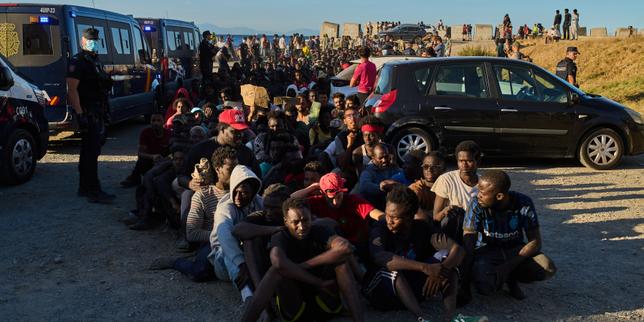
The sea smells of salt, exhaust fumes, and an old, restless history.
Standing on the high concrete of the promenade, you can almost reach out and touch the other side. Spain is right there. A faint blur of white buildings, distant cranes, and the heavy pulse of European highways. Yet between here and there lies a paradox carved into stone, wire, and sovereign pride. Ceuta is a European footprint planted firmly on African soil, a tiny enclave where two continents stare each other down across a razor-thin border of fences and guard posts.
I remember the dust stinging my eyes during a midday windstorm a few summers ago, watching a line of trucks idle for hours under the merciless Mediterranean sun. Drivers slept against steering wheels. Fresh produce slowly warmed in refrigerated trailers. Commerce, patience, and human lives all suspended in a bureaucratic purgatory.
To understand what is happening now, you have to look beyond the dry diplomatic cables traded between Rabat and Brussels. You have to look at the people caught in the machinery.
Look at a man like Tariq. (This is a composite portrait based on interviews with cross-border workers and local traders.) Every morning before dawn, Tariq leaves his modest apartment in Tetouan. He is a skilled mechanic, but his livelihood depends entirely on the porous, highly contested economic gravity of the border towns. For years, thousands like him crossed daily to work, trade, and sustain a delicate micro-economy that kept two distinct worlds breathing together.
Then the rules shifted.
Fences grew higher. Surveillance cameras multiplied. Restrictions tightened under the heavy hand of European security policies designed to stem migration flows. But in sealing the cracks against desperate migration, European policymakers inadvertently built a wall through the heart of legitimate regional commerce.
When borders become choke points, everyone suffocates.
Recently, the diplomatic friction reached a boiling point. The government in Morocco issued a direct, urgent call to the European Union. Stop crippling our development. The phrase sounds clinical on paper. In reality, it is a cry of frustration from a nation trying to modernize, build industries, and lift millions out of generational economic vulnerability, while tethered to a northern neighbor that often views its southern partner solely through the lens of border control.
Consider the sheer weight of what is at stake.
Trade is not just numbers on a spreadsheet compiled by bureaucrats in Brussels or Rabat. Trade is the refrigeration truck carrying fresh tomatoes from the fertile Souss Valley to European supermarkets. It is the textile worker whose wages pay for her daughter's university tuition. It is the startup founder in Casablanca trying to secure venture capital from Madrid or Paris, only to find his passport subjected to endless administrative delays that signal distrust rather than partnership.
Europe often preaches integration while practicing exclusion.
The European Union remains Morocco's primary economic partner. Billions in goods flow across the Mediterranean annually. Yet, this partnership is frequently strained by an asymmetrical dynamic. Europe demands strict compliance on security, counter-terrorism, and migration containment. It expects Morocco to act as an effective southern gendarme. Yet, when it comes to granting reciprocal mobility, trade flexibilities, and economic support that honors Morocco’s sovereignty and development goals, the doors suddenly feel very heavy.
Development cannot thrive in an atmosphere of constant suspicion.
When the EU treats its southern neighborhood merely as a buffer zone against crisis, it creates new crises of its own. By imposing restrictive visa regimes, bureaucratic red tape, and subtle economic penalties disguised as regulatory compliance, Europe risks alienating the very demographic it needs most: a young, educated, ambitious Moroccan population that wants to build a future at home, provided they are given a fair playing field.
The Moroccan leadership’s message is clear. Partnership cannot be a one-way street built on containment. It must be built on co-development.
Think about what happens when a regional economy is artificially held back. Talent drains northward. Hope dwindles. Young people look at the choppy waters of the Mediterranean not as a vacation destination, but as a desperate gamble for survival. If you choke off legitimate commerce, informal smuggling and desperate crossings fill the vacuum. You cannot wall off poverty and expect prosperity to flourish on the other side. The prosperity of Europe and North Africa is an entangled root system. Pull too hard on one side, and the whole tree trembles.
There is a better path forward, though it requires a profound shift in perspective.
European leaders must stop viewing Morocco exclusively through the panic-tinted glasses of the migration debate. They need to see a nation of vibrant tech hubs, renewable energy pioneers, and industrial powerhouses that are rapidly reshaping the African continent. Morocco is not just a neighbor to manage; it is a vital engine of regional stability and economic innovation.
Back at the border fence near Ceuta, the sun begins to dip below the horizon, painting the water in bruised shades of violet and orange.
The trucks are still there, engines humming softly in the twilight. A customs official stamps another passport with a heavy, rhythmic thud. Behind the paperwork and the political posturing, millions of human beings are simply waiting for permission to thrive.
The iron gates remain locked for now. But history suggests that walls built against the current of human ambition never hold forever. The only real question is how much potential we are willing to waste before we finally decide to open the road.