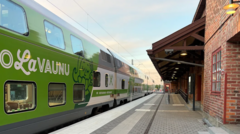
Snow does not fall so much as it occupies the air. It hangs there in the gray twilight of a December afternoon in northern Scandinavia, blurring the boundary between the frozen earth and the bruised sky until geography becomes a matter of pure faith.
For decades, if you wanted to cross from the Finnish timber town of Haparanda-Tornio over into Sweden by train, you hit an invisible wall.
Not a physical barrier of concrete and razor wire, but something more bureaucratic and stubborn: a break in the tracks. Steel stopped. Passengers grabbed their luggage. Boots crunched across a chilly asphalt parking lot, breathing out white plumes of exhaustion, just to board a second train on the other side.
Borders are rarely kind to momentum.
Listen. The silence of the Arctic night is heavy. It smells of pine smoke, wet wool, and the bitter tang of iron tasting the frost. For nearly thirty years, that silence was punctuated by the clumsy shuffle of commuters hauling suitcases through the slush. It was an absurdity born of history. Finland ran on Russian-gauge tracks, slightly wider to match the imperial ambitions of the tsars. Sweden ran on standard European gauge. Two nations, touching shoulders at the top of the world, separated by four inches of iron width.
That petty mathematical discrepancy shaped lives.
Imagine Henrik, a hypothetical software engineer whose roots sprawl messily across both sides of the border. His grandmother lives in a modest yellow house in Kemi, smelling eternally of cardamom buns and woodsmoke. His girlfriend works an architectural firm in Luleå. To eat Sunday dinner with the former and sleep beside the latter required a logistical gymnastics routine that could break a weaker spirit. Bus schedules that missed each other by minutes. Taxis that cost a small fortune. Hours bled away in waiting rooms heated by stubborn radiators that ticked like metronomes.
Henrik did not curse the map out loud. He just sighed a lot, staring out frosted windows at birch trees shivering in the dark.
Borders are designed to divide. Trains are designed to connect. When these two opposing forces collide, something has to give.
For a long time, nothing did. The European Union kept publishing glossy reports about transnational cohesion. Bureaucrats in Brussels sipped lukewarm espresso and talked about frictionless movement while real human beings stood on freezing platforms in Tornio, watching their breath freeze, wondering why a journey of a few dozen miles felt like an expedition across a continent.
Then came the change.
Quietly. Without the grand ribbon-cutting ceremonies that politicians adore.
Engineers arrived with heavy coats, thermoses of black coffee, and laser-guided levels. They laid down dual-gauge tracks. They recalibrated switches. They bridged a gap that should never have existed in the first place, stitching two estranged rail networks into a single, breathing organism.
Now, a new direct passenger train service connects Finland and Sweden for the first time in decades.
Let that sink in. Decades.
Decades of missed connections. Decades of economic friction, where talent stayed on its own side of the river because crossing it was simply too much trouble.
Consider what happens next.
A student in Oulu can pack a laptop, slide into a warm, wood-accented carriage, and step out in Stockholm before the afternoon coffee goes cold. A family in Boden can decide on a whim to spend the weekend wandering the frozen archipelago of the Gulf of Bothnia without worrying about whether their transit pass works across municipal lines.
The mechanics of it are brilliant in their simplicity. Modern dual-gauge rolling stock does not care about imperial history. It glides across the Tornio River on the restored iron bridge, indifferent to the invisible line slicing through the water below. The wheels hum a steady, rhythmic cadence against the rail. Click-clack. Click-clack. A heartbeat returning to a body that had grown numb in the extremities.
We forget how fragile our modern maps really are. We draw lines with ink and blood, and then we spend generations trying to erase them with concrete and cable.
Travel writers love to talk about the romance of the rails, but true rail romance is rarely about plush velvet seats or vintage dining cars. It is about utility. It is about a grandmother knowing her grandson can visit without taking a day off work. It is about regional economies breathing the same air, sharing the same labor pool, trading ideas faster than the wind can strip leaves from the aspens.
When the first integrated train rolled across the border, the local newspapers reported it as a transit milestone. They quoted transport ministers in sharp suits talking about green corridors and sustainable mobility.
They missed the point entirely.
The real story was happening in row three, seat twelve, where an elderly woman with deep lines around her eyes and a faded wool blanket across her knees watched the snowy taiga blur past her window. She wasn't thinking about carbon emissions or multi-modal transport strategies.
She was just watching the distance between her daughters shrink from an insurmountable chore into a simple afternoon ride.
The train slowed as it pulled into the station, hissing softly as the pneumatic brakes released their burden of compressed air. Steam billowed up, mixing with the falling snow. The doors slid open with a sharp, mechanical chime.
Outside, the wind howled down from the Arctic wastes, sweeping across the empty platform. But inside the carriage, it was warm, quiet, and moving forward.