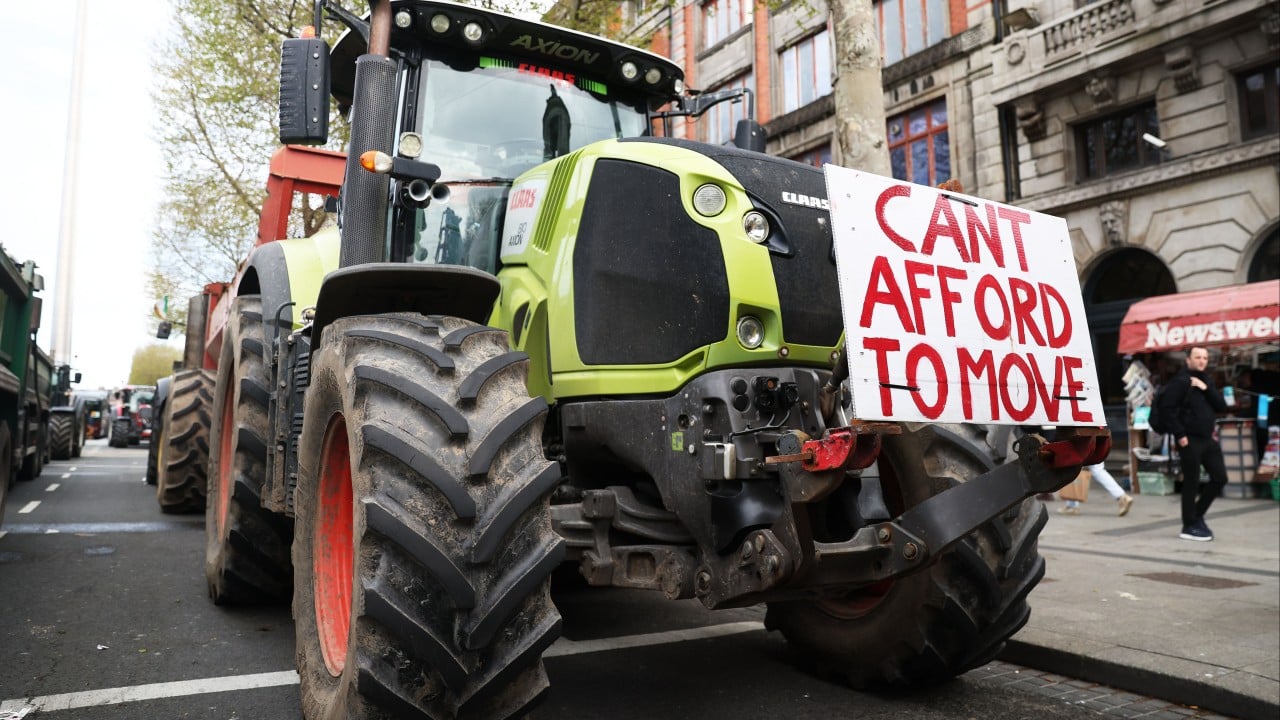
The heavy iron of tractors and the hiss of air brakes finally fell silent on O’Connell Street this morning, not by choice, but under the threat of police tow trucks. After six days of blockades that paralyzed Dublin and pushed Ireland to the edge of a dry-pump crisis, An Garda Síochána moved in to dismantle the "diesel rebellion." While the streets are clearing, the underlying economic rot that sparked this uprising remains, and it is a problem that no amount of police enforcement can solve.
This was never just about the price of a liter of fuel at the forecourt. It was a visceral, unorganized, and desperate response to an existential threat facing the people who actually move the Irish economy. When agricultural contractors like Christopher Duffy and independent hauliers parked their rigs across the M50 and the gates of the Whitegate refinery, they weren't just protesting a spike in prices. They were protesting a mathematical impossibility: the attempt to run a modern, rural-dependent economy on fuel prices that have surged 20% in a single month.
The government’s decision to deploy the Public Order Unit, backed by the looming presence of the Defence Forces, has temporarily restored the flow of fuel. But by using pepper spray and physical force to reopen the Whitegate refinery in County Cork, the state has likely turned a labor dispute into a long-term political grudge.
The Mathematical Breaking Point
The Irish government has spent weeks pointing at the conflict in the Middle East as the sole culprit. It is a convenient shield. While the geopolitical volatility since late February has undoubtedly sent global oil markets into a tailspin, the protesters are looking at their own balance sheets.
For a mid-sized haulage firm or an agricultural contractor, fuel isn't just a line item. It is the lifeblood of the business. When diesel prices fluctuate wildly, fixed-price contracts for moving grain or delivering groceries become suicide notes. The €250 million package announced by the government in March—which included a minor excise duty reduction and a diesel rebate—was effectively swallowed by the market before the ink was even dry.
The protesters demanded a hard cap on fuel prices: roughly €1.10 per liter for green diesel and kerosene. The government calls this "unconscionable" and "illogical." In the cold reality of the boardroom, perhaps it is. But in the cab of a tractor, it is the difference between survival and bankruptcy.
A Rebellion Without Leaders
One of the most striking aspects of this past week has been the absence of the "usual suspects." The Irish Farmers’ Association (IFA) and the Irish Road Haulage Association (IRHA) were notably absent from the front lines. Instead, this was a grassroots movement organized on social media, largely by individuals who felt their official representatives had become too cozy with the halls of power in Leinster House.
This lack of central leadership made the protests incredibly difficult for the state to manage. You cannot negotiate with a hundred different voices on a Telegram group. The government’s refusal to meet with "unrecognized" groups was a tactical move intended to delegitimize the movement, but it only served to harden the resolve of those on the blockades. They didn't want a seat at a committee table; they wanted a reduction in the tax take that accounts for nearly half the price of a liter of fuel.
The Green Transition vs Rural Reality
The Irish government’s long-term strategy is built on a rapid transition away from fossil fuels. Carbon taxes are the primary tool for this shift. However, for a farmer in Roscommon or a trucker in Donegal, there is no "green" alternative sitting in the driveway. The technology for electric heavy-duty machinery and long-haul trucks is either non-existent or prohibitively expensive for the small operator.
To these workers, carbon taxes feel less like an environmental incentive and more like a punitive levy on their existence. The blockade of the Whitegate refinery—Ireland’s only oil refinery—was a symbolic strike at the heart of this tension. By choking off 40% of the country’s fuel processing capability, the protesters showed just how fragile the "old" energy economy still is.
The Carrot and the Heavy Stick
The weekend’s police operations were a calculated gamble. Commissioner Justin Kelly and Justice Minister Jim O’Callaghan shifted from "monitoring" to "enforcement" only when the fuel shortages reached a critical point. With over 500 service stations running dry and emergency services warning of delayed response times, the public mood began to shift.
The government is now attempting a classic "carrot and stick" maneuvers. On one hand, they used the Public Order Unit to clear the streets. On the other, they have called an emergency cabinet meeting to sign off on a new €500 million support package.
This new package is expected to include more aggressive tax cuts and direct aid for the sectors most impacted. It is a massive U-turn for a government that, only days ago, insisted there was "no more money in the pot."
What Comes After the Blockade
While the tractors are heading back to the farms, the resentment is just beginning to simmer. The use of pepper spray on protesters at Whitegate has provided the movement with images of martyrdom that will be shared for months.
The government may have won the battle for the motorways, but they are losing the war for the rural vote. The 56% support for the protesters found in recent polling suggests that the cost-of-living crisis has created a level of solidarity that crosses industry lines. Plumbers, couriers, and small business owners see themselves in the hauliers' struggle.
If the upcoming financial package doesn't provide a permanent mechanism to decouple domestic fuel prices from global volatility—or at least provide a significant buffer for essential industries—the tractors will be back. Next time, they might not be so willing to move just because a tow truck shows up.
The era of quiet compliance with escalating energy costs is over. The Irish state has successfully cleared O'Connell Street, but it has yet to clear the path for a sustainable economic future for its primary producers. The machines are off, but the drivers are still awake.