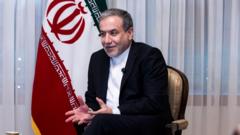
The headlines are screaming about a regional conflagration. Iran is rattling the saber, claiming that if the United Kingdom allows the United States to launch strikes from British sovereign bases—specifically those in Cyprus—it constitutes "participation in aggression." The media treats this like a new era of brinkmanship. They want you to believe we are one takeoff clearance away from a global meltdown.
They are wrong.
The lazy consensus among analysts is that the UK is "trapped" between its "Special Relationship" with Washington and the risk of being dragged into a direct war with Tehran. This narrative assumes that Iran’s threats are credible military warnings. They aren't. They are PR stunts designed for internal consumption and to spook a jittery European public. If you’ve spent any time analyzing the structural realities of Persian Gulf power dynamics, you know that Tehran’s "red lines" are more like suggestions written in disappearing ink.
The Sovereign Base Myth
Most commentators don't even understand the geography of the threat. When Iran warns the UK about "bases," they are primarily looking at RAF Akrotiri in Cyprus. It’s a vital logistics and strike hub. But here is the reality: Iran lacks the conventional reach to reliably strike Cyprus without triggering a NATO-level response that would end the Islamic Republic’s existence in a weekend.
The "participation in aggression" rhetoric is a classic legalistic trap. By framing it this way, Tehran tries to use international law as a shield while simultaneously ignoring it through the use of regional proxies. It’s a cynical play. They want to make the political cost of hosting US assets higher than the military benefit.
I’ve watched Western governments blink at these threats before. It’s a mistake every single time. When you treat a bluff as a legitimate threat, you grant the adversary the power they haven't earned. The UK isn't "participating" in aggression; it is maintaining the infrastructure of a global security architecture that Iran has spent decades trying to dismantle from the shadows.
Logic of the Proxy Coward
Let’s dismantle the idea that Iran wants a direct fight. If Tehran were truly ready to treat British base usage as an act of war, they wouldn't be sending letters or making televised speeches. They would be activating the IRGC-QF (Islamic Revolutionary Guard Corps - Quds Force) to hit the logistics chain.
The fact that they are talking instead of shooting proves they are terrified.
The Iranian regime’s survival is their only true North Star. A direct strike on a British sovereign base—which would be an attack on the UK itself—is the one thing that guarantees a full-scale Western intervention. They know this. We know this. But the "experts" on cable news love the drama of a "ticking clock" scenario.
Why the "Risk of Escalation" Argument is Flawed
- The Asymmetry of Pain: The UK and US can absorb economic shocks. The Iranian regime, already leaning on a crumbling economy and a restless, young population, cannot absorb a total blockade or the destruction of its oil infrastructure.
- The Proxy Buffer: Iran uses the Houthis, Hezbollah, and PMF groups precisely because it cannot afford to be the one pulling the trigger. The moment they threaten a state directly for hosting an ally, they lose the "plausible deniability" that is the cornerstone of their entire foreign policy.
- Hardware vs. Hype: The UK’s Type 45 destroyers and the US carrier strike groups are not just there for show. Iran’s "swarm" tactics are effective against commercial tankers, but they are a suicide mission against a coordinated carrier group defense.
The Business of Fear
Follow the money. Who benefits when the UK is portrayed as a vulnerable "accomplice"? It isn't the British taxpayer. It’s the oil speculators and the defense contractors who thrive on "instability premiums."
If you are a CEO or an investor looking at the Middle East, you shouldn't be asking "Will Iran strike RAF Akrotiri?" You should be asking "Why is the West allowing Tehran to dictate the terms of engagement through rhetoric alone?"
The "laziness" in the current reporting comes from a refusal to acknowledge that the UK’s involvement is actually a de-escalation tool. By providing the US with stable, sovereign launch points, the UK ensures that any military response is precise, intelligence-led, and rapid. This prevents the "slow-burn" wars that actually destroy regional markets.
The Cyprus Connection: A Strategic Masterstroke
RAF Akrotiri and Dhekelia aren't just patches of sand. They are "Sovereign Base Areas." This is a nuance the competitor article missed entirely. These are not leased land like a typical US base in Germany. They are British Overseas Territories.
When Iran threatens these bases, they aren't just threatening a military operation; they are threatening a territorial invasion of the United Kingdom. It is the equivalent of threatening to bomb Portsmouth or Manchester.
Is the Iranian leadership suicidal? No. They are survivors. They are masters of the "gray zone"—the space between peace and total war. By shouting about "participation in aggression," they are trying to widen that gray zone to include the UK’s domestic politics. They want the British public to protest, to fear, and to demand a withdrawal.
Stop Asking if We Are at War
The most common question people ask is: "Are we on the verge of World War III?"
It’s the wrong question. It’s a headline-grabbing, low-IQ question.
We have been in a state of hybrid warfare with Iran for decades. From the 1983 Beirut barracks bombing to the modern-day Houthi attacks on Red Sea shipping, the "war" is already happening. The use of British bases isn't a "new" escalation; it’s a necessary tactical adjustment to a conflict that Tehran started long ago.
The real question is: Why are we still pretending that Iran's "warnings" carry moral or legal weight?
We have seen this movie before. In 1988, during Operation Praying Mantis, the US Navy destroyed half of Iran's operational fleet in a single day after a mine hit the USS Samuel B. Roberts. What was the Iranian response? They backed down. They always back down when met with overwhelming, credible force.
The UK letting the US use its bases isn't "inviting" an attack. It is the only way to prevent one. Weakness is the ultimate provocateur. If the UK were to buckle and deny the US access, it would signal to Tehran that their bullying works. That would lead to more aggression, not less.
The Hard Truth About "Diplomacy"
Diplomacy without the credible threat of force is just a slow-motion surrender. The UK’s role as a "force multiplier" for the US is what keeps the shipping lanes open. If you enjoy the fact that your electronics, fuel, and grain aren't three times the price they were last week, you should be thanking the planners at RAF Akrotiri, not criticizing them.
The competitor article frames this as a risky gamble. I frame it as a mandatory insurance policy.
The Iranian regime is a rational actor focused on self-preservation. They will bluster, they will fund a few more drone strikes by their proxies, and they will claim "moral victory" in their state-run media. But they will not touch a British base. They know that the moment they do, the gray zone disappears, and the full weight of the West’s combined technological and military superiority lands on their doorstep.
Stop reading the fear-mongering scripts. The UK isn't "participating in aggression." It is enforcing a reality that Tehran is desperate to escape: the era of the proxy bully is ending.
If you’re waiting for the "inevitable" Iranian retaliation against British soil, don't hold your breath. You’ll be waiting forever. Tehran knows exactly where the line is, and they have zero intention of crossing it. They just want to see if you’re stupid enough to believe they will.
Don't be.
Stop treating the bully's manifesto like a strategic white paper.
The bases stay open. The planes keep flying. And the regime in Tehran stays exactly where it is: behind a microphone, shouting into the void, terrified of the day the West finally stops listening.
Move on.