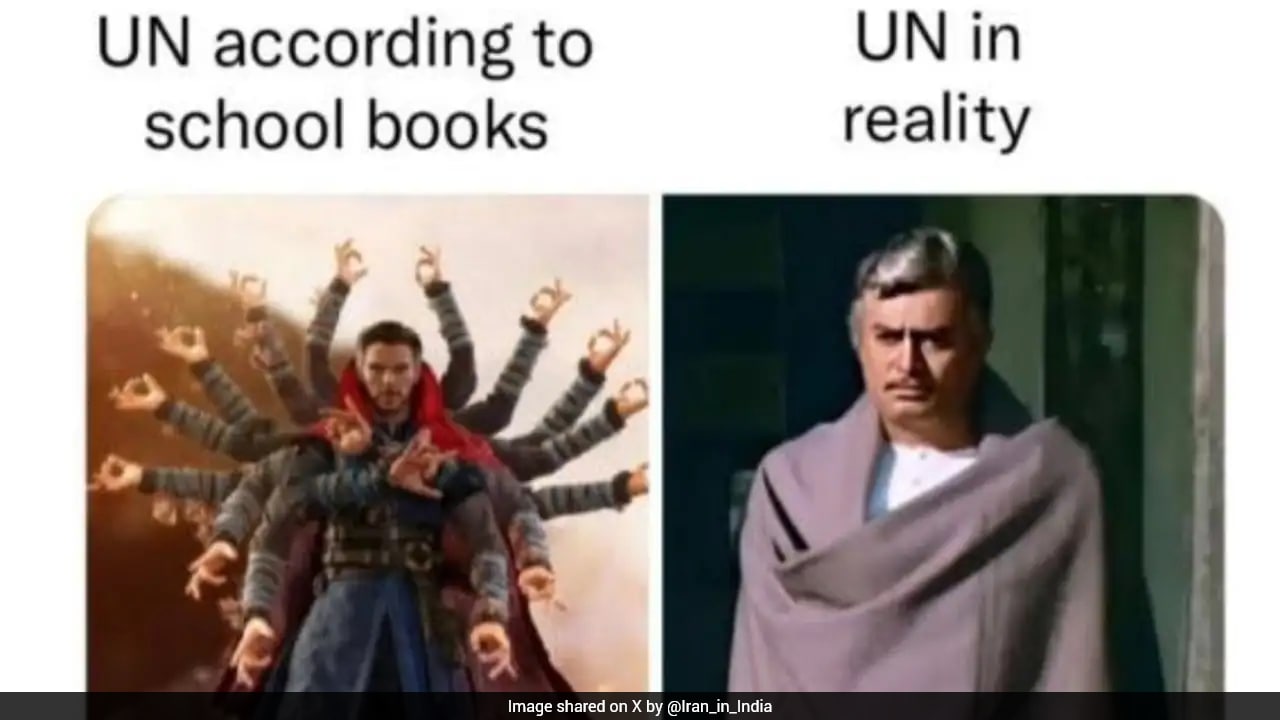
International diplomacy has officially entered the shitposting era. When a government delegation turns to Bollywood classics and Marvel blockbusters to mock the United Nations, you know the script has flipped. Iran recently used a bizarre mashup featuring Thakur from the legendary 1957 Hindi film Sholay and Doctor Strange from the Marvel Cinematic Universe to ridicule the UN Security Council. It sounds like fever-dream internet fiction, but it's entirely real.
You're probably wondering how a classic Bollywood tragedy about a retired police officer losing his arms intersects with mystical Marvel sorcery in an official geopolitical statement. That's the exact trap most mainstream coverage falls into—treating it as a quirky viral moment without looking at the underlying messaging. Let's break down what actually happened, why digital satire is replacing traditional statecraft, and what this weird cultural crossover tells us about modern global power dynamics.
The Viral Weaponization of Pop Culture
State-sponsored propaganda used to look stiff. You'd get a somber man in a suit standing behind a mahogany podium, reading dry talking points off a teleprompter while translators droned in the background. Those days are dead. Modern state media arms divisions know that an algorithm doesn't care about diplomatic decorum. It cares about engagement.
By combining the iconic imagery of Sholay—where the villain Gabbar Singh chops off Thakur's arms—with Doctor Strange's multidimensional hand gestures, the Iranian digital campaign hit a very specific nerve. The visual metaphor was blunt: the United Nations is rendered powerless, missing its arms, completely unable to act or defend itself against real-world crises.
It's absurd, sure. But it's effective. Millions of people who would never read a twenty-page UN resolution watched, shared, and debated a meme combining a 1970s Bollywood revenge drama with Hollywood superhero lore. When global institutions lose their monopoly on gravity, satire fills the vacuum.
Why Sholay and Doctor Strange Made It Into Geopolitics
You don't just pull Sholay out of a hat. The film is a cultural touchstone across South Asia and parts of the Middle East, symbolizing vengeance, institutional failure, and justice outside the law. When foreign state accounts tap into Bollywood imagery, they're playing a calculated localization game. They want regional resonance packaged inside globally
Why Iran Mocking the UN With Sholay and Doctor Strange Broke Internet Culture
entertainment
Geopolitics usually plays out in dry press briefings and carefully worded diplomatic cables. But internet culture operates by a completely different set of rules. When state actors start weaponizing cinematic tropes from Bollywood classics and Marvel blockbusters, you know digital communication has entered a strange new phase.
Iran recently decided to critique the United Nations Security Council using a meme mashup that paired legendary Bollywood villain Gabbar Singh from the 1975 epic Sholay with Doctor Strange's magical arm gestures. It sounds bizarre because it is. Yet, it exposes how pop culture shorthand now dictates global political commentary.
The Cinematic Blueprint of Modern Diplomacy
Let us look at how the visual language works. In Sholay, the brutal bandit leader Thakur famously loses his arms, rendering him physically powerless against his tormentors. When Iranian state media or official accounts wanted to mock the United Nations and its perceived toothlessness in the face of international crises, they didn't write a long white paper. They grabbed a cinematic reference everyone recognizes.
Then came the Doctor Strange overlay. The mystic arts require precise, intricate hand movements to cast spells, open portals, or bend reality. By contrasting the helpless armless bandit trope with the hyper-competent, reality-altering hand gestures of a superhero, the digital messaging sent a blunt, sarcastic signal. The UN isn't just missing its arms; it is casting spells that do nothing to change actual physical realities on the ground.
You might wonder why statecraft relies on movie references now. Simple. Nuance is dead on social media feeds. If you want a message to travel across borders instantly, you bypass traditional diplomacy and tap directly into global meme literacy. Millions of people who have never read a UN resolution understand the shorthand of a movie meme.
Why Pop Culture Swallows Serious Politics
We live in a culture where major world events get filtered through TikTok edits and Twitter reactions. When political institutions become meme fodder, it signals a deeper shift in public trust. People don't look to international bodies with solemn respect anymore. They look at them as content.
Think about how bizarre this specific collision is. A 1970s Hindi masala western about rural Indian vengeance meets a modern Hollywood multi-verse franchise, all deployed by Middle Eastern political strategists to critique a Geneva-based bureaucratic institution. Globalized media has turned every culture's art into public domain property for whoever wants to make a point online.
Critics often call this trivializing serious issues. They argue that reducing massive geopolitical conflicts to a movie comparison strips away human suffering. That is entirely true. But it misses the point of why these memes work. They work because audiences are exhausted by sterile diplomatic language. Sarcasm cuts through the noise faster than a press release ever could.
The Mechanics of State-Sponsored Memes
Governments used to rely on state television broadcasts and official newspaper editorials to shape narratives. Today, communication departments have meme units. They monitor digital trends, track what formats are peaking, and translate foreign policy stances into visual punchlines.
This specific instance proves that the playbook has changed permanently. To grab attention in a crowded media ecosystem, you cannot just state your position. You have to entertain your audience while attacking your adversary.
When a nation pulls characters from a 50-year-old Bollywood film to mock a global security organization, it proves that pop culture is the only universal language left. The next time a major international crisis hits, don't just watch the news tickers. Watch the meme pages. That is where the real narrative battle is happening.