The coffee in the ceramic mug is lukewarm, but the man holding it doesn't notice. He is staring at a digital ticker on a flickering screen in a small office in suburban Ohio. To the rest of the world, the number $100.12 is a statistical milestone, a flashing red light on a trading floor in London or New York. To him, it is the sound of a budget snapping. It is the sudden, sharp realization that the summer road trip to see his daughter in Raleigh just became a luxury he might not be able to afford.
Oil has climbed back over the triple-digit mark.
While headlines focus on the abstract mechanics of global trade, the reality of expensive energy is never abstract. It is felt in the fingers of a delivery driver tightening his grip on the steering wheel as he calculates his diminished take-home pay. It is felt in the aisles of a grocery store where the price of a gallon of milk rises to cover the cost of the diesel that brought it there. This is the human tax of a geopolitical standoff thousands of miles away.
The Choke Point
Imagine a narrow hallway through which nearly a third of the world’s seaborne oil must pass. This is the Strait of Hormuz. It is a geographical fluke, a slender ribbon of blue water separating the Persian Gulf from the open ocean. On a map, it looks like a delicate neck.
When Iran disrupts shipping in these waters, it isn't just a military maneuver. It is a hand tightening around that neck.
The facts are stark: Iran has a history of using this narrow passage as a pressure valve. In the current climate of global tension, any hint of a ship being harassed, a tanker being detained, or a naval exercise in these waters sends a ripple through the market. This isn't just about the oil that is actually blocked. It is about the fear of the oil that could be blocked.
Fear is expensive.
Traders call it a risk premium. To the rest of us, it’s just the cost of a chaotic world. When a tanker slows down to navigate a zone of high alert, the invisible machinery of global logistics grinds. The insurance for that vessel—and the millions of gallons of crude it carries—skyrockets. Those millions of dollars in extra insurance don't just disappear. They are eventually divided into fractions of a cent and added to every gallon of gasoline, every plastic toy, and every polyester shirt on the planet.
The Invisible Chain
Consider the journey of a single barrel of crude oil. It starts in the deep, silent reservoirs of the Middle East, a dark liquid that represents the accumulated energy of millions of years. It is pumped into a massive vessel, a steel leviathan that displaces hundreds of thousands of tons of seawater.
Then comes the disruption.
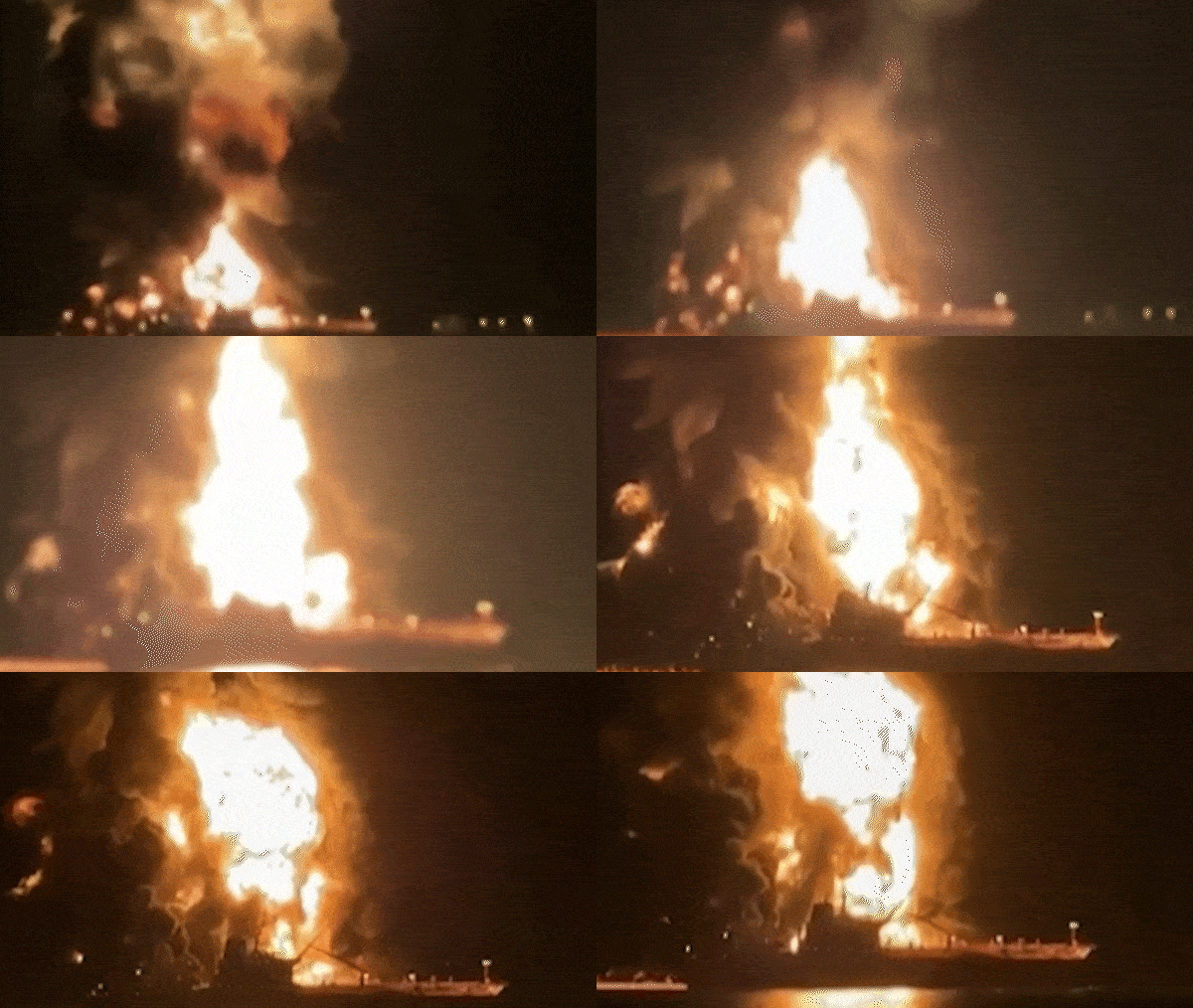
A radio transmission from an Iranian patrol boat. A sudden change in course. A delay of three days.
This is the moment the narrative of global business meets the narrative of a single family. Because that three-day delay isn't just a logistical hiccup. It is a signal to a refinery in New Jersey that supply might be tightening. That refinery adjusts its prices. The regional wholesaler sees the change and adjusts theirs.
By the time the man in Ohio pulls his silver sedan up to the pump at 6:30 AM on a Tuesday, the disruption in the Strait of Hormuz has already reached him. He watches the numbers on the pump spin faster than they did last week. He feels a small, sharp pinch in his chest.
That pinch is the sound of the middle class being squeezed.
The surging price of oil past $100 is more than a metric of economic health. It is a psychological weight. High energy prices act as a regressive tax, hitting the poorest families the hardest. It’s the difference between a new pair of school shoes for a growing child and making the old ones last one more semester.
The Cost of a Fragile System
We have built a world that is remarkably efficient and terrifyingly fragile.
For decades, we relied on the idea that global trade was a river that would never stop flowing. We optimized for "just-in-time" delivery. We assumed that the $100 barrel was a ghost of the past, a relic of the 1970s or the early 2000s that we had evolved beyond.
But we didn't evolve. We just became more dependent.
When Iran disrupts the Gulf, it reveals the thinness of the ice we are skating on. It reminds us that our modern, digital, high-speed lives are still fundamentally anchored to a heavy, black sludge that must travel through some of the most politically volatile waters on Earth.
The surge isn't just about supply and demand. It is about the realization that we are not as in control as we think we are.
We can talk about renewables. We can discuss the transition to electric vehicles and the long-term shift away from fossil fuels. Those are important conversations. But they are conversations for the next decade.
For the person trying to figure out how to pay for a commute tomorrow morning, those conversations are cold comfort.
The Weight of $100
There is a specific gravity to $100. It is a round number that signals a shift in the collective consciousness. Below that mark, we can convince ourselves that energy is just another commodity, a variable cost that fluctuates within a manageable range.
Once we cross it, the tone of the conversation changes.
Central banks start looking at interest rates with a new sense of urgency. Inflation, which had been a fading shadow, suddenly grows long and dark again. The "energy shock" is a phrase that starts appearing in memos and on news crawls.
But the real shock is personal.
It’s the small business owner who has to tell his employees he can't give them a raise this year because the cost of running his fleet of delivery vans has gone up 30 percent. It’s the farmer who looks at the price of fertilizer—a product intrinsically linked to the price of natural gas and oil—and wonders if it’s even worth planting the north forty this spring.
These are the human stakes of a geopolitical chess match.
The man in Ohio finally sets his coffee down. He hasn't taken a sip, and now it’s cold. He closes the tab on his browser, but the number $100.12 is burned into his mind. He stands up, grabs his keys, and heads out to his car.
He drives a little slower today. He tries to coast to the red light, hoping to save a few drops of the precious, expensive liquid in his tank. He is one of billions of people currently adjusting their lives to accommodate the ripples of a conflict they didn't start, in a place they will never visit, over a resource they cannot live without.
The world is a very small place when the oil stops moving.
We are all connected by a pipeline of necessity, and when someone at the other end of that pipeline decides to turn the valve, we all feel the pressure drop. The surge past $100 isn't a headline. It's the sound of a billion small lives becoming just a little bit harder, a little bit more uncertain, and a lot more expensive.
The tankers will continue to move. The diplomacy will continue to fail and succeed in equal measure. But the next time you see a price on a sign at a gas station, don't just think about the money. Think about the invisible threads of power and politics that pull that price up, and the people at the other end of those threads who are trying, desperately, to hold on.
A single barrel of oil has never been heavier.