The morning air smells like damp earth and hot silicon.
Look down at your palm. Inside that thin rectangle of glass and aluminum sits a universe of elements pulled from the deep crust of the Earth. Lithium from salt flats, cobalt from narrow tunnels miles beneath the surface, rare earth metals refined in quiet, heavily guarded factories far away. To you, it is a tool for messages and maps. To the global chessboard, it is the new oxygen.
We rarely think about where the stuff of our future comes from until someone shuts the valve.
Consider a factory floor in a mid-sized manufacturing hub. The machines hum a steady, rhythmic bassline. Robotic arms snap into place with terrifying precision, stitching microchips onto circuit boards. For years, this was how progress worked. It felt infinite. It felt weightless. People talked about the cloud as if technology existed in the sky, free from gravity and borders.
Then the ground shifted.
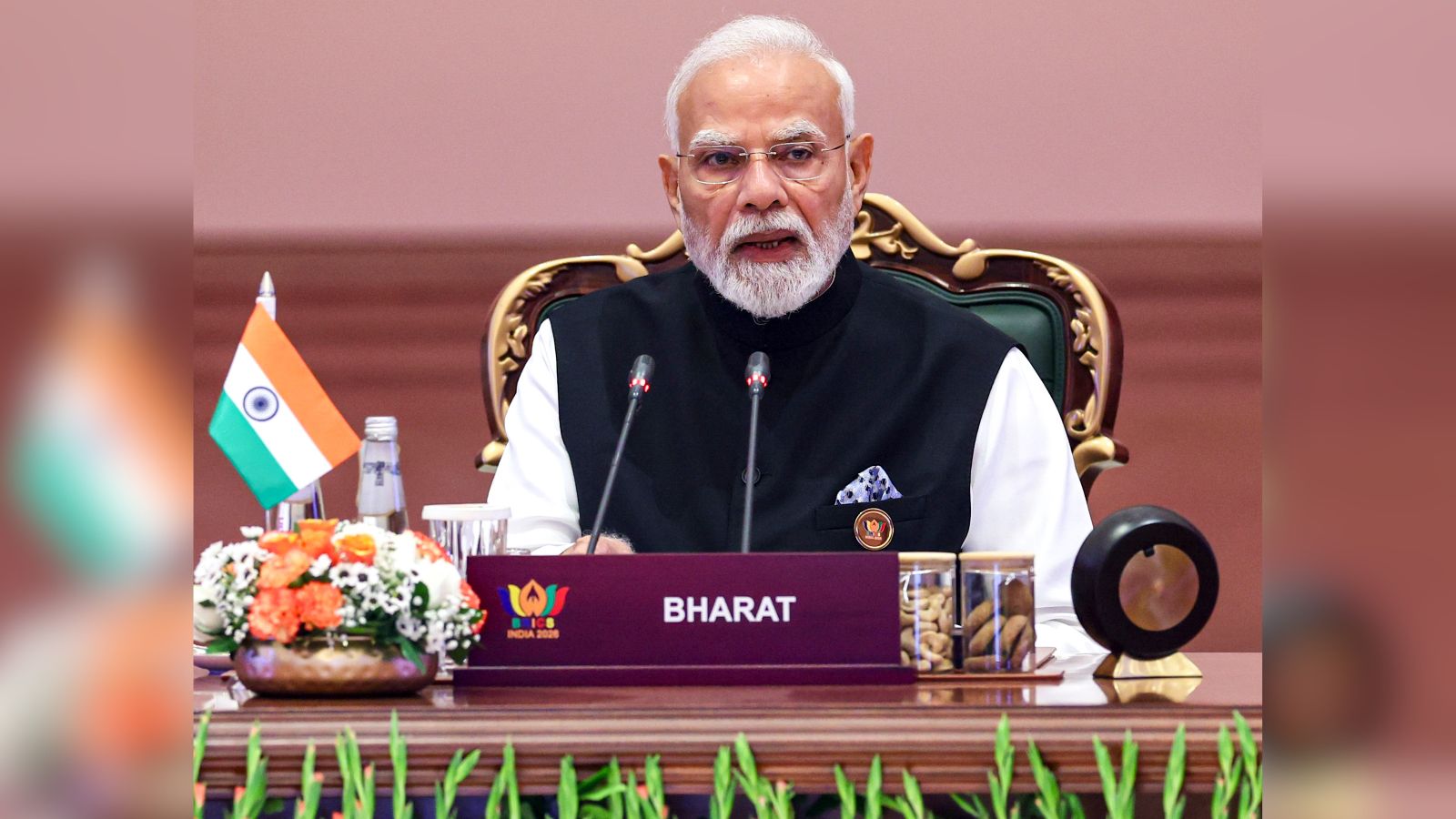
At the recent BRICS Summit, leaders gathered behind polished mahogany tables to address a quiet panic. Prime Minister Narendra Modi stood before his peers and delivered a warning that cuts straight to the bone of modern civilization: the weaponization of technology and critical minerals.
Think about what that word means. Weaponization.
A weapon is something you use to force someone's hand. It is something you withhold to make them bend. When everyday resources—the foundational building blocks of electric vehicles, smartphones, medical scanners, and artificial intelligence infrastructure—are turned into diplomatic leverage, the entire planet holds its breath.
Imagine Maya. She is an engineer working on clean energy storage in a university lab. Every morning, she tests new variations of battery cathodes, hoping to find a combination that relies on more abundant materials. She does not care about geopolitics. She cares about efficiency, about voltage, about giving the world a cleaner way to store the sun's energy. But every time she orders a specialized sample of a rare mineral, she runs into a wall of export restrictions, skyrocketing prices, and bureaucratic red tape.
Maya is feeling the first tremors of a resource war.
For decades, globalization promised a shared table. The idea was simple: every nation would specialize in what it did best. One country mines, another refines, another designs, another assembles. It was efficient. It was cheap. It connected continents in a web of mutual reliance.
But mutual reliance only works when everyone trusts the other to keep their promises.
When critical supply chains concentrate in just a handful of geographic locations, vulnerability skyrockets. If a single nation controls the extraction or processing of over sixty percent of the world's essential minerals, they hold a master key to the twenty-first century. Turn that key one way, and factories flourish. Turn it the other way, and entire industries grind to a halt.
This is not science fiction. It is happening right now, in quiet shipping ports, in customs offices, and in subterranean boardrooms where trade agreements are rewritten behind closed doors.
Technology was supposed to democratize the world. We were promised that the internet would flatten hierarchies, that information would flow like water, and that borders would matter less and less. Instead, we find ourselves retreating behind digital and physical walls. Code is weaponized. Semiconductors are restricted. Critical minerals are hoarded.
Why? Because whoever controls the raw inputs of the digital age controls the trajectory of human power.
Let us step back for a moment and look at the sheer scale of what we are extracting. To power the transition away from fossil fuels, humanity needs to dig up, process, and deploy more metals and minerals in the next few decades than we have in the entire history of industrial civilization. Every wind turbine, every solar farm, every server farm training the next generation of artificial intelligence models requires a physical anchor in the earth.
The irony is staggering. We are building a virtual world on the back of very heavy, very finite dirt.
When leaders like Modi call out the weaponization of these resources, they are voicing a fear shared by developing nations everywhere. The fear is that the old colonial model of extraction and dominance will simply be digitized. Instead of spices and silk, the currency of control is lithium, gallium, germanium, and advanced computing architecture. Instead of gunboats in harbors, the pressure comes through export bans and algorithmic choke points.
So how do we break the cycle?
The answer does not lie in retreating into isolationism, where every country tries to mine, refine, and manufacture everything within its own borders. That is economically impossible and environmentally disastrous.
Instead, the solution requires a stubborn commitment to diversification and shared innovation. It means investing heavily in recycling technology so that yesterday's discarded electronics become tomorrow's raw materials. It means building transparent supply networks that cannot be easily hijacked by a single actor. It means treating technology not as a contest of supremacy, but as shared public infrastructure.
Back in the lab, Maya wipes a smudge of graphite from her safety goggles and looks at her readout. The numbers are stubborn. The alternative material is still twenty percent less efficient than the restricted mineral she needs.
She sighs, turns off her equipment, and starts the calculation over again.
She has to. Because the future of how we communicate, how we heal, and how we keep the lights on depends entirely on whether we can figure out how to share the earth we stand on before we wall it off completely.