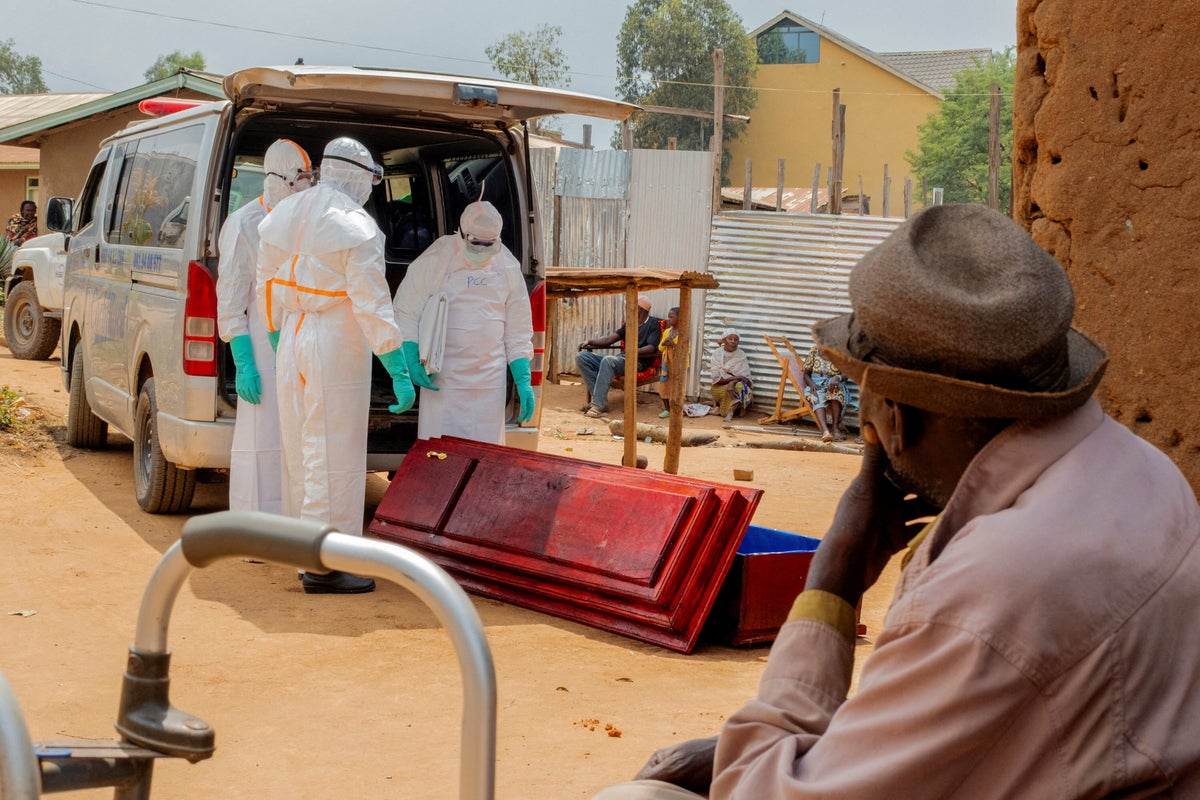
The air in the treatment center does not smell like medicine. It smells like bleach and chlorinated sweat, a sharp, chemical sting that coats the back of your throat the moment you step past the plastic sheeting.
I stood there in a heavy yellow gown, sweat pooling in the rubber toes of my boots, watching a man try to drink water. His hands shook so violently the plastic cup clattered against his teeth. He was younger than me, perhaps twenty-four, with a wife sitting on the red dirt outside the perimeter fence, staring at the ground with a look of absolute, hollow exhaustion.
Seventeen hundred.
That was the number echoing in the radio dispatch crackling from the nurse's hip. One thousand, seven hundred lives swallowed by the eastern Congo outbreak, a surge moving faster than any medical corps has managed to map. On paper, it is a statistic. A metric of failure, a data point for a weekly briefing in Geneva or Kinshasa. In the ward, it is the sound of ragged breathing through a chlorine-fogged mask and the sickening weight of a body carried out in a yellow plastic sack before the morning sun has even burned the mist off the valley.
We talk about outbreaks as if they are weather events. We say they sweep through, they strike, they surge. The language implies an act of nature, a hurricane crossing an ocean, completely indifferent to human design. But viruses do not march blindly. They walk on our hesitation. They travel down unpaved roads in the back of crowded share-taxis, hitch a ride in the grief of a mourning family washing a body according to ancient custom, and exploit the quiet, corrosive mistrust of men and women who have spent decades being forgotten by the state.
Consider what happens when a community sees a white-suited team arrive in the back of a gleaming UN Land Cruiser. To a grieving mother, they do not look like saviors. They look like an occupying army arriving to steal her dead child away from sacred ground, sealing them in a box, denying them the final rites that anchor a culture to its humanity.
Fear is an epidemiological vector. It is just as lethal as the filovirus itself.
When the first tremors of this surge began, the local clinics did not fall because the doctors lacked grit. They fell because the infrastructure of trust had already been hollowed out by years of conflict. Militia checkpoints fractured supply chains. Gunfire silenced community health workers before they could trace a single contact. By the time the laboratory confirmed the first few cases in the dense, bustling markets of the eastern provinces, the virus had already carved a multi-week head start through a population constantly running for cover.
Mathematics in an epidemic is a cruel game of catch-up.
A single transmission chain branches like a shattered windshield. One infected trader visits a market. He touches a wooden counter, shakes hands with a cousin, sleeps beside his wife. Within a week, twenty people are carrying a microscopic assassin that hijacks the endothelial cells, turning the body's own plumbing against itself. The blood vessels begin to leak. The organs falter. And the numbers tick upward.
Seventeen hundred.
Then seventeen hundred and one.
We try to explain this using reproductive numbers and incubation periods, drawing neat little curves on whiteboards in air-conditioned offices thousands of miles away. But the reality on the ground is messy, visceral, and terrifyingly fast. The eastern Congo surge moves at the speed of a handshake, the speed of a whispered prayer over a sickbed, the speed of desperation.
Yet, amidst the gray ash of the crisis, you find moments of stubborn, defiant grace.
I watched a local nurse named Chantal—her face marked by deep lines of fatigue, her eyes bloodshot from thirty-six hours without sleep—kneel beside a terrified ten-year-old boy. The boy's mother had already died in the isolation ward. He was alone, burning with fever, crying for his aunt. Chantal didn't reach for a clipboard or a needle. She took off her protective face shield—risking exposure, breaking every protocol drilled into her during safety training—just so the boy could see a human face instead of a faceless yellow monster. She held his small, dry hand through the thick rubber of her glove and sang a lullaby in Swahili until his crying softened into shallow, exhausted breaths.
That is how you fight an epidemic. Not just with monoclonal antibodies and cold-chain freezers, though those are the shields we desperately need. You fight it by honoring the grief of the people you are trying to save.
When local leaders are brought into the response rooms, when traditional healers are trained to recognize early symptoms instead of being treated as obstacles, the walls begin to crumble. When families are allowed to participate safely in burials rather than having their loved ones spirited away by strangers in biohazard suits, the whispers stop. The roadblocks clear.
The outbreak is fast, yes. The virus does not wait for committee meetings or budget approvals. But human resilience, when finally mobilized from the bottom up rather than imposed from the top down, has a ferocious speed of its own.
The sun dipped below the jagged green ridgeline of the Kivu mountains, painting the canvas of the sky in bruised shades of violet and orange. Outside the treatment fence, the crowd had thinned, though a few figures remained, huddled under blankets against the mountain chill, waiting for news that might never come.
Inside, the hum of the oxygen concentrator was the only sound left in the world.
Chantal wiped her brow with the back of her forearm, leaving a smudged streak of dust across her forehead. She looked down at the empty chart in her hand, then across the rows of cots where the battle lines of humanity are drawn every single day. She didn't smile. There was nothing to smile about. But she didn't walk away either. She stepped forward, picked up a fresh cup of oral rehydration salts, and walked back into the hot zone.