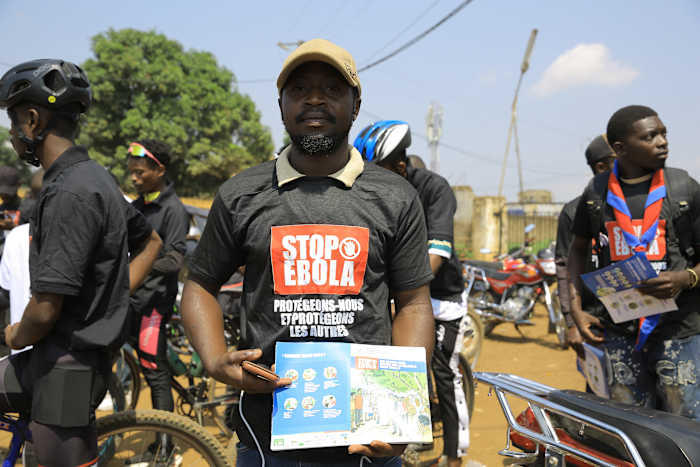
The air in the eastern provinces of the Democratic Republic of the Congo carries a specific kind of weight. It is thick with the scent of damp earth, woodsmoke, and an underlying, quiet panic that does not show up on weather reports. I remember standing near a small clinic outside Beni during a previous scare, watching the red dust swirl around the boots of motorcycle taxis carrying medicine. Back then, we thought we knew the enemy. We mapped its movements by the chalkboards of local hospitals, tracking a shadow that crawled from village to village with a predictable, terrifying slowness.
Now, the math has changed.
Speed is the terrifying variable here. Imagine a fire that does not just jump from log to log, but travels along invisible underground roots, popping up yards away before anyone smells smoke. Public health data tells us the current Ebola epidemic spreading through the region is moving at a velocity eighteen times faster than the historic outbreaks we studied in textbooks. Eighteen times.
That number is an abstraction until you look at it through the eyes of a father holding a running child, wondering if today is the day the fever takes hold.
Numbers lie on paper because they freeze chaos into tidy decimals. But on the ground, speed means the tracking teams are always playing catch-up. It means a contact-tracing network built for a brisk walk is suddenly trying to catch a sprinter in the dark.
Let us be precise about what this means mechanically. In standard epidemiological terms, an outbreak's momentum is governed by its reproduction number and the efficiency of transmission chains. When medical infrastructure is strained by regional conflict, distrust, and porous borders, those chains multiply exponentially. The virus finds the gaps. It moves through crowded market towns where thousands cross paths daily, buying cassava, trading goods, and carrying invisible hitchhikers on their skin and clothing.
Consider a hypothetical case study to understand the human engine of this statistic. Dr. Mukendi, a fictionalized amalgam of the dozens of exhausted physicians I have spoken with in North Kivu, starts his shift at dawn. He washes his hands in a chlorinated bucket. By noon, he has seen three patients with classic early symptoms: sudden fatigue, a spike in body temperature, a headache that feels like a vice. In past years, he would have forty-eight hours to trace their recent movements, isolate their family members, and vaccinate their immediate circle.
Today, by noon, those three patients have already visited a bustling roadside market, attended a crowded community prayer, and boarded a shared taxi heading toward a provincial hub.
The virus is no longer waiting for permission to spread. It is riding the bus.
Why is this happening with such ferocious velocity? Part of the answer lies in population density and mobility. The eastern Congo is a region of immense movement. People travel constantly for trade, family, or to escape local violence. When a pathogen enters a highly mobile population, its biological clock accelerates. It outpaces the public health response not because the science is failing, but because the logistics of human life are faster than the logistics of international aid delivery.
There is also the profound psychological weight of fatigue. Communities here have endured decades of conflict, displacement, and multiple health crises, including previous bouts of Ebola and measles. When a new warning sounds, the reaction is rarely immediate panic; more often, it is a weary numbness. Skepticism takes root. Rumors travel faster than the virus itself. If you have survived war, cholera, and economic collapse, a microscopic threat that requires you to isolate from your dying family member feels counterintuitive to every human instinct you possess. Love tells us to hold tight. Survival tells us to run. The virus exploits that terrible contradiction.
To bridge this gap, modern medicine must become as agile as the disease. That means shifting from reactive quarantine to preemptive ring vaccination, deploying decentralized testing units that deliver results in minutes rather than days, and placing community leaders at the very center of the response. Medical protocols dictated from distant capitals fail if they do not respect the dignity and local knowledge of the people living through the crisis.
We must acknowledge how frightening this is. There is no comfort in a sanitized statistic. The eighteenfold increase is a call to look directly at the fragility of our global health safety nets. It is a reminder that a fire in the heart of the Congo eventually warms the air of the entire world, not because of distant panic, but because our fates are stitched together by the very flights and trade routes that define modern existence.
The sun drops low behind the Virunga Mountains, casting long, bruised shadows across the valley. In thousands of small homes tonight, lanterns are lit. Families share meals. And somewhere out in the dark, an invisible spark races along a hidden root, testing the limits of human resilience once more.