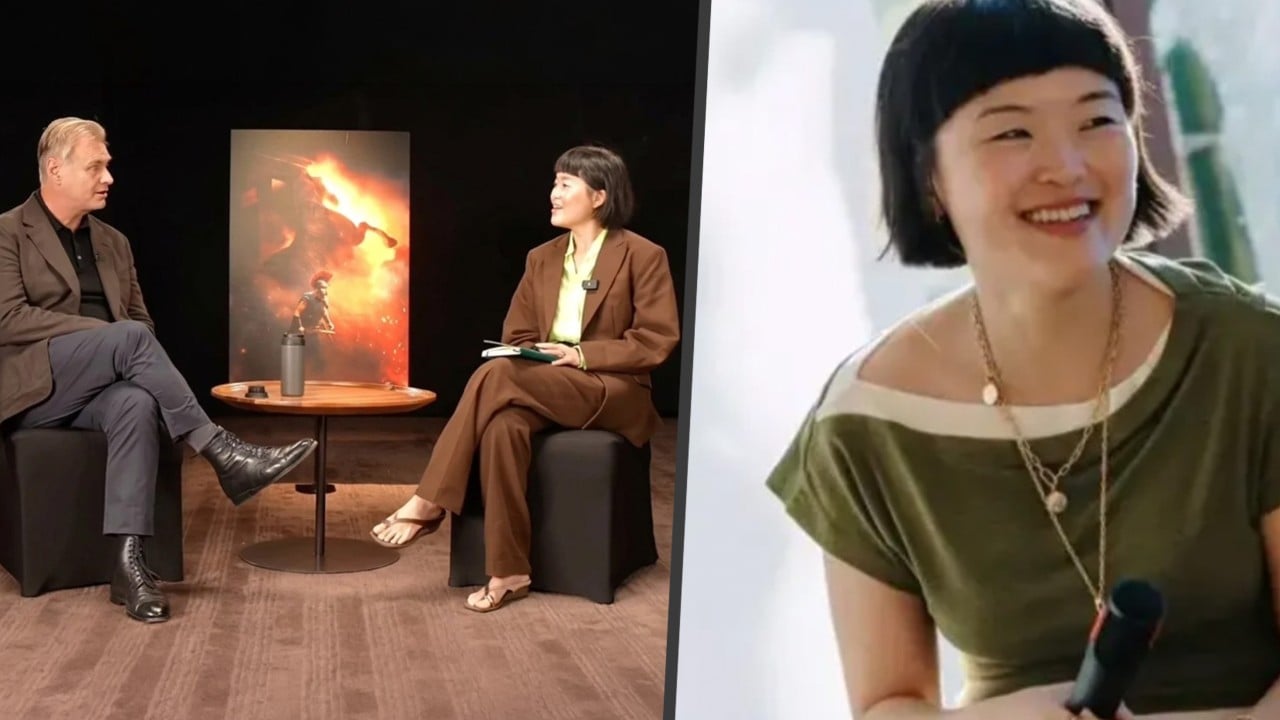
Zhuge Yiyang, known to millions of digital followers under the pseudonym Zhongshu, skyrocketed to global internet stardom following a high-profile, philosophical interview with filmmaker Christopher Nolan regarding his adaptation of The Odyssey. The 29-year-old Boston College political philosophy doctoral candidate was universally praised for abandoning conventional promotional fluff in favor of deep literary and structural critique. Commentators hailed her performance as a watershed moment for modern cultural commentary. That towering pedestal has now violently collapsed. Within weeks of her viral triumph, relentless digital sleuths on platforms like Douban unmasked a systematic pattern of intellectual theft, proving that her widely consumed podcast episodes and published journalism were heavily plagiarized from English-language sources.
The exposure illustrates a darker truth about modern intellectual clout-chasing. When digital economies reward rapid content consumption above all else, originality often becomes a casualty.
The Anatomy of a Fabricated Persona
The unraveling began not through formal academic audits, but via meticulous crowdsourced scrutiny. Listeners familiar with global intellectual media began noticing suspicious overlaps between Zhuge's podcast, Du Shu Bu Cheng Lin, and various English-language academic products. The smoking gun appeared in an episode discussing Iran's political structure, where Zhuge mirrored a specific English podcast transcript down to a bizarre mistranslation. An automated transcript of the original foreign show had mistakenly rendered the phrase health and literacy "corps" into the word "court". Zhuge's Chinese-language broadcast repeated the error, utilizing "court" in a context where it made zero historical or linguistic sense.
This specific linguistic glitch exposed a wider pattern of translation without attribution. Investigative netizens soon uncovered parallel borrowing in her print journalism. An essay regarding academic artificial intelligence policy published in a prominent Chinese business outlet mirrored structure and introductory lines verbatim from an article previously printed in The Atlantic. Prefaces written for translations of classical texts by Hannah Arendt and Plutarch suffered identical structural contamination, lifting analytical frameworks from Western scholars without a nod of acknowledgement.
The deception extended straight into her professional credentials. While frequently marketed to the public as an elite university professor, investigative checks revealed her actual teaching footprint resided inside a local lifelong learning community catering primarily to adults aged fifty and older. Promotional tours for her newly released translations faced immediate cancellation as book organizers quietly backed away from the escalating scandal.
The Arrogance of Manufactured Authority
What makes this unraveling uniquely fascinating is the offender's response to accountability. Confronted with mounting evidence of widespread appropriation, Zhuge offered no substantive defense, retraction, or apology. Instead, she retreated behind an impenetrable wall of elitist grandiosity, publicly recycling a phrase she used during her chat with Nolan: "We live in an age that demands apology from greatness."
This framing reveals an acute symptom of modern intellectual branding. By positioning herself as an misunderstood iconoclast persecuted by the masses, she attempts to weaponize the very criticisms leveled against her. It is a playbook borrowed straight from contemporary political populism, where objective verification is dismissed as mere noise generated by an envious mob.
The tragedy lies in how easily audiences are seduced by intellectual theater. In an attention-starved digital ecosystem, confident delivery frequently masquerades as genuine scholarship. Zhuge understood how to package Western academic tropes for domestic audiences hungry for sophisticated cultural validation. She performed the role of the rigorous philosopher so convincingly that millions overlooked the absence of original thought.
The illusion is shattered, leaving behind a cautionary tale about the fragile architecture of internet fame and the enduring cost of intellectual dishonesty.
Christopher Nolan's Odyssey to China - A Struggle Session?
This video provides a deep analysis of the philosophical implications and critical reception surrounding the viral interview that initially thrust Zhongshu into the international spotlight.
http://googleusercontent.com/youtube_content/1