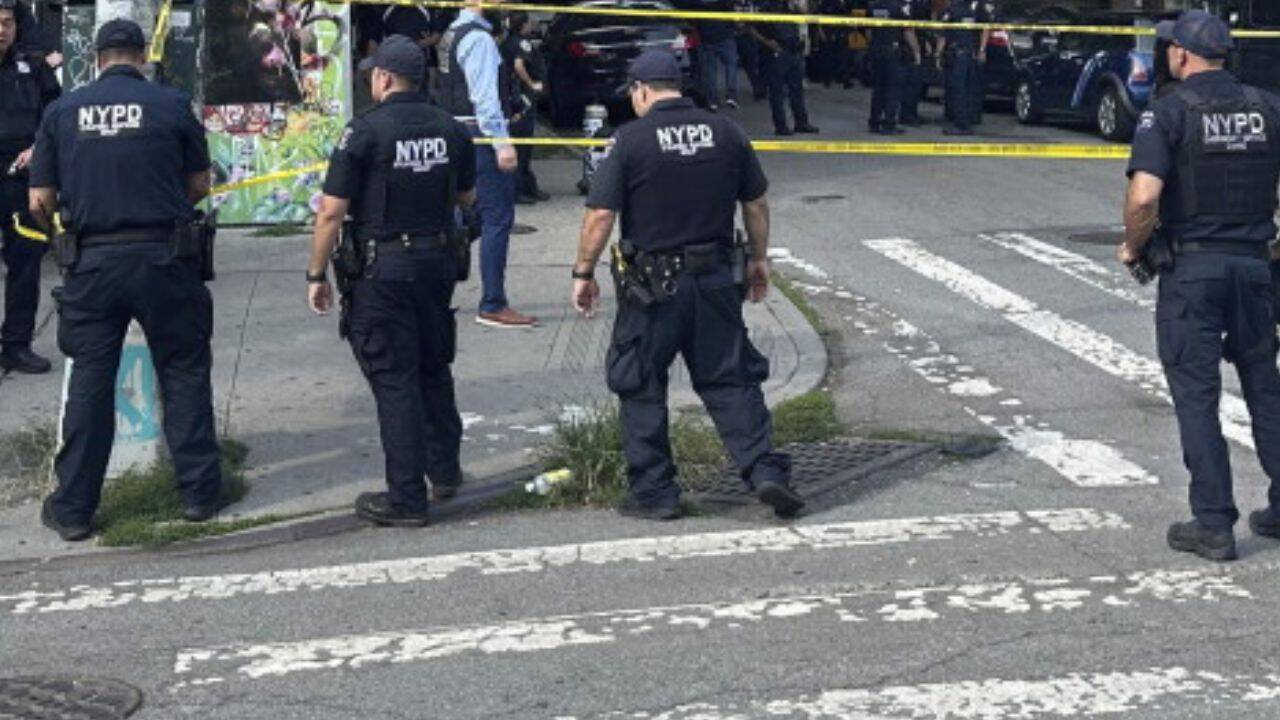
Standard breaking-news coverage of a domestic stabbing and a subsequent police shooting follows a script so predictable you could set your watch by it. Four people injured inside a New York home. A woman shot by officers after charging at them with a knife. Cue the boilerplate updates, the anonymous neighborhood quotes, and the instant tug-of-war between two lazy narratives: either police acted in textbook self-defense against an imminent lethal threat, or officers escalated a volatile domestic scene into lethal force.
Both sides are asking the wrong question.
People read a headline like that and immediately argue over whether the shooter had "no choice" or whether the response was "excessive." That framing treats a chaotic, split-second crisis like a courtroom closing argument played in slow motion. Worse, it hides the mechanics of what actually happens inside a confined residential space when edged weapons, acute emotional distress, and armed responders collide.
I have spent years analyzing use-of-force incidents, tactical training curricula, and crisis intervention protocols from the inside out. I have watched agencies pour massive budgets into shiny gadgets and one-day checkbox seminars while ignoring the exact spatial, physiological, and communication bottlenecks that get people killed or permanently scarred. Let us dismantle the lazy consensus around domestic stabbings, edged-weapon charges, and police shootings without pretending the answers are neat or painless.
The Myth of the Simple "Charge With a Knife"
When a headline says a woman charged at officers with a knife after four people were stabbed at a New York home, casual readers picture a movie villain lunging across a wide-open plaza. Real residential interiors do not work like movie sets.
Hallways are narrow. Kitchens have islands, counters, appliances, and zero room to backpedal without tripping over a chair or a threshold. A person holding a blade in a tight room does not need to sprint forty yards to pose a severe threat. A three- to six-foot lunge takes a fraction of a second—faster than most people can blink, let alone draw, aim, and fire with precision while moving backward.
In use-of-force circles, trainers often reference the old rule of thumb that an attacker with an edged weapon can cover roughly twenty-one feet in about one and a half seconds. Real-world biomechanics vary wildly depending on footwear, surface traction, start posture, and obstacle clutter, so treating any fixed number as a universal law of physics is sloppy. Still, the underlying principle holds up under scrutiny: distance disappears fast indoors, and backing up in a cluttered home is a great way to lose your balance.
Here is where the first misconception trips people up. Many assume that if a suspect is female, or if she appears emotionally distressed, the physical threat is somehow lesser or easier to subdue without firearms. A blade does not care about the size or sex of the person holding it. A kitchen knife or utility blade creates deep, rapidly bleeding wounds regardless of who is gripping the handle.
At the same time, assuming that "charged at officers" automatically settles every tactical question is just as lazy. Context matters enormously. Was the suspect cornered in a dead-end room? Were bystanders or injured victims still inside the line of fire? Had officers just arrived to find four bleeding people and no clear picture of who was victim, witness, or assailant?
What "Imminent Threat" Actually Means Under Pressure
Outside observers often confuse possibility with imminence, or they judge split-second decisions using frame-by-frame video reviewed three weeks later on a calibrated monitor. Neither habit helps anyone understand reality.
In law and tactical doctrine, an imminent threat is not an abstract future risk; it is an immediate danger happening right now that requires a rapid response to prevent death or serious bodily injury. Under acute stress—often called the sympathetic nervous system surge—human perception narrows. Tunnel vision sets in. Fine motor skills degrade. Auditory exclusion can muffle commands that sounded crystal clear during classroom roleplay.
That physiological reality explains why armchair critiques of "why didn't they just shoot the knife out of her hand" or "why didn't they use a Taser" sound absurd to anyone who has studied real encounters. Handguns are not precision surgical tools designed to hit a moving piece of steel in dim indoor lighting. Conducted electrical weapons like Tasers require two probes to make effective electrical contact across a gap, can be defeated by heavy clothing or awkward angles, and carry no guarantee of stopping an immediate lunge in tight quarters.
None of that gives responders a blank check. Recognizing the limits of less-lethal tools is not the same as excusing poor positioning or reckless entry. A contrarian look at use-of-force demands holding two truths at once: split-second lethal force can be legally justified in close quarters, yet the conditions that created a close-quarters ambush might have been shaped long before the trigger was pulled.
Why Domestic Crisis Calls Are Tactical Landmines
If you want to understand why domestic stabbing calls spiral out of control so frequently, stop looking solely at the final second and start looking at the first ninety seconds of dispatch and arrival.
Domestic calls are notorious among experienced first responders because the emotional temperature is already near boiling before anyone knocks on a door. When four people have already been stabbed inside a New York home, the scene is not a quiet argument that might cool down with a calm chat. It is an active trauma zone layered over a volatile interpersonal crisis.
Think about the information fog officers walk into. A caller might be screaming, disconnected, or giving conflicting details. Four injured people mean multiple potential bleeding emergencies, chaotic movement, and confusion over whether another assailant is present or whether the person holding a weapon is acting out of rage, psychosis, panic, or a combination of all three.
Consider a thought experiment. Imagine a scenario where two officers arrive at a multi-room apartment after reports of multiple stabbings. They hear yelling, see blood near the entrance, and spot an injured person slumped near a doorway while a woman holding a large blade moves rapidly toward them down a short hallway. There is no wide perimeter. There is no time for a twenty-minute negotiation while someone with a knife closes the gap in a narrow corridor. In that moment, the tactical geometry leaves almost zero margin for error.
Now flip the lens. What if responders push too deep into a tight space without staging, cover, or clear lines of sight when a safer containment option exists? Or what if a community relies almost exclusively on armed patrol units to handle severe mental health crises until violence has already erupted?
Researchers and policing scholars—including figures like David Klinger, known for work on the emotional and perceptual realities of police shootings, and Geoffrey Alpert, who has extensively studied use-of-force decision-making and training—have pointed out for years that real-world encounters are shaped by dynamic chaos rather than neat textbook checklists. Training that teaches rigid "if-then" scripts often breaks down when rooms are small, lighting is harsh, and adrenaline spikes.
The Trap of Treating Every Crisis Like a Single Hammer
Modern public debate loves neat moral buckets. One camp treats police as infallible guardians whenever a weapon is visible. The other treats every police shooting as evidence of systemic malice. Both positions are intellectually lazy.
When four people are stabbed in a home, innocent victims are already paying the price of severe interpersonal violence. When an officer shoots a person charging with a knife, another household often faces lifelong trauma, grief, or permanent injury. Calling one side "good" and the other "evil" turns a complex failure of safety and crisis response into a sports rivalry.
Answering the Questions People Actually Search
Whenever a story like a domestic stabbing and police shooting breaks, people rush to search engines with the same predictable questions. Most of those questions are built on shaky premises. Let us tear them down and look at what actually holds water.
"Why didn't officers just shoot the weapon out of her hand or aim for the leg?"
Because real life is not a western movie, and human bodies under stress do not work like ballistics dummies. A hand holding a knife moves erratically, especially during a charge. Legs move fast, offer smaller and more mobile targets than center mass, and contain major arteries like the femoral artery—meaning a leg shot can still be fatal while missing can send a round straight into a wall, a bystander, or another room.
Aiming for center mass exists for a basic biomechanical reason: it maximizes the probability of stopping an immediate threat quickly while minimizing misses. Anyone demanding "shoot the knife" or "shoot the leg" is asking responders to gamble with innocent lives on a low-percentage shot.
"Couldn't a Taser or pepper spray stop someone charging with a knife?"
Sometimes, under ideal conditions. Often, no. Pepper spray does not instantly disable a determined or chemically/adrenaline-fueled attacker, and in a small indoor space, blowback can affect the officers or victims nearby. Tasers are far more capable than baton or spray when both probes connect cleanly and muscle lockup occurs, yet they fail regularly due to missed leads, loose fabric, tangles, or short ranges where a suspect covers the distance before neuromuscular incapacitation takes hold.
Relying on a tool with a high failure rate as your sole defense against a charging blade inside a narrow home is a recipe for tragedy. Less-lethal options belong in the toolkit, not on a pedestal of false certainty.
"What can households and communities actually do to prevent scenes like this?"
Start earlier than the moment sirens approach the block. Severe domestic violence and acute psychiatric crises rarely appear out of thin air with zero warning signs, though they often go unaddressed until escalation becomes extreme.
Practical steps that actually move the needle include:
- Take escalating threats and erratic behavior seriously before a crisis peaks. Minimizing severe agitation, substance misuse, or escalating hostility inside a home often delays help until weapons enter the picture.
- Plan exits, not heroics. In a domestic emergency involving a weapon, getting injured people out and putting solid barriers or locked doors between the threat and potential victims matters far more than trying to wrestle a blade away bare-handed.
- Fund and coordinate real crisis response alongside patrol. Police are essential when lethal weapons are in play, but mental health crisis teams, rapid follow-up care, and domestic intervention programs reduce how often untreated crises fester until someone picks up a knife.
- Demand realistic scenario training over performative optics. Agencies get better outcomes when officers train under high-stress, decision-heavy scenarios with clear de-escalation where safe and decisive action where required—not when leadership chases headlines with superficial reforms.
Where My Contrarian Take Can Backfire
A sharp contrarian argument loses credibility fast if it pretends there are no trade-offs. Here is the honest catch with pushing back against instant outrage and focusing on tactical and systemic realities.
First, explaining why a close-quarters knife charge creates an immediate lethal dilemma can sound cold or dismissive to families grieving a loved one who was shot. Even when force is legally justified, a human life lost or shattered is still a tragedy, not a mere training case study.
Second, emphasizing practical constraints and realistic training can easily be co-opted by defenders of bad policing who want to wave away every legitimate question about accountability, poor tactics, or preventable escalation. Nuance requires defending reality without excusing carelessness.
Third, long-term prevention—better mental health support, earlier domestic intervention, smarter urban and residential crisis coordination—does not give people an instant villain to blame tonight. Humans crave simple answers right after a shock. Truth rarely obliges.
Stop rooting for a pre-packaged storyline every time a violent domestic call hits the news. Look at the geometry of the room, the speed of a blade, the fog of a multi-victim crisis, and the hard work of stopping violence before a weapon is ever raised.