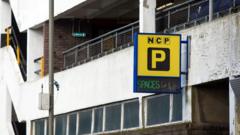
The collapse of National Car Parks (NCP) into administration is not a localized failure of management, but the terminal phase of a structural misalignment between fixed-cost physical assets and a radically devalued urban utility. When an entity managing over 500 sites and employing nearly 700 staff enters insolvency, the market typically looks for a singular "black swan" event. In reality, NCP’s failure is a case study in the Yield Compression Paradox: the cost of maintaining urban real estate increased while the marginal utility of the service—parking a combustion engine vehicle in a city center—underwent a permanent downward shift.
The Debt Serviceability Trap
NCP’s capital structure was built on the assumption of high-occupancy cycles that no longer exist. To understand the collapse, one must examine the Fixed-Lease vs. Variable-Revenue Disconnect. Unlike modern "asset-light" tech platforms, NCP operated under long-term, upward-only rent reviews. These leases were signed during an era of peak urban commuting.
- Rent-to-Income Inversion: As city councils implemented Clean Air Zones (CAZ) and Low Emission Zones (LEZ), the pool of eligible vehicles shrank. However, the contractual rent owed to landlords remained static or increased.
- Interest Rate Sensitivity: Large-scale parking operators often use high leverage to secure prime city-center footprints. As global interest rates climbed, the cost of servicing existing debt stripped the company of the liquidity needed for site maintenance and digital transformation.
- The Maintenance Deficit: Structural decay in multi-storey car parks requires significant capital expenditure (CapEx). When operational cash flow is diverted to debt service, the physical asset degrades, further driving down the premium price consumers are willing to pay.
The Triple Headwind of Urban De-Growth
The collapse was accelerated by three converging macroeconomic forces that disrupted the fundamental unit economics of the parking industry.
The Post-Pandemic Anchor: The shift to hybrid work did not just reduce volume; it destroyed the "Early Bird" high-margin revenue segment. In the traditional model, the weekday commuter provided a predictable, high-value floor for revenue. Without this anchor, NCP was forced to rely on "Transient" or "Event-based" parking, which is notoriously volatile and price-sensitive.
Regulatory Asphyxiation: Local government policy has pivoted from car-accessible to car-hostile. The "15-minute city" concept and the expansion of pedestrianized zones effectively cut off the "Last Mile" access to many NCP locations. When a city council removes the connecting infrastructure (roads) leading to an asset (the car park), the asset’s valuation effectively drops to zero, regardless of the quality of the facility.
The EV Transition Lag: While the shift to Electric Vehicles (EVs) is cited as a future opportunity, for an insolvent firm, it represents a prohibitive cost. Retrofitting 1970s-era concrete structures with high-voltage charging grids requires a level of investment that NCP’s balance sheet could not support. The company was trapped in a "Technical Debt" cycle: too broke to innovate, yet losing customers because they failed to provide the infrastructure modern drivers require.
Deconstructing the Operational Failure
The operational logic of a parking firm relies on Throughput Optimization. NCP failed to transition from a "space-rental" model to a "logistics-hub" model.
- Pricing Inelasticity: NCP historically utilized a high-price, high-friction model. Even as demand fell, their pricing remained rigid in many regions, failing to use dynamic algorithms that competitors like JustPark or YourParkingSpace used to capture "slack" in the market.
- Asset Misutilization: A car park is essentially a multi-level platform in a high-density area. While competitors began exploring dark kitchens, micro-fulfillment centers, or last-mile delivery hubs for Amazon or Deliveroo, NCP remained tethered to the single-use car storage model. This lack of diversification meant that 100% of their revenue was exposed to the decline of private car ownership.
The Creditor Dilemma and the Pre-Pack Strategy
The entry into administration suggests a search for a "Pre-Pack" deal, where the profitable parts of the business are sold off while the "toxic" leases are left behind in the insolvent shell. This is a common but brutal strategy in retail and hospitality.
The 700 jobs at risk represent the frontline of this structural shift. In a modern, automated parking environment, the requirement for on-site personnel has vanished. Automatic Number Plate Recognition (ANPR) and mobile payment apps have rendered the "parking attendant" role obsolete. Any "NewCo" emerging from the ashes of NCP will likely be a leaner, digital-first entity with a headcount reduction of 50-70%.
The Valuation Cliff for Urban Landlords
The collapse of NCP sends a shockwave to commercial property landlords. For decades, a "long-term lease to NCP" was considered a safe, bond-like investment. That certainty has evaporated. Landlords now face two unpleasant realities:
- Re-letting Risk: Who will take over a 10-story concrete block in a city center that bans diesel cars? The cost of converting these structures into residential or office space is often higher than the value of the land itself due to low ceiling heights and heavy structural constraints.
- The End of Passive Income: Future parking contracts will likely move toward "Management Agreements" rather than "Fixed Leases." This shifts the risk from the operator back to the landlord, who must now accept that their income will fluctuate based on daily parking demand.
Strategic Trajectory: The Pivot to Mobility Hubs
To survive, the remnants of NCP or its successors must abandon the definition of "car park." The successful urban asset of 2026 is a Multi-Modal Mobility Node. This requires a fundamental shift in the cost function:
- Integration of Micro-Mobility: Allocating the ground floor to e-bike and scooter charging.
- Grid Balancing Services: Using parked EVs as a distributed battery (Vehicle-to-Grid) to sell energy back to the city during peak hours.
- Logistics Density: Converting the least-accessible top floors into automated storage or vertical farming, where human access is unnecessary.
The failure of NCP is a signal that the era of "dumb" real estate is over. The market no longer rewards the mere ownership of space; it rewards the intelligent orchestration of utility. Operators who fail to integrate into the digital and regulatory fabric of the modern city will find their assets stranded, their leases unserviceable, and their business models obsolete.
Move all remaining high-liquidity capital into the acquisition of ANPR technology patents and EV-infrastructure partnerships. Divest from any site located within a planned Tier 1 or Tier 2 Zero Emission Zone unless the landlord agrees to a 40% rent reduction or a revenue-share model. The priority is no longer occupancy—it is the monetization of every square meter through non-parking revenue streams.