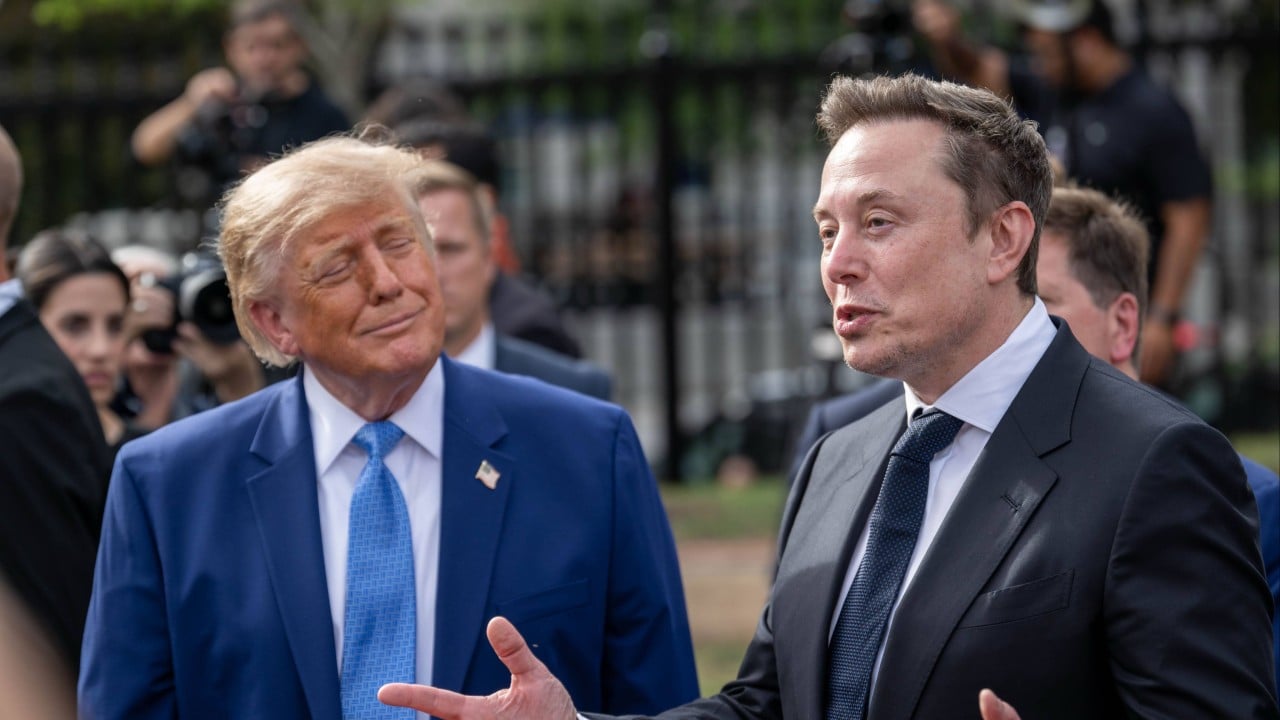
When President Donald Trump presented the National Medal of Science to SpaceX and Tesla chief executive Elon Musk during a high-profile ceremony at the White House, mainstream coverage framed it primarily through a political lens. Yet, beneath the political theater lies a deeper structural shift in how the American state rewards and integrates private industrial power. Alongside Musk, tech luminaries such as Nvidia chief Jensen Huang and Google co-founder Sergey Brin received the nation's highest civilian honors for scientific and engineering achievement. This alignment signals an era where traditional federal research laboratories share center stage with hyper-capitalized commercial enterprises that dictate the pace of modern infrastructure.
To understand why this moment matters, one must examine the evolution of the National Medal of Science itself. Established by Congress in 1959 in the wake of the Sputnik shock, the award was originally designed to honor academic researchers, theoretical physicists, and public-sector biologists who pushed the boundaries of fundamental knowledge. Think Vannevar Bush or chemists working under strict academic auspices. Over the decades, however, the center of gravity for technological breakthroughs shifted away from university quads and into venture-backed corporate workshops. By awarding these medals to corporate titans who command multi-trillion-dollar market caps, the federal establishment formally acknowledges a reality that has been brewing for twenty years. The primary engines of applied physics and computational scale are no longer funded exclusively by public grants; they are fueled by private equity, commercial payloads, and proprietary artificial intelligence models.
The inclusion of Musk in this echelon highlights the profound convergence between state security interests and commercial aerospace. SpaceX did not achieve its current dominance through traditional defense procurement models. Instead, it bypassed legacy bureaucratic hurdles by developing reusable orbital-class rocket boosters through iterative failure and private capital deployment. When a government bestows its top scientific medal on an industrialist whose rockets now service NASA supply runs and military payloads alike, it blurs the line between civilian enterprise and national sovereign capability. Critics argue that honoring active corporate chiefs creates an uncomfortably close feedback loop between regulatory bodies and the regulated billionaires. Defenders counter that ignoring private sector engineering feats would render these state honors obsolete, disconnected from where actual physical breakthroughs occur.
Consider the parallel recognition of Jensen Huang. Nvidia's graphics processing units became the unexpected bedrock of the modern artificial intelligence boom, underpinning everything from defense contractor simulations to commercial large language models. When the state honors the architect of that silicon pipeline, it is effectively recognizing that semiconductor supply chains are as vital to national defense as aircraft carriers and nuclear stockpiles. The ceremony in Washington was not merely an award presentation; it was a public ratification of techno-industrial consolidation.
Yet, this dynamic introduces severe structural vulnerabilities. When the nation's technological advancement relies heavily on a handful of eccentric billionaires and hyper-concentrated corporate monopolies, public accountability becomes secondary to corporate velocity. If an academic laboratory fails, another research group takes its place. If a dominant private aerospace provider or semiconductor foundry stumbles due to internal corporate governance failures, the entire national security apparatus feels the shockwaves. The state has effectively outsourced its high-risk R&D floor to private balance sheets, absorbing the upside while underwriting the underlying infrastructure through massive federal contracts.
History suggests that wrapping corporate supremacy in the flag carries distinct long-term risks. When industrial titans become too big to fail and too technologically dominant to regulate effectively, the traditional checks and balances of a democratic republic begin to fray. The state validates their supremacy with gold medals and public acclaim, cementing an alliance where corporate boardrooms and federal agencies operate as a single fused entity.
The medals have been handed out, the photos archived, and the political cycle moves forward. But the underlying architecture of American innovation has permanently changed, leaving the public sector increasingly dependent on private empires to maintain its edge.
President Trump awards medals to Elon Musk, Nvidia CEO Jensen Huang and other top executives at the Science: A New Golden Age Summit.
This video provides a direct look at the official proceedings where these high-level technology and science awards were distributed to industry leaders. [ Tech Executives Awarded ]