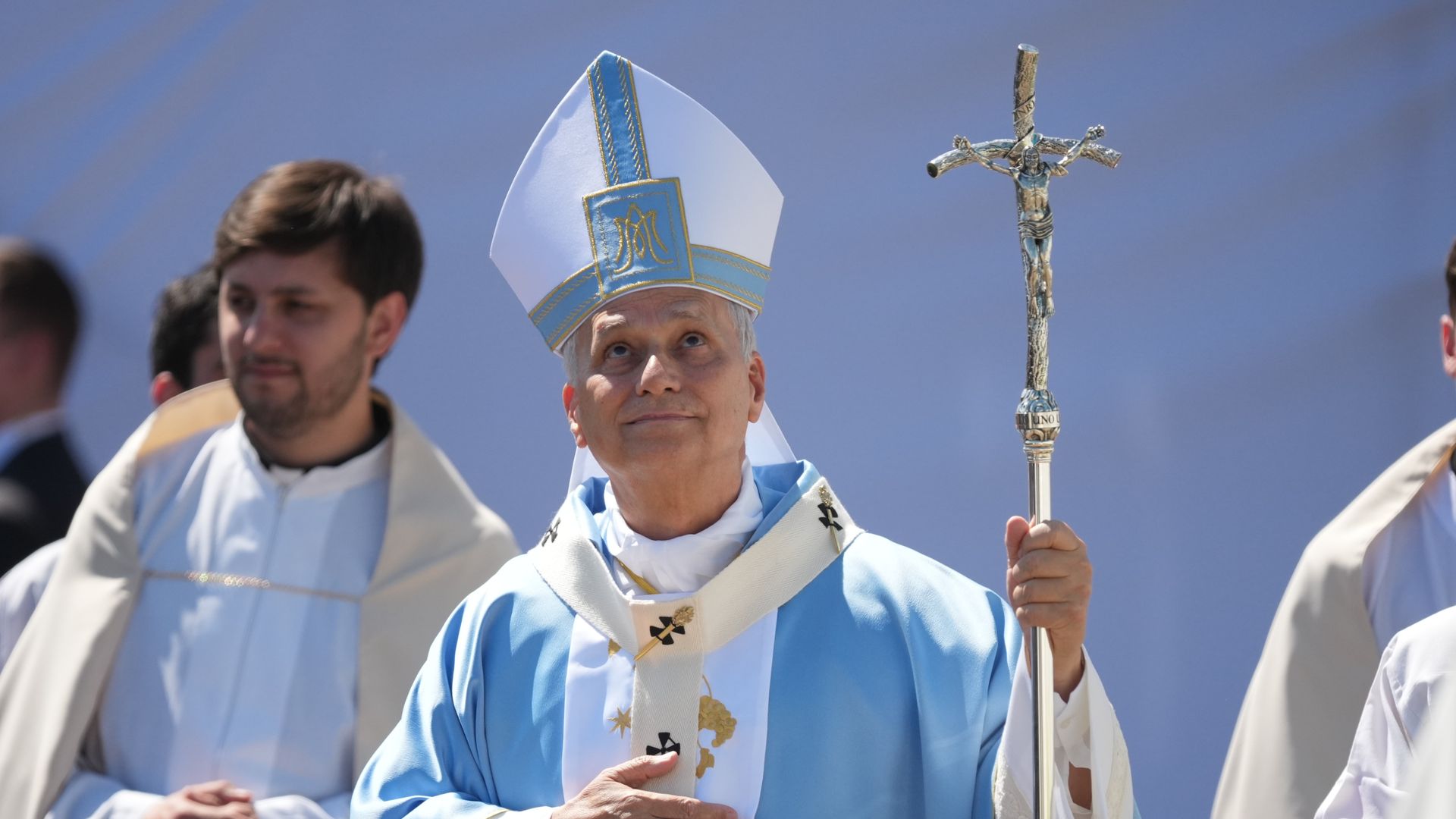
The papal plane lifted off from Buenos Aires leaving behind a deeply fractured nation and a clear ideological warning. By concluding his long-awaited homecoming with an urgent call for social cohesion, Pope Francis directly challenged the radical free-market agenda of President Javier Milei, exposing an irreconcilable divide over who bears the true cost of economic recovery.
Surface-level coverage frames this historic visit as a simple story of personal reconciliation between two stubborn Argentine leaders. That reading misses the point entirely. What unfolded across the plazas and cathedrals of Argentina was not a polite diplomatic détente, but a high-stakes collision between two incompatible worldviews regarding human dignity, state responsibility, and the morality of capital. For another view, read: this related article.
For decades, observers of Vatican diplomacy have watched pontiffs navigate hostile political terrain with coded language and careful protocol. Francis abandoned that playbook on his own soil. Having stayed away from his homeland for more than a decade to avoid being used as a political pawn by the Peronist establishment, the Argentine pontiff finally returned at a moment when the country's social fabric is stretched to its breaking point. His message was unmistakable. A balanced budget built on the backs of the vulnerable is not a moral victory.
The Architecture of an Ideological Collision
To understand why this visit carried such explosive weight, one must look at the mechanics of the opposing philosophies at play. On one side stands Javier Milei, an anarcho-capitalist economist who rode a wave of hyperinflationary fury into the Casa Rosada. His governing thesis is blunt and uncompromising. The state is not the solution to Argentina's chronic dysfunction; the state is the disease. Through aggressive deregulation, massive public spending cuts, and the dismantling of state subsidies, his administration has pursued fiscal surplus with religious fervor. Similar insight on this matter has been shared by The New York Times.
On the other side stands Pope Francis, whose entire papacy has been defined by a fierce critique of unchecked market fundamentalism. Grounded in Catholic Social Teaching, the Vatican's economic framework rejects the notion that the invisible hand of the market naturally distributes justice. In this view, property and capital carry a social mortgage. When economic shock therapy slashes pensions, shutters soup kitchens, and erodes real wages in the short term to secure macroeconomic stability in the long term, Rome views it not as necessary medicine, but as structural abandonment.
The tension between these two men has deep, bitter roots. Before ascending to the presidency, Milei famously disparaged the Pope in television appearances, labeling him an imbecile and accusing him of promoting communism while standing on the wrong side of history. Although Milei later walked back the insults and embraced Francis at the Vatican in a widely photographed display of pragmatic truce, the underlying philosophical chasm never closed. Handshakes in Rome are easy. Governing a country where poverty rates have surged past half the population is something else entirely.
The Street Reality Behind the Macroeconomic Metrics
Wall Street analysts and international bondholders have largely applauded Milei's fiscal discipline. Monthly inflation rates cooled from terrifying peaks, the central bank rebuilt depleted reserves, and Argentina posted its first fiscal surpluses in over a decade. On spreadsheets in New York and London, the turnaround looks remarkable.
On the ground in the sprawling suburbs of Greater Buenos Aires, the math tells a radically different story.
The elimination of transport and utility subsidies hit working-class families overnight. Small businesses collapsed under the weight of plummeting domestic consumption. Public universities marched in the streets to protest funding freezes, while retirees watched the purchasing power of their fixed incomes evaporate at the pharmacy counter.
Francis did not need briefing papers from the Roman Curia to understand this reality. As Jorge Mario Bergoglio, the former Archbishop of Buenos Aires, he spent years walking the unpaved streets of the villas miseria—the city's impoverished shantytowns. He built an entire pastoral network of curas villeros (slum priests) who live alongside the marginalized and operate the community kitchens and addiction recovery centers that serve as the final safety net when the state retreats.
During his visit, the Pope deliberately bypassed the sterile corridors of financial power to spend time with these grassroots organizers. By elevating their work, he sent a sharp signal to the Casa Rosada. When government ministers accuse social movements of corruption and cut off food aid to community kitchens pending audits, they are not merely dismantling bureaucratic waste. They are severing lifelines in neighborhoods where the private sector has no financial incentive to operate.
Why the Unity Plea Was Actually a Warning
Mainstream headlines focused heavily on the Pope's closing remarks calling for national unity and dialogue. In political journalism, "unity" is often treated as a soft, generic platitude—the kind of harmless sentiment leaders offer when they want to avoid taking a side.
In the context of Argentine politics, calling for unity is a direct rebuke to Milei's governing style.
Milei's political survival depends on polarization. He thrives on framing every policy debate as an existential war between the virtuous producers of wealth and the parasitic "caste" of politicians, union bosses, and state dependents. Compromise is treated as treason. Consensus is dismissed as weakness. By constantly attacking congress, provincial governors, and journalists, the president maintains the revolutionary energy that keeps his base mobilized while structural reforms inflict severe pain.
Francis knows this playbook intimately, having watched successive Argentine governments weaponize division for half a century. His insistence on fraternity and social friendship directly undermines the narrative that economic salvation requires crushing political opponents. A society cannot heal its currency if it destroys its capacity for basic solidarity.
Consider a hypothetical example of how this plays out in a mid-sized industrial town in Santa Fe province. If a local factory closes due to collapsing domestic demand and removal of import protections, a purely libertarian framework views that closure as efficient market clearing—capital moving away from uncompetitive enterprise. Yet the immediate human fallout hits the parish hall, the municipal clinic, and the local school. Without coordinated institutional support and social dialogue between labor, business, and the state, the town does not simply recalibrate; it decays into generational despair. That gap between abstract economic efficiency and lived human consequence is precisely where the Vatican planted its flag.
The Geopolitical Stakes for Latin America
The friction in Buenos Aires extends far beyond Argentina's borders. Latin America has become a testing ground for radical populist experiments on both the ideological left and right, and the Catholic Church is fighting to maintain moral relevance across a region where evangelical Protestantism is rapidly gaining ground.
For years, conservative critics accused Francis of turning a blind eye to authoritarian abuses by leftist regimes in Venezuela and Nicaragua while reserving his sharpest critiques for capitalist democracies. His firm pushback against Milei was, in part, an effort to reassert the Vatican's independent moral authority. The Church cannot afford to be seen as a chaplain to austerity, nor can it allow its social doctrine to be co-opted by nationalist movements that wrap harsh economic policies in religious imagery.
Milei has actively courted global conservative figures, positioning himself as a standard-bearer for a new libertarian right. By challenging Milei on his home turf, Francis drew a bright line between traditional Catholic social thought and modern anarcho-capitalism. The two systems share virtually no DNA. One prioritizes the common good and the protection of the weak; the other enshrines absolute individual liberty and property rights above all else.
The Dilemma Facing Argentina's Bishops
Caught squarely in the middle of this clash is the Argentine Episcopal Conference. For months prior to the papal visit, local bishops walked a tightrope. They repeatedly sounded the alarm over rising hunger and the suspension of food deliveries to community centers, earning fierce pushback from government officials and libertarian influencers on social media. At the same time, the Church hierarchy has been careful not to align itself with the discredited Peronist opposition, whose decades of fiscal mismanagement and corruption created the inflationary monster Milei was elected to slay.
This is the gray area that commentators often ignore. The critics of Milei's shock therapy do not have an easy, painless alternative sitting in a drawer. Argentina's previous economic model—built on printing money to fund sprawling deficits, artificial exchange rates, and suffocating regulations—had completely collapsed. A painful adjustment was mathematically unavoidable regardless of who won the presidency.
Francis acknowledged this underlying reality by refusing to endorse past administrations or offer specific technocratic prescriptions. Popes do not write central bank monetary policy. Instead, he challenged the distribution of the burden. If austerity is necessary, the moral test of a government is whether the sharpest cuts fall on the entrenched privileges of the powerful or on the daily bread of the poor.
What the Homecoming Revealed About Power
The visual contrast throughout the visit told the entire story without needing a single press release. On one side stood a president surrounded by economists, tech entrepreneurs, and foreign investors celebrating sovereign risk spreads and deregulated markets. On the other stood an aging pontiff in a wheelchair, flanked by slum priests, labor leaders, and mothers fighting to keep neighborhood soup kitchens open.
Neither man backed down. Milei remained polite, respecting the protocol owed to a head of state and the spiritual leader of millions of Argentines, yet his administration gave no indication that it would soften its fiscal targets or restore dismantled subsidies. The shock therapy continues unabated.
Francis boarded his return flight to Rome having accomplished what he came to do. He refused to let his presence be used to sanctify an economic program he views as fundamentally unjust, and he reminded a deeply polarized nation that a country is more than an economy. Markets measure price, efficiency, and return on capital, yet they remain entirely blind to the quiet erosion of human dignity until the social fabric finally tears.