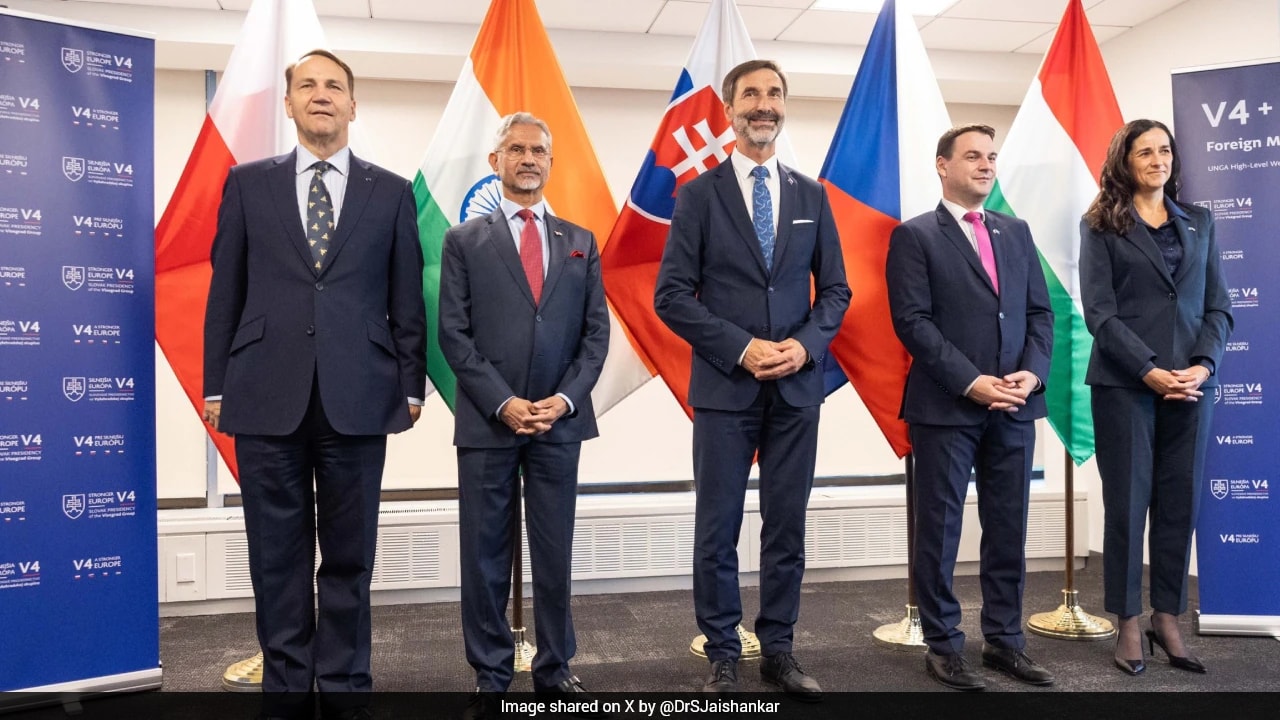
The architecture of global power is frozen in the wreckage of 1945. When the United Nations Security Council was forged, the victorious powers of a devastated world carved up geopolitical authority into a permanent five-member club equipped with absolute veto power. Decades have passed, empires have dissolved, and the center of demographic and economic gravity has shifted decisively toward the Global South. Yet the high table of international security management refuses to accommodate reality. New Delhi’s multi-decade campaign for a permanent seat on the United Nations Security Council recently received fresh diplomatic endorsement on the sidelines of the General Assembly, where the Visegrád Group—comprising Poland, Hungary, Slovakia, and the Czech Republic—formally backed India's inclusion.
Diplomatic communiqués from New York celebrate these moments as historic milestones. They are nothing of the sort. They are recurring theatrical maneuvers in a broken multilateral system where symbolic nods substitute for structural transformation.
The Arithmetic of Impasse
To understand why endorsements from Central European states or periodic nods from Western capitals fail to move the needle, one must examine the merciless mathematics of Article 108 of the United Nations Charter. Altering the composition of the Security Council requires an affirmative vote of two-thirds of the General Assembly, followed by ratification by two-thirds of the member states—a threshold that explicitly includes all five permanent members.
Every single incumbent permanent member holds an individual veto over its own dilution. A regional bloc statement from Eastern Europe, an annual bilateral declaration from Paris, or a carefully hedged statement of support from Washington cannot bypass this procedural bottleneck.
Publicly, the United States, the United Kingdom, and France express support for India’s inclusion in an expanded council. Privately, the diplomatic hedging tells a different story. The structural incentives for the existing five powers are entirely misaligned with expanding genuine authority. Sharing a permanent seat means diluting legislative dominance over international sanctions, peacekeeping mandates, and enforcement actions.
The Veto Trap and Second-Class Status
A core tension defines the diplomatic stalemate. When major capitals endorse an expanded council, they frequently attach caveats that new permanent members should temporarily or permanently forego the veto power.
New Delhi has rightly rejected this proposition. Accepting a permanent seat without veto authority creates a structural caste system within the high table—a second-tier permanent membership designed to appease demographic ambitions while keeping real executive control concentrated in traditional hands. A permanent seat stripped of veto capabilities is an administrative title, not an instrument of sovereign parity. India's foreign policy establishment understands that entering the chamber as a decorative fixture normalizes an unequal global hierarchy rather than dismantling it.
The Regional Counter-Mobilization
The obstacles are not confined to New York procedural hurdles or Western reservations. Opposition is institutionalized through rival coalitions like Uniting for Consensus, informally known as the Coffee Club. Middle powers such as Italy, Pakistan, Argentina, and Mexico organize explicitly to block the aspirations of the G4 alliance—India, Brazil, Germany, and Japan.
For regional rivals, preventing a competitor's permanent elevation trumps abstract commitments to multilateral modernization. Pakistan, for instance, maintains an active diplomatic containment strategy against New Delhi's bid, leveraging regional anxieties and coalition politics to ensure that any consensus on council expansion remains permanently out of reach. Within multilateral bodies, obstruction is easy; consensus is nearly impossible.
The G4 Coordination Dilemma
The structural strategy of the G4 coalition introduces its own complications. By binding their ambitions together, India, Brazil, Germany, and Japan attempt to present a united front for global governance reform. Yet this solidarity creates shared vulnerabilities.
Japan's inclusion faces intense regional resistance from China and historical complications in East Asia. Germany’s bid complicates European representation dynamics, as other European nations question why a continent already over-represented by France and the UK should secure another permanent slot. By tying India's ascent to a complex, multi-continental package deal, the coalition guarantees that opposition to any single member sinks the entire reform architecture.
The Limits of Multilateralism
Diplomats will continue to issue warm statements during high-level weeks. Trade ministers will sign bilateral frameworks, and regional forums will produce declarations acknowledging that a nation representing over one-fourteenth of humanity cannot permanently be locked out of the world's primary security arbiter.
These gestures generate headlines, but they do not alter the balance of power. The United Nations Security Council remains an institutional relic of a post-war order that is slowly eroding under the weight of contemporary geopolitical shifts. Until the costs of maintaining an outdated architecture outweigh the benefits of exclusivity for the incumbent powers, India's permanent seat will remain an unfulfilled promise, trapped inside a fortress designed to keep challengers out.
India's UNSC Bid Gets Fresh Backing From Hungary ...
This video provides additional context regarding the recent diplomatic backing India received from Central European nations for its UN Security Council seat bid.