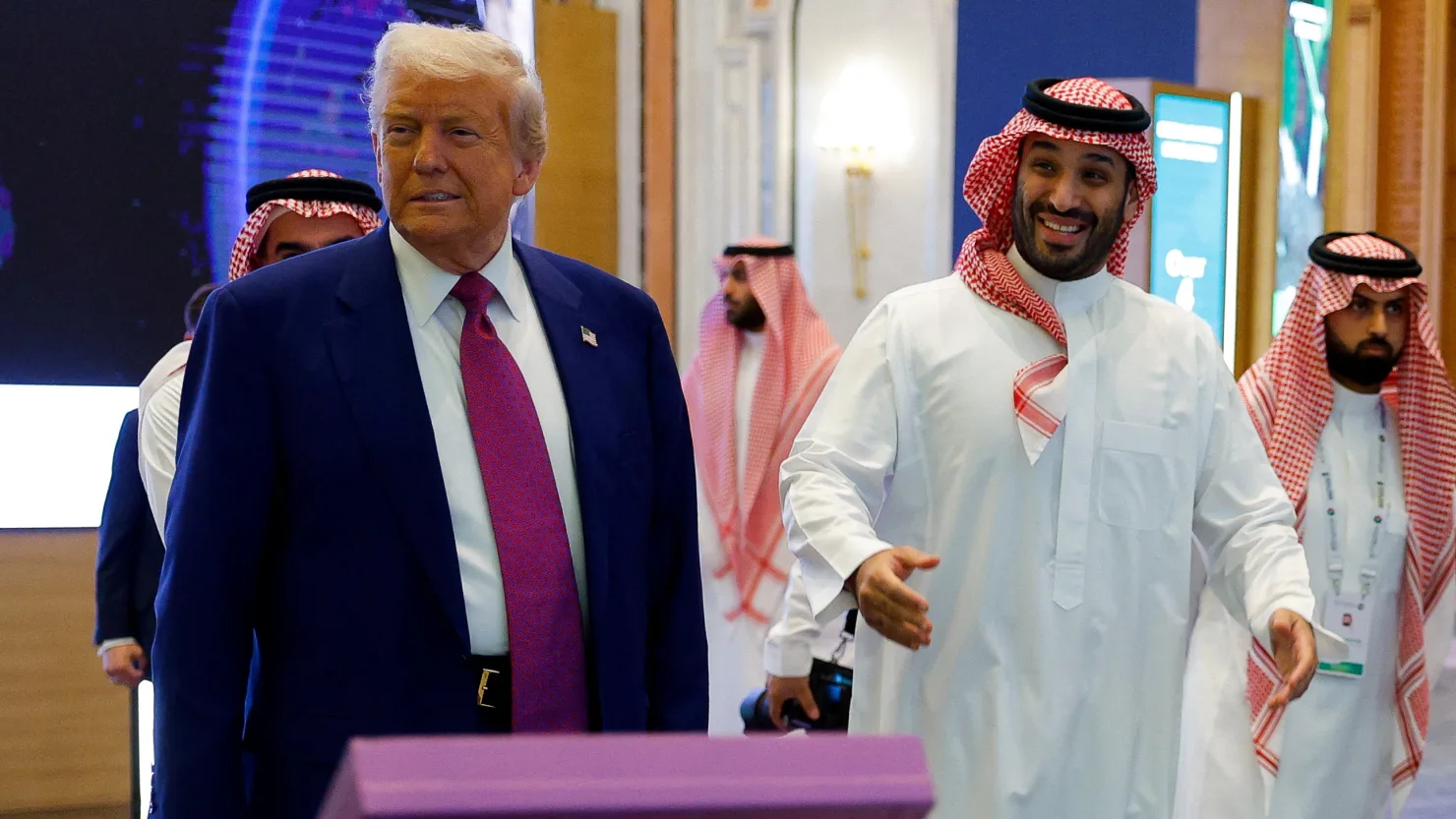
The fault lines in the Persian Gulf are shifting beneath heavy layers of transactional diplomacy. Donald Trump and Saudi Crown Prince Mohammed bin Salman have forged a high-stakes partnership designed to lock Riyadh into Washington's orbit while aggressively containing Iranian influence. Yet, this bilateral alignment carries a hidden cost. Beneath the optics of major defense packages, technology sharing, and massive capital flows, a sprawling shadow war threatens to drag both leaders into a conflagration neither can fully control.
Foreign policy observers often misread the relationship as a simple friendship. It is an uneasy convergence of survival instincts and economic ambitions. For Washington, the objective is straightforward: anchor Saudi Arabia firmly against rising great-power competitors while extracting financial commitments that feed American industrial priorities. For Riyadh, the calculations are far more existential. Mohammed bin Salman requires American security architecture and advanced military export licenses to safeguard Vision 2030, his sweeping domestic transformation project.
However, this architecture is sitting on top of an active fault line.
The Friction of Regional Ambitions
The primary miscalculation in the current U.S.-Saudi strategy lies in the assumption that economic integration can bypass unresolved regional flashpoints. Washington wants Riyadh to lead a cohesive regional security framework that includes normalization with Israel. Meanwhile, the Saudi leadership faces intense domestic and regional pressure regarding the ongoing humanitarian catastrophe and the lack of a genuine political horizon for Palestinians.
When security guarantees are traded like corporate assets, the margin for error narrows dramatically. For instance, consider a hypothetical scenario where an Iran-backed proxy launches a precision drone strike against critical oil processing infrastructure in the Eastern Province. Under the tighter alignment framework, Washington faces immense pressure to retaliate kinetically against Tehran or its proxies. Such a strike would instantly transform a localized proxy friction point into a full-scale regional war, disrupting global energy markets and exposing the vulnerability of Saudi mega-projects.
The architects in Washington and Riyadh are banking on deterrence through overwhelming economic and military dominance. History suggests otherwise. Deterrence often fails precisely because local actors calculate that the superpower backing them is overextended.
The Trap of Transactional Foreign Policy
The danger of the Trump-MBS axis is its hyper-transactional nature. Long-term strategic stability cannot be built solely on quarterly deliverables, massive defense contracts, and semiconductor access. When strategy is reduced to dealmaking, traditional guardrails disintegrate.
Iran watches these developments with calculated hostility. Tehran perceives the warming ties between Washington and Riyadh as an existential encirclement strategy. As economic pressure mounts and proxy networks face sustained pressure, Tehran's incentive to accelerate its asymmetric capabilities increases. The theater of conflict is no longer confined to diplomatic cables; it plays out in maritime chokepoints like the Bab al-Mandab strait, cyber space, and targeted drone operations across the Arabian Peninsula.
The spread of this shadow war exposes a brutal truth. Neither Donald Trump nor Mohammed bin Salman can insulate their economies from the shockwaves of a wider regional escalation. The very defense agreements meant to project invulnerability may end up serving as the tripwire that draws both nations directly into the battlefield.
Geopolitical realignments are rarely bloodless. As the Gulf becomes the epicenter of great-power competition once again, the margin for diplomatic error has effectively vanished. The spreading war is not a distant possibility; it is already testing the limits of the new Washington-Riyadh axis.
This video provides additional context regarding how the escalating tensions and conflicts involving Iran are putting the close U.S.-Saudi partnership to the test.