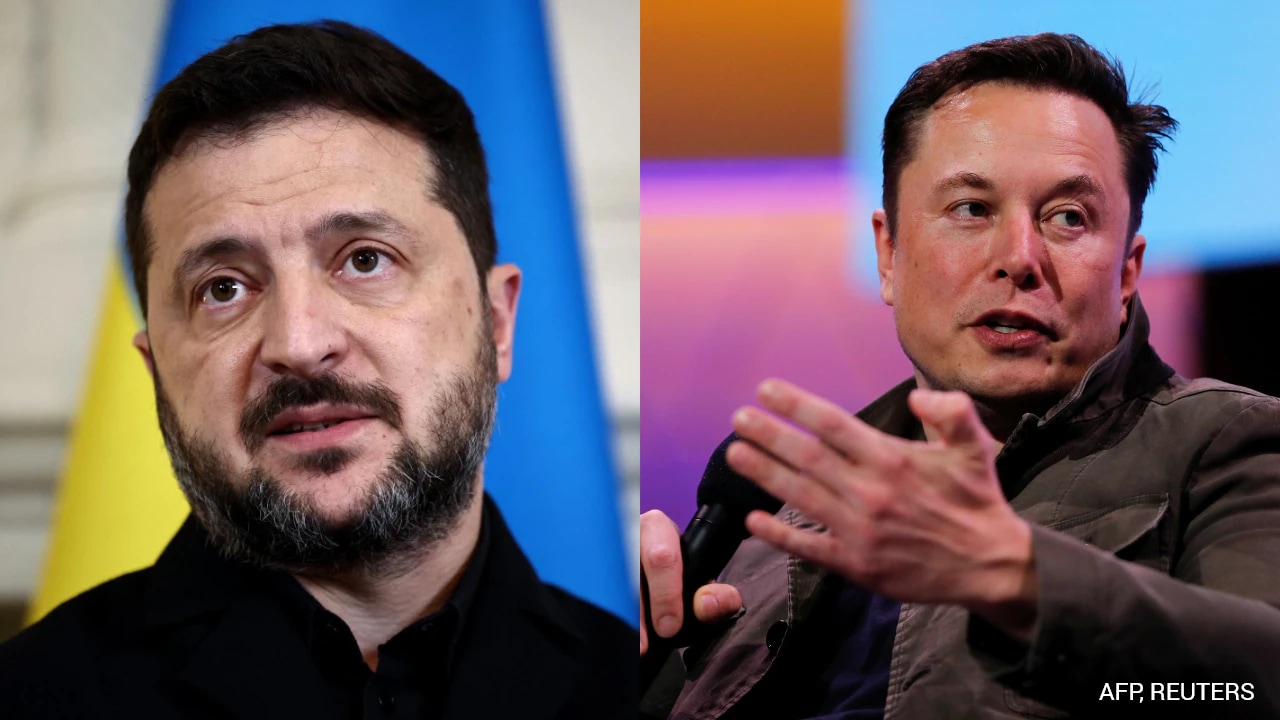
When Elon Musk declared that Volodymyr Zelensky is not always truthful during an appearance at The New York Times DealBook Summit on November 18, 2026, the confrontation looked like just another viral feud between a billionaire tech founder and a wartime president. It is not. Behind the insults and social media posts over recent strikes on Ukraine sits a brutal structural conflict over who actually governs modern warfare when commercial low-Earth-orbit satellites become battlefield infrastructure.
For months, Kyiv and SpaceX have been locked in a bitter dispute over connectivity restrictions, throttling, and military strikes. Ukrainian officials have accused SpaceX of slowing down vital links used to intercept incoming Russian drones and conduct mid-range strikes against occupying forces. Musk, speaking via video link to Andrew Ross Sorkin while traveling with President Donald Trump's delegation in China, pushed back sharply. He rejected claims that SpaceX restricted the military-grade Starshield network, insisted that Zelensky was asking to use commercial Starlink satellites for offensive operations, and asked bluntly why a private executive should be expected to make "kill decisions."
Strip away the cable-news theatrics and the snarky memes, and you find a deeper crisis. A sovereign nation fighting for survival now depends on a private corporation whose founder openly questions its leadership and whose satellites sit at the center of high-stakes diplomatic bargaining.
Why Commercial Satellites Collided With Modern Warfare
Traditional military communications rely on dedicated defense satellites, rigid command chains, and explicit government contracts. Starlink was built differently. It is a massive constellation of commercial satellites designed for high-speed, low-latency broadband on Earth, scaled through rapid rocket launches and mass-produced user terminals.
When Russia invaded Ukraine and knocked out conventional communications networks, that commercial architecture became indispensable. Troops in the field used Starlink dishes for command-and-control links, reconnaissance feeds, and coordination where fiber lines were severed or jammed. Over time, Ukrainian forces also adapted satellite connectivity for drone operations and strike coordination, blurring the line between civilian connectivity and kinetic warfare.
That collision creates a nightmare for any private company. A commercial broadband network is governed by terms of service, export controls, corporate risk tolerance, and the personal convictions of its chief executive. A military campaign is governed by operational necessity, speed, and survival. When a drone operator or field commander relies on a commercial link to intercept an incoming threat or hit an artillery position, a software throttle or a policy restriction is not an abstract corporate boundary. It is a tactical setback on the ground.
Musk has repeatedly drawn a bright line around offensive military use. From his perspective, supplying connectivity that enables strikes crosses from providing communications into participating in lethal targeting. Yet on a fluid front line, defenders rarely view hitting an enemy launch site or occupying force as an optional "offensive" luxury. To Kyiv, striking targets inside occupied territory or intercepting incoming aerial threats is part of defending the state.
The Fog Over Starshield, Speed Caps, and Accountability
One reason this clash has grown so toxic is that neither side agrees on what actually happened technically or who pulled the lever.
Reporting in October 2026 pointed to restrictions affecting Ukraine's access to SpaceX satellite services, followed by arguments over speed caps and whether Starlink or Starshield was throttled. Ukrainian leaders have argued that reduced speeds degraded their ability to intercept drones and carry out mid-range strikes against Russian military targets. SpaceX and Musk have disputed characterizations of Starshield restrictions while maintaining that commercial Starlink was never meant to serve as an engine for offensive attacks.
Even Washington's public posture has added to the confusion. Defense Secretary Pete Hegseth stated in October that the Pentagon had not pulled back service or issued directives to manipulate it, pointing instead to terms-of-service compliance. Meanwhile, Musk has publicly argued that limits on speed or usage belong with the U.S. military and the president, even as critics pointed to his own public clashes with Kyiv and his reposting of arguments that extending Starlink to Ukraine was a mistake.
When a vital battlefield system operates inside a cloud of conflicting statements, accountability evaporates. If a strike fails or an interceptor misses its window because bandwidth dropped, soldiers on the ground cannot easily tell whether the cause was Russian electronic warfare, a technical bottleneck, a contract rule, or a political dispute. That ambiguity breeds resentment on both sides. Kyiv sees its lifeline politicized. SpaceX sees itself blamed for every operational frustration in a war it did not start.
Geopolitics Meets Corporate Power in Beijing
Timing matters enormously in high-stakes diplomacy, and Musk's DealBook remarks did not happen in a vacuum. He spoke from China alongside President Trump's delegation as talks unfolded involving Trump, Russian President Vladimir Putin, and Chinese President Xi Jinping.
At that moment, the dispute over Ukraine's connectivity stopped being merely a technical disagreement between a satellite operator and a foreign government. It became entangled with big-power diplomacy and domestic politics in Washington. A few days earlier, on November 5, Zelensky had warned on German television that concentrating too much power in the hands of one extraordinarily wealthy individual is dangerous—a comment that drew an immediate pushback on X.
When one private executive controls critical battlefield infrastructure and also moves inside high-level diplomatic circles, foreign policy no longer runs solely through embassies and defense ministries.
Consider a hypothetical example to see how precarious that dynamic is. Suppose a European ally or the Pentagon wants to surge high-bandwidth satellite capacity to a threatened sector ahead of a major Russian drone wave, while a corporate executive is simultaneously engaged in sensitive talks with adversaries or pressing a competing geopolitical view. Even if formal contracts remain in place, the perception that private leverage or personal friction can shape wartime access undermines trust across the entire alliance.
To be fair to Musk and SpaceX, there is a genuine counter-argument that critics often gloss over. Private companies are not elected governments. If a foreign military uses a commercial service to guide strikes and triggers escalatory consequences, a private firm can find itself dragged into a geopolitical conflict with little democratic oversight or clear legal indemnity. Asking a businessman to act as an informal arbiter of wartime targeting is a real flaw in how modern defense procurement evolved.
Still, acknowledging that dilemma does not excuse turning a life-or-death defense dependency into a public sparring match. Leaders carry weight when they speak, especially when their companies hold near-monopoly capabilities in orbit.
What Kyiv and Its Allies Must Confront Now
Blaming Zelensky or Musk alone misses the real structural lesson. Ukraine's vulnerability stems from over-reliance on a single commercial provider for mission-critical communications, while Western allies allowed a private company's commercial network to fill gaps that sovereign defense systems should have covered years ago.
There are no easy fixes, and any transition carries friction. Building redundant satellite links, expanding hardened military communications, and negotiating ironclad rules of engagement take time, money, and engineering discipline. No alternative system can match SpaceX's launch cadence or orbital scale overnight.
Yet waiting for goodwill or hoping social media truces will hold is a losing strategy. Governments that treat commercial megaconstellations as a cheap substitute for resilient sovereign defense infrastructure invite exactly this kind of crisis—where wartime strikes, diplomatic bargaining, and billionaire grievances collide in full view of the world.
Kyiv and its partners need binding, transparent operational agreements with clear technical guarantees, paired with an urgent push to diversify communications channels before the next winter offensive tests every link in the chain.