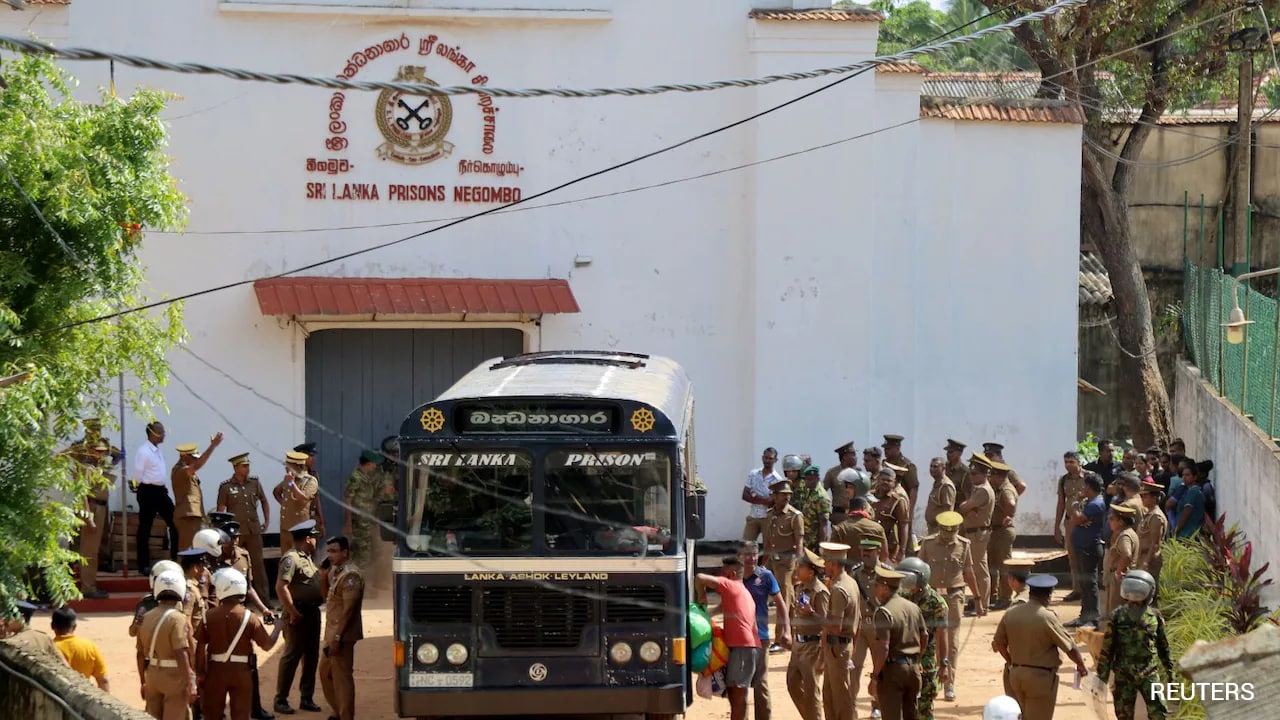
A state cannot solve a structural collapse by shifting its walls. Yet, that is exactly what the Sri Lankan government is attempting to do following the horrific bloodbath at Negombo Prison. The justice ministry recently announced its plan to convert a disused hospital section in Mahamodara, located in the southern Galle District, into a makeshift holding facility. This policy decision aims to alleviate an unprecedented overcrowding emergency. It came directly after rival drug cartels turned a high-security penitentiary into a slaughterhouse, leaving at least 27 people dead, including seven prison guards, and more than a hundred others severely injured.
The state response was predictable. Authorities deployed military drones, launched three separate investigations, and promised swift administrative action. But shifting prisoners into a defunct medical clinic does not address the core systemic failure. The island nation is currently running its penal network at roughly four times its intended capacity, packing more than 41,000 individuals into facilities built for a fraction of that number.
This is not a temporary logistical hiccup. It is an indictment of a broken judicial system and an unsustainable law enforcement strategy. By treating human beings as excess stock to be stacked in different rooms, the state ignores the underlying conditions that caused the Negombo catastrophe.
The Night Negombo Burned
The violence that erupted on a Sunday evening inside Negombo Prison was both shocking and entirely foretold. Negombo is situated roughly 35 kilometers north of the capital city of Colombo. It has long been known as a high-pressure cooker where rival syndicates from the country’s illicit narcotics trade are forced into close contact. The initial spark was a territorial clash between two prominent drug gangs during a routine holding period. By Monday morning, the confrontation escalated from a fistfight into an all-out insurrection.
Inmates quickly overpowered a group of guard staff. They seized service weapons and opened fire within the crowded wards. The prison became a war zone.
Outside the walls, terrified family members gathered in tears, desperate for any shred of information regarding their relatives. Above them, air force helicopters circled, and specialized commandos secured the outer perimeter, though they refrained from entering the burning facility. When order was finally restored by late Monday evening, the state run medical center in Negombo was overwhelmed. Hospital director Pushpa Gamlath confirmed receiving dozens of victims suffering from close-range gunshot wounds, deep lacerations, and severe blunt-force trauma. Eighteen of the most critically wounded had to be rushed under heavy armed escort to the Colombo National Hospital to save their lives.
The aftermath saw coffins draped in the national flag arriving at the prison department headquarters in Colombo. Colleagues paid their last respects to the fallen guards. Justice Minister Harshana Nanayakkara publicly expressed shock, stating that human beings had died and that such an event should never have occurred. However, grief does not substitute for policy. Shifting the ringleaders to separate facilities and organizing judicial commissions of inquiry are well-worn scripts in Sri Lankan governance. They rarely yield structural adjustments.
Shuffling Human Inventory Across Provinces
The decision to take over a section of the disused Mahamodara hospital reveals a government running out of options and space. The state intends to retrofit the medical structure with high-security barriers, surveillance apparatus, and reinforced cells to hold spillover inmates.
This spatial shell game ignores reality. A hospital building is architecturally designed to facilitate care, openness, and sanitation. Turning it into a cage requires significant structural modifications that rarely meet minimum humanitarian standards for incarceration.
The United Nations statement issued in Colombo shortly after the riot pointed directly to these historical failures. Overcrowding, outdated administrative practices, and sub-human conditions in detention centers have been recognized as critical challenges for decades. The state's quick fix treats the symptoms of a diseased penal system while ensuring the disease itself continues to spread.
Moving prisoners from the Western Province down to the Southern Province creates massive logistical friction for an already strained bureaucracy. Inmates must be transported across significant distances for regular court dates. This drains fuel, requires massive security escorts, and bogs down police personnel who should be working active investigations. It also severs the vital link between prisoners and their families. In Sri Lanka's underfunded correctional system, families frequently provide essential nutrition, clean clothing, and medicine that the state fails to supply. Isolating inmates in distant, repurposed structures increases their desperation. Desperation breeds future riots.
The Failure of the Pre Trial Detainer Assembly Line
To understand why Sri Lanka’s prisons hold over 41,250 people, one must look at the judicial system. The primary driver of this crisis is not an unprecedented spike in violent crime. It is an astronomical backlog of pre-trial detainees.
A substantial percentage of the people currently packed into these sweat-soaked cells have not been convicted of any crime. They are waiting. They wait months, sometimes years, just to see a judge for a preliminary hearing.
The country’s legal machinery moves at a glacial pace. Archaic paperwork requirements, a severe shortage of judges, and understaffed forensic laboratories mean that simple drug possession charges can result in years of administrative detention. Suspected low-level offenders who cannot afford meager bail amounts are thrown into cells alongside hardened cartel enforcers. This turns regional jails into criminal academies.
The state's punitive approach to drug addiction compounds the problem. Large-scale police sweeps routinely net hundreds of street-level users and micro-dealers in a single weekend. Instead of routing these individuals through public health channels or community rehabilitation frameworks, the system funnels them straight into the penal pipeline. The result is an unsustainable influx of bodies into a framework that was already structurally compromised decades ago.
Historical Precedent and the Cycle of Violence
The Negombo riot is not an isolated incident. It is part of a clear historical pattern. In December 2020, during the height of the global pandemic, a remarkably similar insurrection occurred at the Mahara prison facility.
During that event, 11 inmates lost their lives and over a hundred others were wounded when anxieties over virus transmission inside congested cells boiled over into mass panic. The state's response then was temporary compliance. They released a few hundred low-level detainees to ease pressure, promised sweeping changes, and then allowed the system to slide back into its default state of neglect.
Six years later, the death toll has more than doubled. This trajectory shows that the system is growing more volatile over time. When human beings are packed into rooms where they must sleep in shifts on concrete floors, normal human psychology breaks down. Sanitation becomes impossible. Skin diseases, respiratory infections, and mental health crises run rampant. When you add the element of rival drug syndicates operating protection rackets within those very walls, major violence becomes an mathematical certainty.
The government's current strategy of building more walls, whether by acquiring old hospitals or planning new perimeter fences, assumes that the problem is a lack of physical containment. It is a fundamental miscalculation. The problem is a lack of institutional throughput. If the intake speed remains high and the release speed remains low, any new space will be filled to capacity within months of its opening.
Weaponizing Public Infrastructure
Converting healthcare infrastructure into carceral space sends a troubling message about state priorities. The Mahamodara hospital facility might be currently disused, but repurposing medical ground into a prison speaks volumes about the current state of public resources.
Sri Lanka has recently endured profound economic turmoil. Its public healthcare system faces severe shortages of basic pharmaceuticals, specialized medical equipment, and trained personnel. Using state funds to turn a house of healing into a house of confinement is a poor use of scarce capital.
The conversion process requires substantial investment. Installing iron bars, creating isolated cell blocks, building guard towers, and establishing secure armories costs money that could otherwise be used to modernize judicial processing infrastructure. Digitizing court dockets, expanding the numbers of magistrates, and funding mobile court units would do far more to reduce the prison population than opening an ad-hoc jail in Galle.
Furthermore, local communities in Mahamodara are now forced to live alongside a makeshift high-security prison holding volatile gang elements moved from the capital region. This creates justified local anxiety. It also permanently destroys the potential for that public asset to ever return to its original purpose of providing medical aid to an underserved southern population.
Redefining the Parameters of Reform
True security will not be found in the old wards of a southern hospital. If the Sri Lankan government genuinely wishes to prevent another line of flag-draped coffins from entering its departmental headquarters, it must pivot away from temporary containment and address the structural mechanics of its justice apparatus.
A meaningful intervention requires immediate, concrete steps:
- Establish mandatory statutory limits on pre-trial detention: Individuals accused of non-violent offenses must be automatically released on personal recognizance if the state fails to bring them to trial within a set number of months.
- Decriminalize simple narcotics possession: Shifting drug addiction from a criminal matter to a public health framework would immediately remove thousands of low-level detainees from the intake pipeline.
- Expand the judicial workforce: The state must invest heavily in appointing new magistrates and expanding court capacities to clear the multi-year case backlog that leaves thousands trapped in legal limbo.
- Implement independent, external oversight for prison administration: Internal inquiries led by departmental insiders rarely expose systemic corruption or guard complicity in gang activities.
The tragedy at Negombo Prison proved that the current penal architecture is unsustainable. Repurposing a disused hospital in Galle is a desperate effort to hide the overflow of a failing system from view. Until the state stops building new cages and starts repairing its broken legal machinery, the conditions that caused the latest bloodbath will remain perfectly intact.