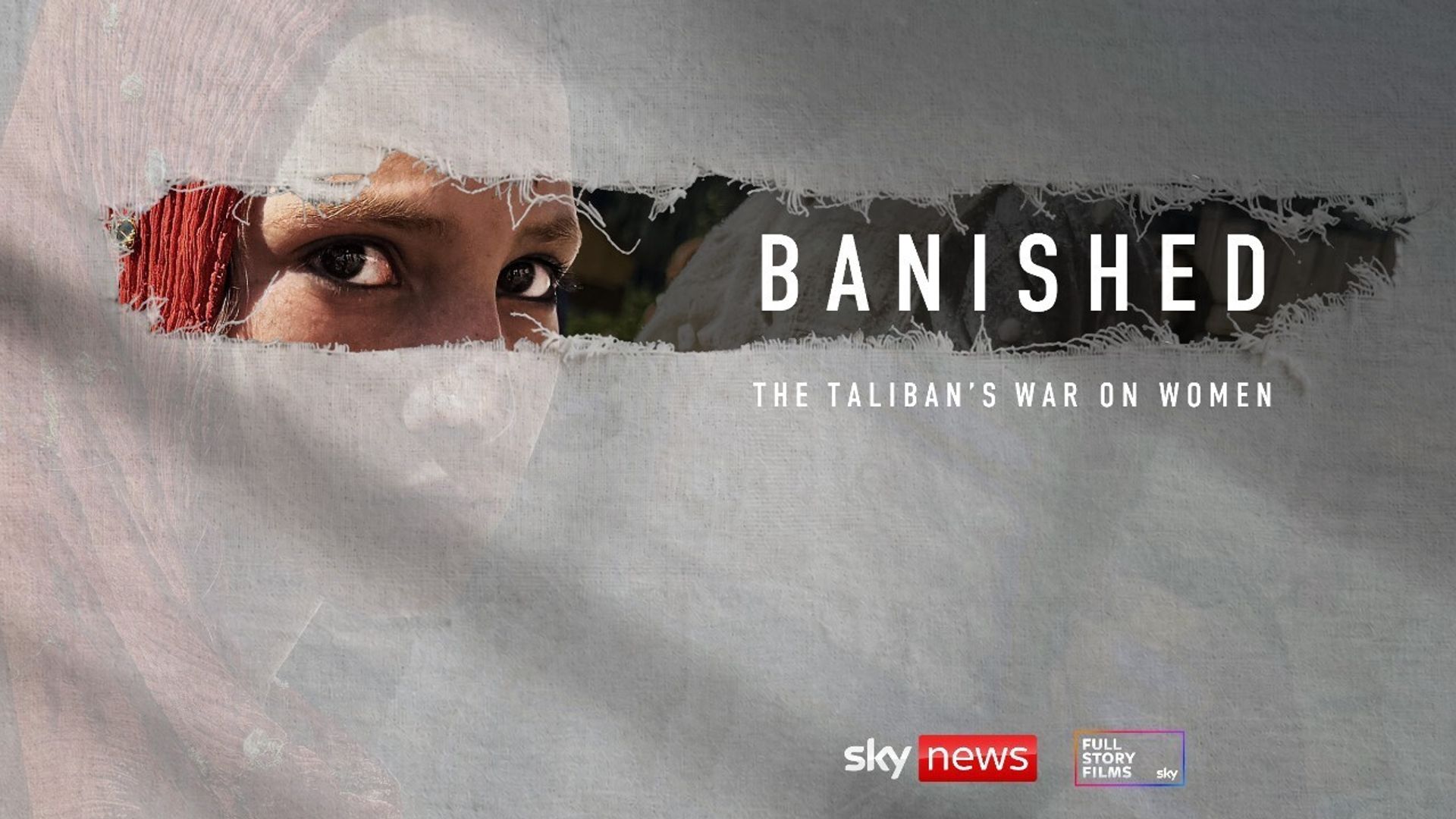
Tickets are officially available for the live theatrical screening of Banished: The Taliban's War On Women, an investigative documentary produced by Sky News that documents the systematic erasure of women from public life in Afghanistan since the 2021 return of the Taliban. While standard promotional notices focus on box office logistics and screening dates, the film itself represents a critical intersection of frontline war journalism, international human rights advocacy, and the changing economics of long-form television documentaries.
The release comes at a moment when global news cycles have largely moved on from Kabul. Four years after the chaotic Western withdrawal, Afghanistan rarely leads evening broadcasts. Sky News is betting that a theatrical rollout, paired with live panel discussions, can force a sustained reckoning with what legal scholars and United Nations experts increasingly classify as gender apartheid. Also making headlines in this space: The Anatomy of State-Driven Media Liquidation.
What the Sky News Investigation Uncovers
Most Western reporting on Afghanistan since August 2021 relies on remote interviews, encrypted messaging apps, or heavily sanitized press tours chaperoned by Taliban minders. Banished breaks that mold by relying on covert on-the-ground footage, hidden-camera testimonies, and prolonged access to underground networks operating inside the country.
The core premise of the documentary is straightforward. The restrictions imposed on Afghan women are not isolated religious decrees or temporary security measures. They form an interlocking legal and administrative architecture designed to remove half the population from civic, economic, and intellectual existence. More insights into this topic are detailed by USA Today.
Viewers are taken inside clandestine classrooms where teenage girls study physics and literature behind blacked-out windows, risking arrest by the Ministry for the Propagation of Virtue and the Prevention of Vice. The film tracks former judges, doctors, and civil servants who went from running state institutions to being legally barred from walking to a pharmacy without a mahram, or male guardian.
Unlike fleeting news packages that treat suffering as a visual backdrop, the documentary traces the bureaucratic precision of the crackdown. Since 2021, the de facto authorities have issued dozens of formal edicts. They banned girls from secondary schools and universities, shuttered women-owned businesses, closed beauty salons—which had served as one of the last remaining female-only public spaces—and prohibited women from working for domestic and international non-governmental organizations.
Why Broadcasters Are Turning to Theatrical Screenings
To understand why a major news network like Sky News is selling tickets to a documentary screening rather than simply dropping the film onto YouTube or its linear broadcast channel, you have to look at the structural realities of modern journalism.
Investigative documentaries are extraordinarily expensive to produce. Sending teams into high-risk environments, securing local fixers, verifying covert footage, and navigating hostile regimes drains newsroom budgets fast. In an era of shrinking digital ad revenues and fractured television audiences, a 60-to-90-minute investigative film can easily disappear in the algorithmic noise of a standard broadcast night.
Theatrical screenings solve three distinct problems for news organizations.
First, they create an event-driven news hook. By staging a premiere with a live Q&A featuring the correspondents, producers, and human rights advocates involved, the network generates earned media across rival outlets, podcasts, and social platforms. Entertainment reporters, political columnists, and foreign policy analysts all cover the room.
Second, live screenings build direct engagement with policymakers and high-information audiences. When a documentary plays in London, New York, or Brussels, the audience is not passive. It includes parliamentarians, diplomats, legal scholars, and diaspora leaders who have the institutional power to act on the reporting. A television broadcast talks to the public; a ticketed screening convenes a coalition.
Third, it establishes editorial prestige. Broadcast networks compete fiercely for industry recognition—BAFTAs, Emmys, Peabody Awards—because prestige underpins subscription value and brand trust. Putting a film in a cinema signals that the journalism transcends daily news churn and belongs in the permanent historical record.
The Architecture of Erasure Inside Afghanistan
The phrase "war on women" often gets used metaphorically in Western political discourse. In the context of contemporary Afghanistan, it functions as a literal description of state policy.
When the Taliban first ruled Afghanistan from 1996 to 2001, their enforcement of gender segregation was brutal, chaotic, and largely improvised by local commanders. Their second iteration is different. It is centralized, codified, and enforced through modern administrative tools.
Consider the economic impact alone. Prior to August 2021, women accounted for roughly 22 percent of Afghanistan's workforce, according to World Bank estimates. They were teachers, nurses, journalists, police officers, and entrepreneurs. By systematically expelling women from the labor market, the Taliban did not just violate individual rights; they deliberately engineered a macroeconomic contraction.
The United Nations Development Programme has estimated that restricting women from working costs the Afghan economy up to $1 billion annually—roughly 5 percent of the country's gross domestic product. In a nation already battered by droughts, frozen central bank assets, and the collapse of foreign aid, voluntarily amputating a massive portion of your productive workforce makes zero economic sense.
That contradiction reveals the true nature of the policy. For the Taliban's leadership in Kandahar, ideological purity outweighs economic survival. Suppressing women is not a byproduct of their governance model; it is the central pillar of their political legitimacy. By demonstrating absolute control over female bodies, movement, and education, the leadership signals to its hardline base that it has not compromised with Western norms.
The Legal Battle Over Gender Apartheid
One of the sharpest insights emerging from the reporting around Banished is the growing push to codify gender apartheid under international law.
For decades, the term "apartheid" has been legally tethered to race, defined by the 1973 International Convention on the Suppression and Punishment of the Crime of Apartheid and the 1998 Rome Statute of the International Criminal Court. Those treaties were drafted to address the institutionalized racial segregation of South Africa. They do not explicitly include sex or gender as a protected category for the crime of apartheid.
Legal experts and Afghan women's rights defenders argue that this gap leaves the international community without the proper vocabulary—or prosecutorial machinery—to confront what is happening in Kabul. While the Rome Statute does recognize "gender persecution" as a crime against humanity, advocates contend that persecution describes discrete acts of abuse, whereas apartheid describes an entire system of governance built on the subjugation of one group by another.
A hypothetical example illustrates the distinction. If a regime arbitrarily arrests female protesters or shuts down a women's newspaper, that constitutes gender persecution. When a regime legally strips women of the right to education, employment, freedom of movement, public speech, and judicial recourse—effectively reducing them to legal non-persons from birth to death—the system itself becomes the crime.
Codifying gender apartheid in upcoming United Nations treaties would carry concrete consequences. It would obligate signatory states to refrain from normalizing diplomatic relations with regimes that practice it, restrict trade and financial transactions that sustain the apparatus of oppression, and open new avenues for universal jurisdiction prosecutions.
The Limits of Western Outrage and Media Attention
There is an uncomfortable truth that documentaries like Banished force audiences to confront. Exposure does not automatically produce intervention.
Since 2021, Western governments have issued hundreds of strongly worded condemnations, imposed targeted travel bans on Taliban officials, and hosted countless summits on Afghan women's rights. None of it has reversed a single decree from Kandahar. In fact, the restrictions have only tightened, culminating in morality laws that even classify a woman's voice in public as an intimate part of her body that must be concealed.
Diplomats find themselves trapped in a strategic bind. Engaging with the Taliban risks granting them the international legitimacy they crave without securing meaningful concessions on human rights. Isolating them completely punishes an already starving population of 40 million people while leaving Western powers with zero leverage on the ground.
Meanwhile, regional powers like China, Russia, Iran, and several Central Asian republics have quietly expanded their diplomatic and economic footprints in Kabul. They accept Taliban ambassadors, sign mining contracts, and ignore the human rights dossier entirely. For Beijing or Moscow, what happens inside Afghan classrooms is strictly an internal affair.
This geopolitical reality creates a sharp divide between public sympathy and state action. Audiences in London or Washington can buy a ticket to a Sky News screening, feel profound moral outrage, and donate to humanitarian funds. Yet their governments have largely concluded that Afghanistan is no longer a core national security priority, especially with active wars in Eastern Europe and the Middle East dominating diplomatic bandwidth.
How Journalists Operate Under Totalitarian Surveillance
Producing a film like Banished requires tradecraft that resembles intelligence work more than traditional television reporting.
When foreign journalists enter Afghanistan today, they are subject to strict accreditation rules controlled by the Taliban's Ministry of Information and Culture. Movement outside Kabul is heavily restricted. Local translators and drivers—the backbone of any foreign bureau—face severe retaliation if their work is deemed critical of the Islamic Emirate. Arrests, beatings, and prolonged detentions of Afghan media workers have decimated the domestic press corps that flourished between 2001 and 2021.
To bypass these controls, investigative teams rely on distributed networks of citizen journalists and hidden recording devices. Women inside Afghanistan film their daily realities on smartphones, strip the metadata to prevent digital tracking, and transmit the files over encrypted channels using virtual private networks.
Every frame carries existential risk for the source. Producers must scrub reflections from mirrors, obscure background landmarks visible through windows, alter vocal pitches, and blur hands or clothing that might identify an individual to neighborhood informants. A single oversight in the editing suite can lead to a midnight raid on a family home in Herat or Mazar-i-Sharif.
This methodology changes the texture of the storytelling. The camera is often shaky, the framing tight, the lighting dim. Yet that visual rawness strips away the polished distance of conventional broadcast news. It forces the viewer into the claustrophobic physical space that Afghan women now inhabit every day.
What Attending the Screening Actually Accomplishes
Skeptics often dismiss documentary screenings and panel discussions as echo chambers for the already converted. That critique misses how policy shifts actually happen in democratic capitals.
Sustained public visibility prevents bureaucratic amnesia. Foreign ministries operate on crisis cycles; when a tragedy stops generating headlines, budgets get reallocated and diplomatic desks get downsized. High-profile investigative journalism keeps the issue on the agenda during parliamentary committee hearings, bilateral trade talks, and United Nations General Assembly sessions.
For audiences attending the Banished screening, the value lies in moving past abstract headlines to understand the mechanics of systemic oppression. Watching how an entire society can be legally dismantled in less than four years serves as a stark warning about the fragility of civil rights anywhere.
Tickets for the event provide direct access to the reporting team behind the investigation, offering a rare chance to interrogate the editorial choices, security challenges, and diplomatic realities that rarely make it into a broadcast script. If you want to understand the true cost of global indifference, start by watching the evidence on screen.