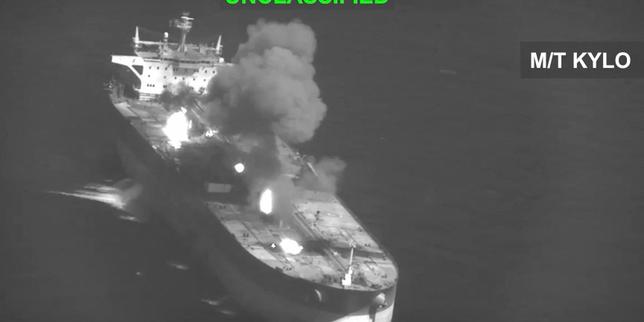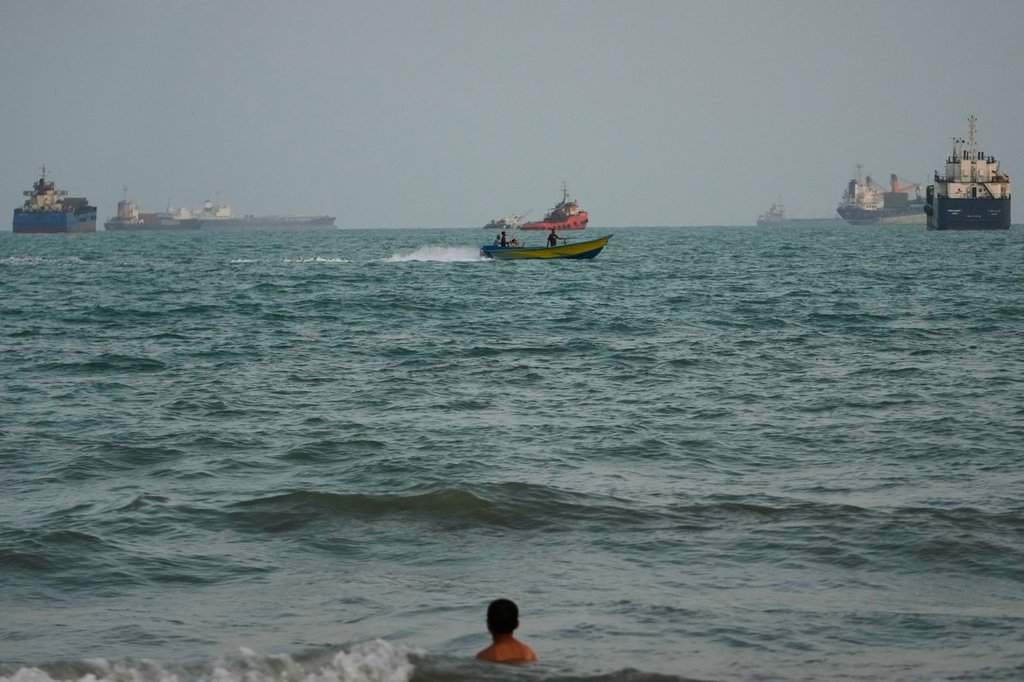
The rules of engagement in the Persian Gulf have fundamentally shifted. Following a failed missile assault by the Islamic Revolutionary Guard Corps against a United States aircraft carrier and a guided-missile destroyer, American forces retaliated not by striking missile batteries, but by permanently disabling three vessels belonging to Iran's export infrastructure. Two tankers were crippled off the coasts of Kharg Island and Jask, while a third unladen carrier was completely destroyed in the Gulf of Oman.
This is not a routine exchange of fire. It marks a calculated escalation into the economic jugular of the Iranian state, transforming a maritime security skirmish into a direct campaign against the shadow network funding Tehran's regional proxies. If you enjoyed this article, you might want to check out: this related article.
The Mechanics of Maritime Retaliation
Military doctrines are rarely rewritten overnight, but the events following the failed missile barrage point to a brutal new calculus. When CENTCOM commander Admiral Brad Cooper stated that the United States would, if necessary, destroy Iran's exposed oil fleet, he was signaling a departure from proportional military defense to asymmetric economic punishment.
Iran's energy export apparatus is uniquely vulnerable. Decades of international sanctions forced Tehran to rely on a shadowy collection of aging, unregistered, or flag-swapped tankers to move crude to clandestine buyers. These vessels lack sophisticated defensive counter-measures. They have no sovereign air cover, and the Iranian Navy lacks the blue-water capability to protect them far from the coast. For another look on this event, see the latest update from The New York Times.
When the Revolutionary Guard fired ballistic missiles at American warships, they crossed a threshold. The United States response bypassed traditional military targets and struck the financial lifeline sustaining the hardline leadership. Two tankers, including the M/T Downy near Kharg Island and the M/T Stark 1 near Jask, absorbed precision strikes that rendered them scrap metal. A third ship, the M/T Kylo, was obliterated in the Gulf of Oman after its crew received orders to abandon ship.
Economic Warfare Under Fire
The timing of these strikes undercuts any notion of a contained conflict. Just a day prior, the White House attempted to characterize the ongoing hostilities as minor skirmishes. Yet the reality on the ground—and on the water—tells a story of escalating desperation and hardening resolve on both sides.
Diplomacy has completely stalled. Negotiations intended to resolve the long-standing nuclear dispute collapsed months ago, leaving military posturing and economic coercion as the primary tools of statecraft. Tehran has sought to weaponize its geographic advantage, attempting to assert control over the Strait of Hormuz, a critical maritime chokepoint through which a substantial portion of global energy supplies normally flows. By restricting commercial traffic and targeting allied shipping, Iran hoped to inflict global economic pain that would force Washington to back down.
Instead, Washington's strategy has pivoted to stripping Tehran of its remaining revenue streams. Kharg Island, the primary terminal through which the vast majority of Iranian oil leaves the country, sits at the epicenter of this confrontation. Explosions rocked the waters near the island as missiles struck home, demonstrating that the critical infrastructure supporting the Iranian budget is well within range of American air and naval power.
The Broader Strategic Horizon
The confrontation carries profound implications for global energy markets and regional stability. Insurance rates for commercial vessels transiting the Persian Gulf are soaring. Shipowners are increasingly unwilling to risk multi-million-dollar assets in a war zone where civilian and military boundaries blur daily.
Furthermore, the domestic political landscape inside Iran faces acute pressure. The administration of President Masoud Pezeshkian has previously expressed a rhetorical preference for negotiated settlements, but the real power centers within the military and the Revolutionary Guard continue to double down on kinetic confrontations. Each exchange of fire hardens domestic political resistance against future compromises, creating a feedback loop of escalation that leaves little room for diplomatic off-ramps.
As long as the Strait of Hormuz remains a contested zone and shadow tankers serve as the primary proxy bank for regional militias, the United States military will maintain its posture of direct economic denial. The message delivered off the coast of Jask and Kharg Island leaves no ambiguity about the future of Iran's commercial fleet when American warships are in the crosshairs.