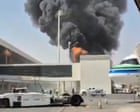
The warning issued by Yemen's Houthi movement targeting commercial passengers and aviation operations connected to Saudi Arabia’s primary aviation hubs marks a severe escalation in a conflict that international observers too often dismiss as a localized stalemate. When Houthi leadership publicly advised civilians and commercial airlines to steer clear of the Riyadh international aviation gateway following a reported military strike, the geopolitical stakes shifted instantly from regional proxy skirmishes to direct threats against international civil aviation.
For the traveling public and global logistics networks, this development shatters any remaining illusions that the airspace over the Arabian Peninsula remains insulated from asymmetrical warfare. The core reality is stark. Commercial aviation hubs in the Gulf are no longer safe harbors operating outside the blast radius of regional conflicts. As ballistic missile and drone technologies become increasingly sophisticated and accessible to non-state actors, the economic lifeline of the Gulf states faces a persistent, asymmetrical hazard.
Understanding this threat requires peeling back layers of official press releases and diplomatic platitudes. The Houthis possess a strategic playbook designed to inflict maximum economic damage with minimal investment. Targeting a major capital airport is not merely a tactical military maneuver; it is an assault on confidence. Tourism, foreign investment, business travel, and cargo transshipment rely entirely on predictability and safety. When a major terminal faces credible airborne threats, the invisible architecture of global commerce shudders.
Decades of reporting on Middle Eastern security architecture reveal a troubling vulnerability in modern air defense doctrines. Traditional anti-ballistic systems are designed to protect fixed military installations, command centers, and strategic oil infrastructure. Defending a sprawling commercial metropolis and its civilian terminals against low-flying, carbon-composite drones and medium-range cruise missiles is an entirely different operational challenge. It demands an economic calculus where defending a single incoming projectile can cost millions of dollars while the threat itself costs a fraction of that to manufacture and launch.
Intelligence assessments indicate that the weaponry utilized in these recent attacks reflects significant technological advancements in guidance systems. No longer reliant solely on crude line-of-sight coordination, these systems incorporate commercial-grade inertial navigation and satellite positioning workarounds that bypass basic electronic jamming. This technological creep changes the equation for civil aviation authorities worldwide. Insurance underwriters are already quietly recalculating war-risk premiums for carriers operating scheduled routes into Riyadh, Jeddah, and surrounding regional fields.
The immediate economic fallout will likely ripple outward long before any formal airspace closures occur. Airlines operating long-haul routes between Europe, Asia, and the Gulf are re-evaluating flight paths, fuel loads, and crew rest locations. If carriers are forced to implement precautionary holding patterns, altitude restrictions, or nocturnal operational blackouts, passenger convenience will degrade rapidly. More critically, air freight capacity—vital for high-value manufacturing components, pharmaceuticals, and perishable goods moving through Gulf hubs—faces imminent disruption.
Saudi security forces are caught in a difficult strategic bind. A heavy-handed military retaliation risks plunging fragile peace negotiations back into all-out hostilities, undermining the Kingdom's sweeping domestic economic transformation plans like Vision 2030, which depend heavily on international tourism and foreign corporate presence. Conversely, absorbing repeated strikes without an overwhelming deterrent posture invites escalation, emboldening non-state actors to test the limits of regional air defense networks further.
Diplomatic channels between regional intermediaries have accelerated behind closed doors. Yet, talks frequently founder on the fundamental asymmetry of the combatants. A state actor must protect millions of citizens, trillions of dollars in infrastructure, and international prestige. An entrenched insurgent movement operating from mountainous terrain has remarkably little infrastructure left to lose. This imbalance strips traditional deterrence theory of its predictive power.
Travelers looking at flight schedules for the coming weeks should prepare for sudden schedule adjustments, increased security screening protocols at Middle Eastern transfer hubs, and potential routing changes that could add hours to long-haul itineraries. Corporate travel managers are already advising clients to review duty-of-care obligations and contingency evacuation protocols for personnel stationed in or transiting through the region.
The Houthi warning against Saudi aviation infrastructure is not an isolated propaganda stunt. It is a calculated stress test of the international community's tolerance for disruption in one of the world's most critical geopolitical choke points. As the calculus of regional security continues to evolve under the pressure of cheap, long-range munitions, the margin for error in Middle Eastern airspace has effectively vanished.