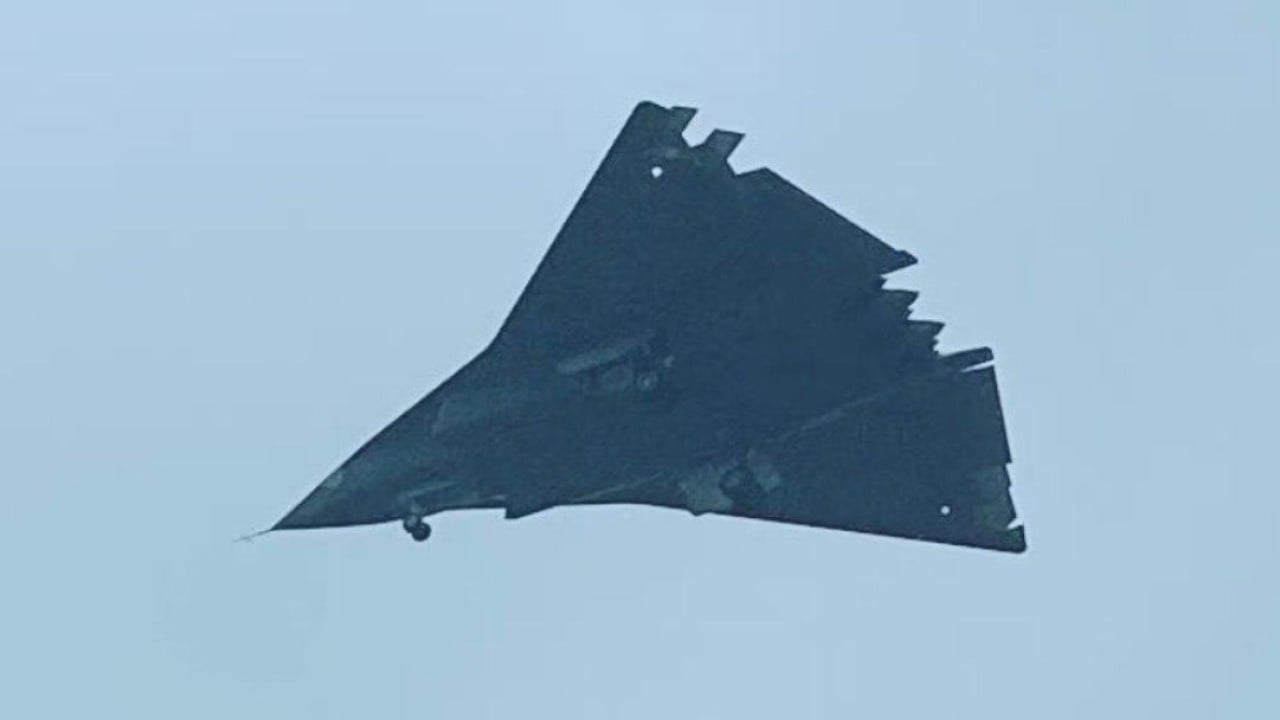
China's sixth-generation fighter jet program is moving past mere aerodynamic redesigns and stepping squarely into directed-energy warfare, specifically examining how airborne directed-energy weapons can intercept incoming missiles. Defense analysts tracking the development of next-generation tactical aircraft often fixate on stealth geometries and variable-cycle engines, yet the real technological leap lies in defensive weapon integration. Integrating directed-energy payloads onto a fighter platform requires solving severe power generation, thermal management, and aerodynamic stabilization problems that current military aviation is only beginning to address.
Air superiority has entered a phase where kinetic missiles face diminishing returns against maneuvering targets. When a high-speed projectile closes in on a high-value asset, traditional countermeasures like chaff, flares, and electronic jamming often fail against advanced radar-guided and heat-seeking seekers. This vulnerability has forced aerospace engineers in Beijing to look at directed-energy weapon integration, specifically solid-state fiber lasers or high-power microwave systems housed within internal weapon bays. The core premise is straightforward. Light travels faster than any missile, meaning a defensive directed-energy system could theoretically neutralize incoming threats in milliseconds without the physical constraints of ammunition storage or reloading cycles.
Yet, moving from concept art to a functional combat system deployed on a sixth-generation airframe involves severe engineering bottlenecks.
The Thermodynamic Nightmare of Airborne Lasers
A laser does not simply fire and vanish into the ether. It generates massive amounts of waste heat. On the ground, massive cooling towers manage this thermal load. Inside the fuselage of a supersonic fighter jet flying at high Mach numbers, space is severely constrained, and ambient air is not always cold enough to cool sensitive optical cavities.
When a high-power laser operates, roughly seventy percent of the electrical energy put into the system turns directly into heat rather than coherent light. If that heat cannot be dissipated instantly, the optical mirrors warp by microscopic margins. Microscopic warping ruins the beam quality, dispersing the energy and rendering the weapon useless against a fast-moving threat. Engineers working on these programs must design lightweight, high-capacity closed-loop cooling systems that can handle hundreds of kilowatts of thermal energy while maintaining the structural integrity of the stealth airframe.
Furthermore, electrical generation remains a massive hurdle. Sixth-generation fighters demand immense electrical power just for their active electronically scanned array radars, electronic warfare suites, and avionics. Adding a defensive laser system means the aircraft's power generators must produce megawatts of continuous electricity. This requires revolutionary advancements in shaft-driven generators or compact auxiliary power units that do not add prohibitive weight to the aircraft.
Aerodynamic Distortions and Beam Control
Shooting a laser from a stationary ground installation is difficult. Doing so from a jet flying at Mach 1.5 through turbulent air layers is exponentially harder.
As the aircraft cuts through the atmosphere, it creates a boundary layer of turbulent air around its skin. When a laser beam passes through this turbulent air on its way out of a turret, the beam scatters and loses its destructive focus. This phenomenon, known as aero-optical distortion, can degrade the power density of the laser to the point where it merely warms the target instead of burning through its guidance fins or warhead casing.
To counteract this, engineers rely on sophisticated adaptive optics systems. These systems use deformable mirrors that adjust hundreds of times per second to correct for atmospheric turbulence in real-time. Developing an adaptive optics turret that can withstand the extreme vibration, pressure, and thermal stress of supersonic flight without losing calibration is an industrial challenge that few nations have mastered.
The turret itself must also be seamlessly integrated into the aircraft's skin to preserve its low observable signature. Any protruding housing would immediately ruin the radar cross-section of a sixth-generation fighter, making it visible to enemy air defense networks long before the defensive laser could ever be deployed. This demands flush-mounted beam directors that can swivel rapidly to cover a 360-degree defensive sphere around the aircraft.
The Strategic Shift in Close-In Air Combat
The introduction of defensive laser systems fundamentally alters how sixth-generation fighters will survive in contested airspace. For decades, survival meant dodging missiles through aggressive high-G maneuvers or relying on stealth to avoid detection entirely. Once detected, an aircraft's survival depended on decoy flares and mechanical countermeasure pods.
A laser-based defense system changes the equation from evasion to active point-defense. If an opposing surface-to-air missile battery or an enemy air-to-air missile launches at the sixth-generation fighter, the aircraft does not need to outrun the missile. It simply needs to point a laser turret at the incoming threat and hold the beam on a critical vulnerability point for a fraction of a second. The missile's seeker head burns out, or its control surfaces melt, causing the projectile to tumble harmlessly out of the sky.
This capability creates a protective bubble around the aircraft, neutralizing the advantage of massed missile salvos. Traditional air defense tactics rely on overwhelming an enemy's ammunition supply or confusing their radar. When a defender can neutralize incoming munitions at the speed of light with near-infinite magazine depth—limited only by fuel and electrical power—the tactical calculus shifts entirely.
However, relying entirely on directed energy introduces new vulnerabilities. Atmospheric conditions heavily degrade laser performance. Heavy rain, dense clouds, thick smoke, and battlefield dust scatter photons and reduce the effective range of the weapon. A sixth-generation fighter operating in poor weather conditions will find its laser defense severely hobbled, forcing it to fall back on conventional electronic warfare and kinetic evasion. Adversaries are already researching reflective coatings and ablative shielding for their missiles to mitigate the effects of high-energy lasers, setting off a classic offense-defense technological arms race.
The push to field these systems in Beijing's next-generation aircraft indicates a long-term bet on directed-energy technology maturing faster than traditional kinetic missile countermeasures can evolve. Whether these systems can overcome the brutal physics of thermal management, aerodynamic turbulence, and power generation within the tight confines of a tactical fighter remains the defining question of modern aerospace engineering. The gap between rendering an artist's concept and engineering a combat-ready laser turret is wide, and crossing it will dictate which military power sets the standard for air dominance in the decades ahead.