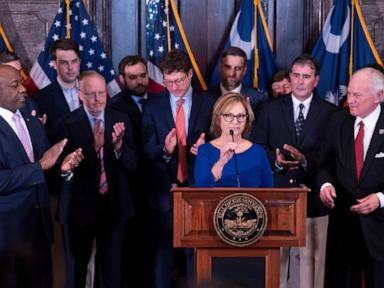
Following the sudden death of veteran U.S. Senator Lindsey Graham at age 71, South Carolina Governor Henry McMaster appointed Graham's younger sister, Darline Graham, to fill his seat. Sworn in on July 14, 2026, Graham becomes the first woman to represent South Carolina in the Senate. She will serve until January 3, 2027, as a temporary caretaker. This quick appointment bypasses typical political infighting to install a trusted family member with no prior elected experience, preserving a crucial Republican vote in a closely divided Senate during a period of leadership transition.
Beneath the emotional tribute of a sister taking over her late brother's duties lies a highly calculated political maneuver. It is a decision that solved several immediate headaches for both national and state Republican leaders, even as it leaves the long-term future of the seat completely up for grabs. Meanwhile, you can read similar events here: The Naval Blockade Fallacy Why Washingtons Middle East Playbook is Already Obsolete.
The Strategic Calculation of a Safe Choice
Governor McMaster's appointment of Darline Graham was not just a sentimental gesture. It was a tactical necessity.
With the Republican party holding a razor-thin majority in the U.S. House of Representatives, McMaster could not risk appointing a sitting member of Congress. Pulling Representatives like Nancy Mace or Ralph Norman from their seats to fill the Senate vacancy would have instantly weakened the Republican grip on the House, prompting special elections and leaving leadership vulnerable in Washington. To see the bigger picture, check out the detailed report by NPR.
By selecting an outsider who has never held public office, McMaster managed to freeze the chess board. Donald Trump's early endorsement of Darline Graham further cleared the path, shielding the governor from accusations of favoritism toward any of the active factions in South Carolina's fierce conservative ecosystem.
It also sidesteps immediate friction in the Senate. The chamber is grappling with the prolonged absence of hospitalized Senate leaders and a packed legislative docket. Graham, who has spent her career in state administration rather than partisan campaigns, is expected to act strictly as a reliable vote, keeping the seat warm while the party prepares for a brutal primary battle.
From the Sanitary Cafe to the Senate Floor
To understand the woman now occupying one of the most powerful chambers in the world, one has to look back at a childhood defined by sudden tragedy and intense sibling loyalty.
Darline and Lindsey Graham grew up in Central, South Carolina, living in a single room behind their parents' business, the Sanitary Cafe. The establishment was a loud, sensory mix of a pool hall, bar, and liquor store.
When Darline was just 11 years old, her mother died of Hodgkin’s lymphoma. Fifteen months later, her father succumbed to a heart attack. Left as orphans, Lindsey Graham, then a 22-year-old student, became his sister's legal guardian. He even legally adopted her to ensure she would have access to his military benefits while he served as an Air Force prosecutor.
                [Sanitary Cafe Childhood]
                           │
             (Parents pass away 15 mos. apart)
                           │
                           ▼
          [Lindsey Graham Becomes Guardian]
                           │
             (Adopts Darline for benefits)
                           │
                           ▼
         [A Lifetime of Campaign Support]
                           │
             (Knocking doors, introducing ads)
                           │
                           ▼
           [The July 2026 U.S. Senate Seat]
He taught her how to ride a bicycle and even how to spell her first name, leading to the "i" spelling instead of the "e" found on her birth certificate. This history made her a fixture in his political life. She knocked on doors for his first statehouse campaign in 1992 and introduced him when he launched his 2016 presidential run. Her presence in his campaign advertisements humanized a senator who never married or had children of his own.
A Bureaucratic Record Under Scrutiny
While national media outlets focus on the familial transition, state political insiders are looking closely at her career in South Carolina's state bureaucracy.
Since 2019, Graham has served as the commissioner of the South Carolina Commission for the Blind. Before that role, she worked with the South Carolina Vocational Rehabilitation Department, the Department of Employment and Workforce, and Clemson University. Her career spans nearly 30 years within state services.
This background makes her a competent administrator, but it does not tell us how she will vote on complex national security issues, federal spending, or judicial appointments. Throughout her career, Graham has kept her personal political opinions entirely out of the public record. She has never had to stake a claim on tax policy, foreign aid, or federal regulations.
Her public statements indicate she will view her brief tenure as an extension of her brother's legacy. At her introductory press conference, she promised to "support the president and carry forward the efforts of my brother." How that translates to actual legislative maneuvers remains to be seen.
The Looming Primary Free-for-All
Darline Graham's appointment is a temporary fix. Her term expires on January 3, 2027, and South Carolina state law dictating how vacancies are filled has set off a frantic, condensed election timeline.
Because Lindsey Graham was already the Republican nominee for the November 2026 general election, state law allows the party to hold a special primary to replace him on the ballot.
The schedule is aggressive:
- July 21 – July 28, 2026: Candidates must formally file for the special primary.
- August 11, 2026: The special primary election will be held.
- August 25, 2026: A runoff election will take place if no candidate secures a majority.
- November 3, 2026: The winner of this primary faces Democratic nominee Annie Andrews in the general election.
This timeline is a logistical nightmare for state election officials. Federal law dictates that military and overseas ballots must be sent out 45 days before any federal election. For the August primary, that deadline has already passed, creating a complex legal conflict that state and federal officials must resolve on the fly.
Meanwhile, the race for the nomination has thrown South Carolina's Republican party into chaos. The state's most ambitious conservative figures are already lining up. State Attorney General Alan Wilson, who recently won the Republican nomination to succeed Governor McMaster, is considered a strong contender. Lieutenant Governor Pamela Evette, alongside Representatives Nancy Mace and Ralph Norman, are also actively weighing bids.
With South Carolina serving as a deep-red stronghold, whoever wins the Republican nomination in August is virtually guaranteed to win the seat in November. The next few weeks will see a massive influx of national donor money and aggressive campaigning in a state accustomed to long, drawn-out political cycles. Darline Graham will watch this storm unfold from the quiet safety of her temporary Senate office, a placeholder in a legacy her brother spent decades building.