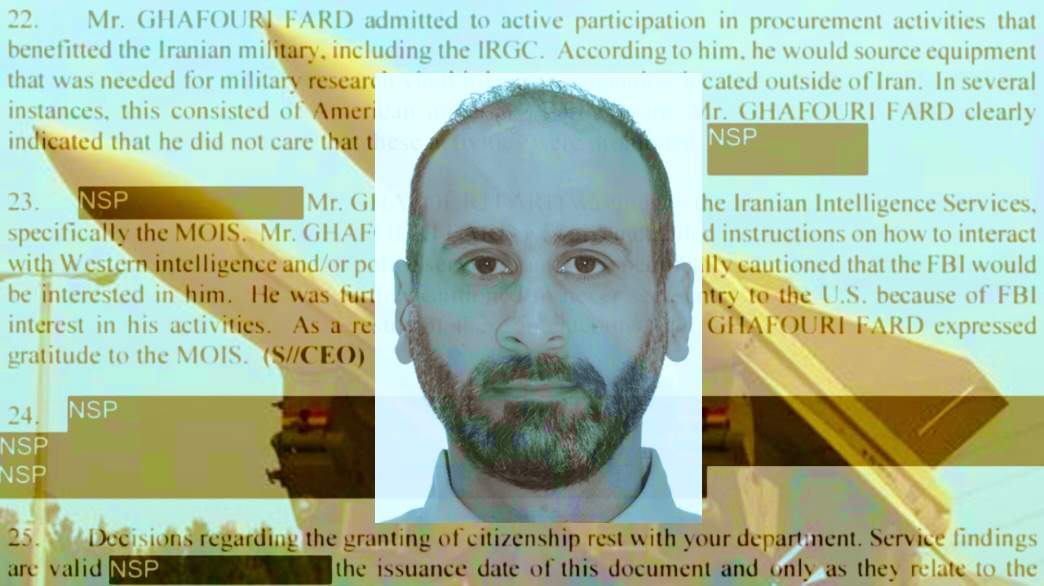
Canadian federal agencies and provincial bodies unknowingly directed more than two million dollars in public procurement funds to an Edmonton-based businessman whose background includes alleged engineering work for Iran's military and the Islamic Revolutionary Guard Corps. The individual, operating under the name Sal Ghafouri, is legally identified in declassified security documents as Mohammad Reza Ghafouri Fard, the son of a former Iranian vice-president.
This procurement failure lays bare systemic vulnerabilities inside Western vetting protocols. While national security agencies tracked potential threats, procurement officers handed out lucrative contracts for military logistics, vehicle maintenance parts, and technology grants. The situation highlights a profound administrative disconnect where the left hand of government buys snow vehicle parts from a supplier while the right hand investigates that same supplier for historical proliferation risks.
The Anatomy of a Procurement Oversight
Public records show that Ghafouri arrived in Canada in 2013 and established corporate entities, including Melanite Group. Over the following decade, his operations secured agreements across multiple government tiers. The Royal Canadian Mounted Police, the Department of National Defence, Innovation, Science and Economic Development Canada, and the Correctional Service of Canada all engaged his companies.
Procurement agencies often rely on self-reporting, basic tax compliance, and corporate registries rather than deep-dive counter-intelligence screenings. If a vendor holds an active business license, possesses a corporate bank account, and undercuts competitors on pricing for mundane goods like vehicle lifts or road motor vehicles, bureaucratic pipelines rarely trigger red flags. Security vetting and procurement vetting operate in separate silos. Intelligence analysts guard their findings closely to protect sources and methods, meaning information regarding a foreign regime linkage rarely reaches a municipal or federal purchasing agent scanning bids for the lowest cost.
Behind the Security Screening Curtain
Declassified Canadian Security Intelligence Service assessments paint a detailed picture of Ghafouri's life prior to his Canadian residency. Investigators allege that he spent four years as an engineer at Rabi Kosar, an Iranian firm dedicated entirely to research and development projects for the nation's military apparatus. Intelligence files state he contributed to projects involving guided anti-aircraft missile designs and electronic jamming systems intended to counter Western aircraft.
Furthermore, intelligence summaries outline allegations that he participated in covert procurement networks utilizing front companies in Southeast Asia to acquire restricted components for Iranian military objectives. Despite these documented intelligence holdings, the transition from an overseas engineering career to a Canadian government contractor faced minimal friction. It was only recently that the federal immigration department initiated formal proceedings to block his path to citizenship, citing him as a potential threat to national security. Legal representation for Ghafouri has noted that he disputes the allegations and intends to challenge the proceedings through available legal mechanisms.
The Broader Administrative Hazard
The presence of political elites' relatives from sanctioned states residing within Western democracies is a recurring policy challenge. Often referred to colloquially in Iran as aghazadehs, children of high-ranking regime officials frequently migrate to North America or Europe, establishing commercial enterprises while their parents maintain hardline anti-Western rhetoric back home.
When these individuals secure state-backed funding or participate in official trade missions, the integrity of domestic economic safeguards takes a direct hit. The core issue extends beyond a single vendor in Edmonton. It exposes an assumption embedded within Western administrative design: that legal incorporation and tax registration equate to absolute alignment with national security interests. Without integrated data sharing between intelligence services and public purchasing boards, state institutions will continually risk subsidizing the very networks they pledge to monitor.