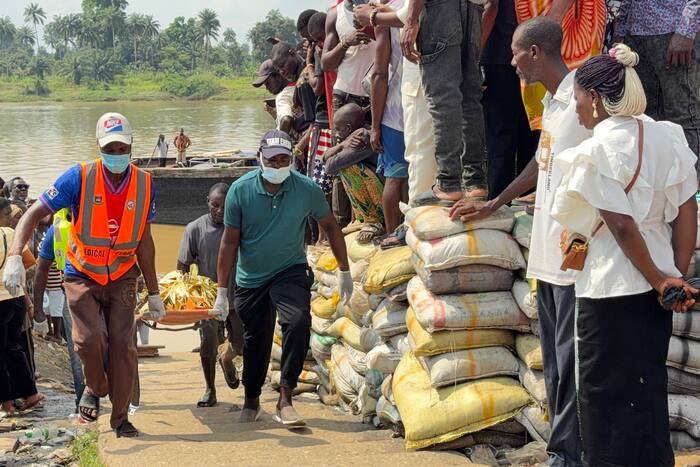
At least 24 people died in Nigeria when an overloaded wooden boat capsized while carrying passengers to a funeral, an incident that reflects a systemic failure in inland waterway regulation rather than an isolated maritime accident. Across Nigeria’s riverine states—particularly Niger, Kwara, Kebbi, and Lagos—vessels routinely operate without life jackets, structural inspections, or manifest logs. While official reports consistently blame sudden turbulence, submerged tree stumps, or passenger panic, the underlying cause is decades of chronic underinvestment in road infrastructure that forces rural communities onto unseaworthy crafts for routine travel and cultural obligations.
The pattern is grimly predictable. A community gathers to bury an elder or celebrate a wedding. Dozens of people board a locally built, flat-bottomed wooden canoe powered by an aging outboard motor. Halfway across a swollen river, water breaches the gunwale. Within minutes, dozens drown in currents they have lived beside their entire lives.
To understand why these tragedies repeat every rainy season, you have to stop viewing them as freak weather events and start examining the economics of rural Nigerian transit.
The Anatomy of an Avoidable Disaster
When a boat capsizes in northern or central Nigeria, the immediate post-mortem from state emergency management agencies follows a familiar script. Authorities cite overloading, night travel, or high water levels. Those factors are real, yet they are symptoms of an informal transport network operating entirely outside federal oversight.
Consider the vessels themselves. Most passenger boats operating on the Niger and Benue rivers are planked wooden canoes constructed by local artisans without naval architectural plans. They lack watertight bulkheads. If a hull cracks against a submerged snag—a frequent hazard during peak flood months between July and October—the entire vessel floods almost instantaneously. There is no compartment to trap air and keep the bow afloat while passengers await rescue.
Furthermore, the physics of these boats work against survival once panic sets in. Flat-bottomed canoes have high initial stability in calm water, which lulls operators into packing passengers shoulder-to-shoulder along the benches and gunwales. However, they possess almost no reserve stability. When an unexpected wave hits or passengers suddenly shift their weight to one side, the center of gravity moves past the point of recovery. The boat rolls violently, trapping passengers underneath the hull or tangling them in cargo.
Why Rural Communities Risk the Water
Critics sitting in air-conditioned offices in Abuja or Lagos often ask why villagers board visibly overloaded boats without life vests. The question ignores the brutal geography of Nigeria’s interior.
In states like Niger and Kebbi, massive hydroelectric dams—Kainji, Jebba, and Shiroro—have reshaped the landscape, creating sprawling reservoirs and wide river channels that bisect agricultural communities. For a farmer or mourner living on one bank, reaching a neighboring village on the opposite shore by road might require a four-hour detour over cratered, bandit-prone highways. By water, the trip takes twenty minutes and costs a fraction of the fuel-inflated bus fare.
When fuel subsidies were removed and transportation costs spiked across the country, reliance on inland waterways surged. Road travel became prohibitively expensive for low-income rural families. Boats became the only viable artery for moving yams, rice, livestock, and people.
Cultural obligations compound the pressure. In many Nigerian communities, attending a funeral is not a casual social choice; it is a sacred duty tied to kinship and communal standing. When dozens of relatives must reach a burial ground before sundown—often required by Islamic burial traditions—waiting for a second boat trip feels impossible. Operators, eager to maximize revenue on a single fuel burn, rarely turn paying passengers away.
The Regulatory Vacuum on Inland Waterways
On paper, Nigeria possesses a clear framework for water transport safety. The National Inland Waterways Authority (NIWA) is mandated to regulate navigation, inspect vessels, license operators, and enforce safety codes across the country's navigable rivers and lagoons.
In practice, NIWA’s footprint outside major commercial hubs like Lagos and Port Harcourt is faint.
Enforcement requires patrol boats, fuel budgets, communication networks, and personnel stationed at hundreds of remote, informal jetties. Those resources barely exist in the rural north. A jetty in a riverine village is often little more than a muddy bank where boatmen tie their ropes to a tree trunk. There are no ticket booths, no weight scales, and no manifest clerks recording who gets on board.
Without manifests, emergency responders never know the true death toll until bodies wash downstream days later. That is why initial casualty reports almost always begin with "at least 24 dead" and creep upward as local divers continue searching the riverbeds.
The Life Jacket Illusion
Following almost every major capsizing, state governors and federal ministers donate thousands of life jackets to riverine communities in televised ceremonies. Months later, when the next boat sinks, almost none of the victims are wearing them.
Why do these interventions fail? The breakdown happens at the intersection of cost, quality, and maintenance:
- Substandard Gear: Many distributed vests are cheap, foam-filled imports that lose buoyancy after prolonged exposure to sun and river water, or they lack crotch straps, causing them to slip over a wearer’s head upon impact with the water.
- Hygiene and Wear: Boat operators rarely clean or dry shared vests between trips. Passengers heading to a funeral or wedding in their finest traditional attire refuse to put on damp, foul-smelling, mildew-stained jackets.
- Commercial Leakage: Because operators face tight margins, donated life jackets frequently disappear from jetties and reappear for sale in urban markets hundreds of miles away.
Submerged Hazards and Climate Volatility
Even a well-maintained wooden boat faces severe environmental threats on Nigeria’s major rivers. Decades of unchecked deforestation along riverbanks have accelerated soil erosion, washing massive trees into the waterways. During the dry season, these trunks settle into the silt. When heavy rains arrive and water levels rise, they become invisible underwater battering rams.
At the same time, dam management upstream introduces sudden, unpredictable shifts in river currents. When operators at Kainji or Shiroro release excess water to protect dam integrity during heavy rainfall, downstream river levels can surge rapidly. Local boatmen, operating without weather radios or real-time hydrological alerts, navigate swollen, debris-choked channels using nothing more than visual memory and a flashlight at dusk.
Night travel remains one of the deadliest habits on the water. Most rural canoes lack navigation lights. Once darkness falls, spotting floating logs or oncoming vessels becomes pure guesswork. Yet traders returning from distant markets and mourners traveling after work routinely push off after sunset, gambling their lives against the current.
What Real Accountability Would Look Like
Fixing Nigeria’s waterway crisis does not require futuristic marine technology. It requires basic, localized enforcement and infrastructural honesty.
First, responsibility must be decentralized. Federal agencies based in distant capitals cannot police thousands of rural river crossings. State governments and local government councils must empower and fund Community Jetty Committees—tasking local traditional leaders and union heads with physical enforcement at the water's edge. If a village head is held legally and financially accountable when an unmanifested, overloaded boat leaves his riverbank, loading practices will change overnight.
Second, Nigeria needs a serious transition away from fragile planked canoes toward modern fiber-reinforced plastic (FRP) vessels. Fiberglass boats are lighter, far more durable against submerged logs, require less fuel, and can be molded with built-in foam flotation chambers that make them virtually unsinkable even when swamped. While the upfront cost exceeds that of a wooden canoe, state-backed microfinance schemes for boat unions could phase out rotting timber hulls over a five-year window.
Finally, dredging and snag-clearing must become continuous maintenance budgets rather than occasional political contracts. Clearing deadwood from known commuter corridors between riverside villages costs a fraction of building a single kilometer of asphalt highway, yet it directly removes the physical triggers behind dozens of fatal hull breaches every year.
Until state authorities treat rural river crossings with the same regulatory urgency as urban airports and federal highways, the water will keep claiming the living on their way to bury the dead.